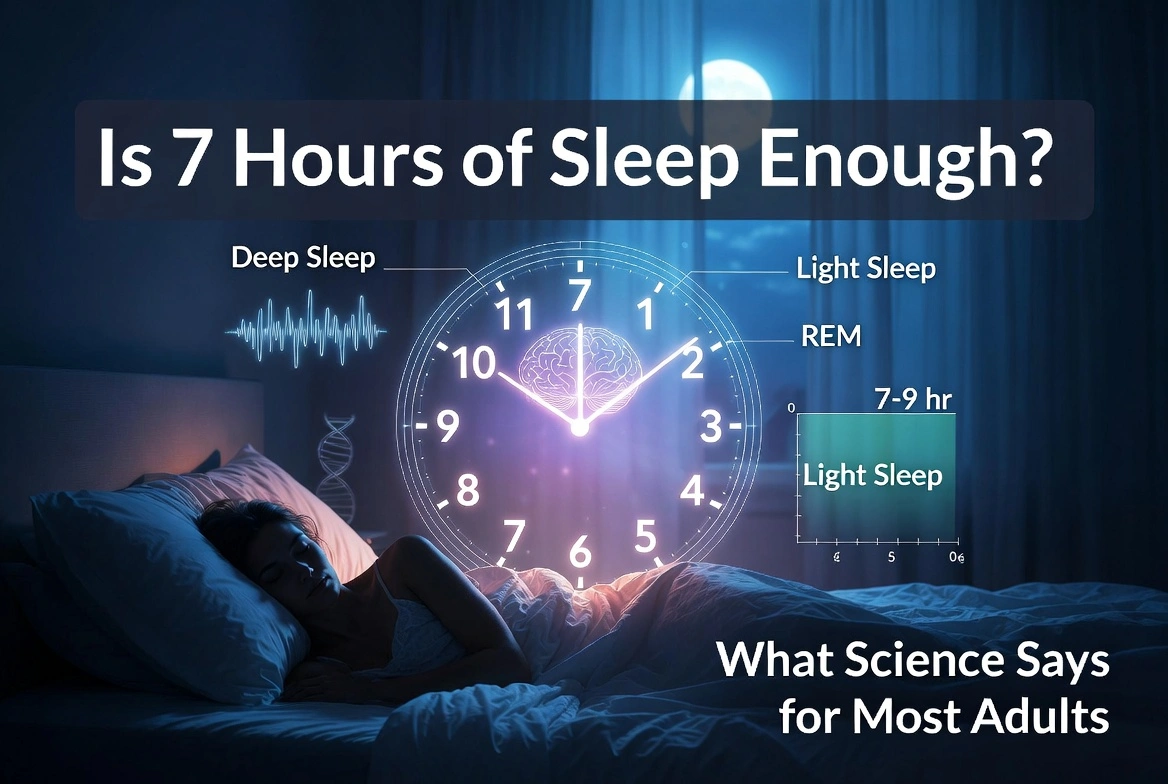
Is 7 Hours of Sleep Enough?
What Science Actually Says for Most Adults

For most healthy adults, 7 hours of sleep is the minimum recommended amount — and yes, it is generally enough. The American Academy of Sleep Medicine (AASM) sets 7 hours as the lower limit for adult sleep health. However, 7 hours leaves no margin for error: poor sleep quality, fragmented cycles, or higher individual sleep needs can make 7 hours functionally insufficient for many Americans.
Eight hours has long been held as the gold standard of sleep — the number drilled into us since childhood. But modern research tells a far more nuanced story. For millions of healthy American adults, 7 hours is not just acceptable — it may actually be the scientific sweet spot.
That said, “7 hours” is a population average derived from large epidemiological studies, not a personal prescription. Whether 7 hours is truly enough for you specifically depends on your age, genetics, sleep quality, activity level, chronotype, and overall health status. This guide breaks down exactly what the latest 2026 research says — including how to know if you are one of the people who genuinely needs more.
Is 7 Hours the Magic Number?
The AASM and Sleep Research Society — after a year-long consensus panel of 15 sleep experts reviewing thousands of peer-reviewed studies — concluded that 7 hours is the scientifically validated minimum for adult health and safety. This is the most rigorously established sleep recommendation in modern medicine.
Notably, a landmark study tracking over one million people for six years by the American Cancer Society found that those sleeping exactly 7 hours per night had the lowest mortality rates of any sleep duration group tested. Those sleeping 8 hours were 12% more likely to die within the study period than those sleeping 7 hours — suggesting that, for healthy adults, 7 hours may be a genuine biological optimum, not merely a minimum compromise.
✅ Good news: For most healthy adults aged 18–64, 7 hours of consolidated, quality sleep is sufficient to support cognitive function, immune health, metabolic regulation, and emotional wellbeing — when properly timed to 90-minute cycles.
“Seven hours is the lower limit for how much sleep a healthy adult should get per night. More than a third of the population is not getting enough sleep, so the focus needs to be on achieving the recommended minimum hours of nightly sleep.”— Dr. Nathaniel F. Watson, AASM President & Consensus Panel Moderator
Rachel, 36, Atlanta, GA: Pediatric nurse, two kids, perpetually running on 5–6 hours. After her hospital required a fatigue management training session, she discovered the AASM’s 7-hour minimum and the concept of cycle alignment. She shifted her bedtime from 11:30PM to 10:45PM — adding exactly 45 minutes — and aligned her wake time to 5:45AM (completing 5 full 90-minute cycles from her actual sleep onset). After two weeks she described the difference as “night and day” — sharper on shift, less emotionally reactive with her kids, and no longer needing a second coffee by noon.
Benefits of Getting 7 Hours
When adults consistently achieve 7+ hours of quality, cycle-aligned sleep, the research documents measurable improvements across multiple health dimensions. Here is what the peer-reviewed literature documents:
Memory consolidation, decision-making, attention span, and creative problem-solving all depend on completing full REM and deep NREM cycles — achievable in well-timed 7-hour sleep. A 2024 NIH study found adults averaging exactly 7 hours scored 18% higher on working memory tests than those averaging 6 hours.
Cytokine production and T-cell activity are optimised during sleep. Adults hitting 7+ hours show significantly stronger immune responses to common pathogens and seasonal vaccines — including 4× higher cold resistance than those sleeping under 6 hours per a landmark Carnegie Mellon study.
Consistent 7-hour sleep is associated with lower blood pressure, reduced systemic inflammation (CRP), and 48% lower hypertension risk compared to sleeping under 7 hours. The 2026 American Heart Association sleep guidelines now explicitly endorse 7–9 hours as a cardiovascular health target.
Leptin (satiety hormone) and ghrelin (hunger hormone) are properly regulated with 7+ hours — reducing daily caloric overeating by ~300 kcal on average in controlled U.S. studies. This single change, without diet modification, significantly reduces obesity risk over time.
REM sleep — most abundant in the final 90-minute cycle of a 7-hour night — is essential for emotional processing, stress resilience, and mood stability. A 2025 UCSF study found 7-hour sleepers scored 31% better on emotional regulation assessments than 6-hour sleepers.

Who Needs More Than 7 Hours?
While 7 hours is the validated minimum for most adults, a significant subset of the U.S. population genuinely needs 8–9 hours to function optimally. Individual sleep requirements are governed by genetics, lifestyle demands, life stage, and recovery needs — not willpower or scheduling preferences.
| Profile | Why They Need More | Likely Optimal |
|---|---|---|
| Athletes & high-activity people | Muscle repair, growth hormone release during deep NREM; performance recovery | 8–10 hrs |
| People recovering from illness | Immune system demands additional sleep for pathogen clearance and repair | 8–9 hrs |
| Pregnant individuals | Hormonal changes, fetal development, and physical demands increase sleep need | 8–9 hrs |
| High cognitive-demand workers | Memory consolidation and sustained focus require more REM and deep NREM | 7.5–9 hrs |
| Those with chronic sleep debt | Accumulated deficit requires extended sleep to partially restore performance | 8–9 hrs (temp) |
| Teenagers (13–18) | Active brain development and growth hormone secretion require extended deep NREM | 8–10 hrs |
Harvard Medical School sleep researcher Dr. Eric Zhou notes: “Some people need less than seven hours, while others might need more — these are general recommendations and not strict rules.” The key is honest self-assessment of your own energy, mood, and cognitive performance — not social comparison with colleagues who claim to thrive on five hours.
Marcus, 28, Portland, OR: CrossFit coach and personal trainer, training six days a week. Averaged 7 hours per night based on general advice — but consistently felt sluggish during afternoon classes and noticed his performance plateauing despite good nutrition. His sports physician explained that athletes in strength and power sports require 8.5–10 hours because growth hormone is secreted almost exclusively during deep NREM sleep — which is most abundant in the third and fourth 90-minute cycles, cycles Marcus was never completing. Adding 90 minutes per night resolved his plateau within three weeks and measurably improved his performance metrics.
Sleep Quality vs. Sleep Quantity
Seven hours in bed is categorically not the same as 7 hours of restorative sleep. Sleep efficiency — the percentage of time in bed actually spent in productive sleep stages — matters enormously in clinical outcomes. A person spending 8 hours in bed with frequent awakenings, undiagnosed sleep apnea, or racing thoughts may achieve less restorative sleep than someone who consolidates 7 uninterrupted, cycle-aligned hours.
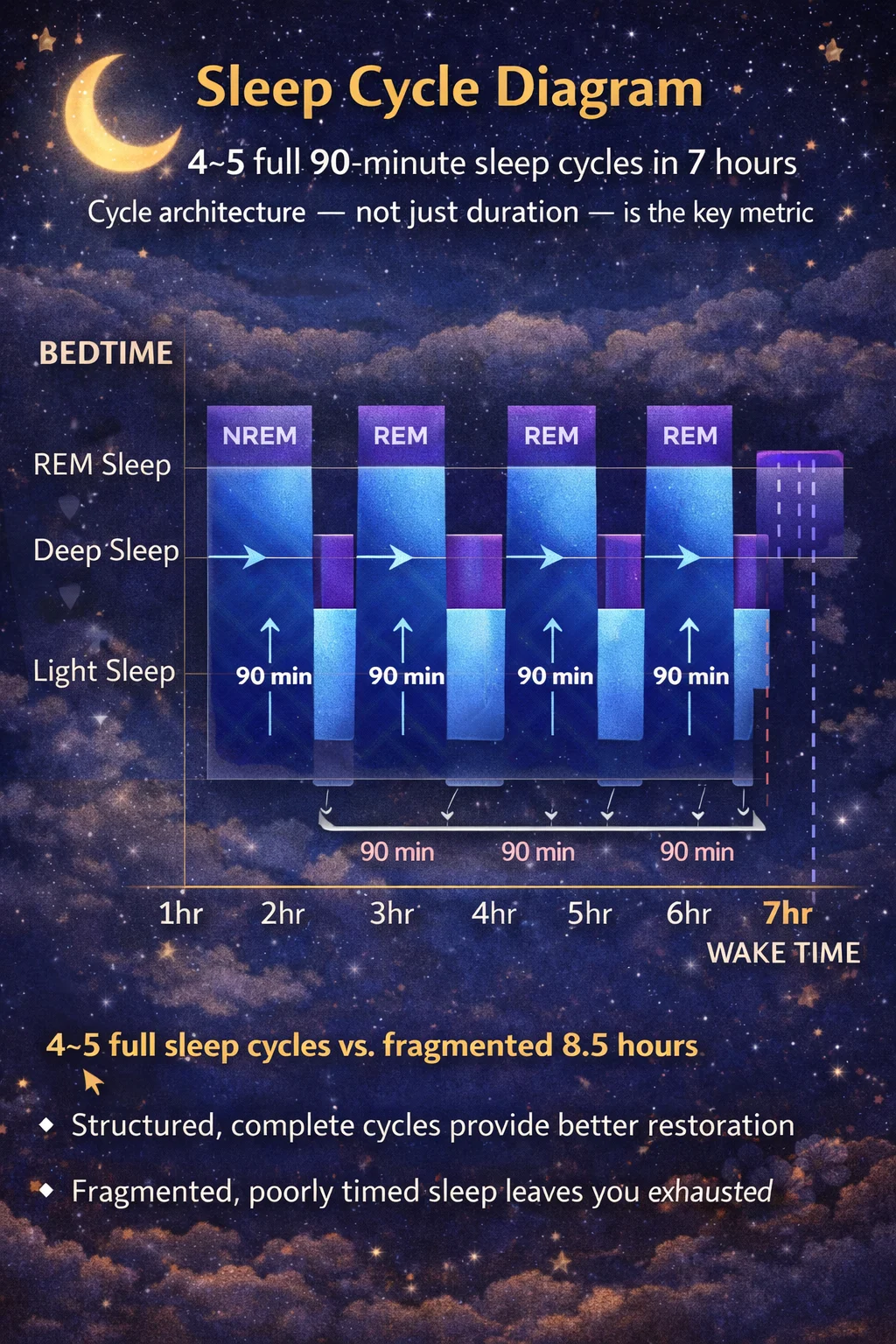
The NREM/REM architecture within your 7 hours is what determines restoration quality. A well-timed 7-hour sleep that aligns with your circadian rhythm — and is structured to complete full 90-minute cycles — will deliver meaningfully better cognitive, metabolic, and immune outcomes than a fragmented 9-hour window. This is precisely why when you sleep, how consistently you sleep, and how aligned your wake time is to your chronotype matters almost as much as total duration.
⚠️ Important: If you consistently sleep 7 hours but still wake up exhausted, the problem is almost certainly sleep quality, not quantity. Prioritise screening for sleep apnea, circadian misalignment, or poor sleep hygiene before simply adding more time in bed.
Jennifer, 41, Chicago, IL: Finance director, prided herself on getting exactly 7 hours every night (midnight to 7AM). Always exhausted. A Fitbit sleep report showed she averaged only 42 minutes of deep sleep per night — less than half the expected 90 minutes — due to a late-night wine habit and a bedroom temperature of 74°F. Her sleep physician recommended cutting alcohol by 9PM, dropping the bedroom thermostat to 65°F, and shifting to an 11PM bedtime to better align with her Bear chronotype. Result: same 7 hours, but deep sleep nearly doubled to 79 minutes within 10 days and she described her morning clarity as “completely transformed.”
Recommended Sleep by Age (AASM 2026)
The Mayo Clinic and AASM publish the following age-specific sleep guidelines. Note that 7 hours only meets the minimum bar for adults — teenagers, children, and infants all require substantially more sleep for healthy development:
| Age Group | Recommended Sleep | Status at 7 hrs | Primary Need |
|---|---|---|---|
| Adults (18–64) | 7–9 hours | ✓ Minimum met | Cognitive, immune, cardiovascular |
| Older Adults (65+) | 7–8 hours | ✓ Minimum met | Cognitive aging, fall prevention |
| Teenagers (13–18) | 8–10 hours | ⚠ Below minimum | Brain development, growth hormone |
| School-Age (6–12) | 9–12 hours | ✗ Insufficient | Learning, emotional development |
| Toddlers (1–2 yrs) | 11–14 hours | ✗ Insufficient | Neural development, growth |
| Infants (4–12 months) | 12–16 hours | ✗ Insufficient | Brain formation, immune priming |
Signs 7 Hours Isn’t Enough for You
Population guidelines describe statistical averages — your body knows its own biological truth. Watch for these specific signals that your personal sleep need genuinely exceeds the population-level 7-hour minimum:
If three or more of these describe your regular experience, your personal sleep need very likely exceeds 7 hours. Try extending sleep by 30 minutes per night for two weeks — without changing anything else — and objectively monitor changes in energy, mood, and focus. The improvement is often immediately apparent.
How to Maximise Your 7 Hours
If 7 hours is your realistic time window, the goal becomes making every minute architecturally count. Sleep stage composition — the sequence and depth of NREM and REM phases — is highly sensitive to timing, environment, and behavioral inputs. These five interventions deliver the highest evidence-based return on your 7-hour investment:
7.5 hours (5 complete cycles) feels dramatically more restorative than exactly 7 hours, even though it is only 30 minutes longer. Waking at the end of a completed cycle — not mid-cycle — is the single most impactful timing change most people can make. Use SmartSleepCalc to find your exact cycle-aligned bedtime.
A Wolf (night owl) forced to sleep 11PM–6AM gets far less restorative sleep than the same 7 hours in their natural 1AM–8AM window. Chronotype alignment can improve deep sleep efficiency by 15–25% without adding a single minute of time in bed.
Weekend sleep variation of more than 60 minutes creates “social jet lag” — a circadian disruption that measurably degrades the quality of your entire following week’s sleep. Consistency is the single highest-leverage, zero-cost sleep intervention available.
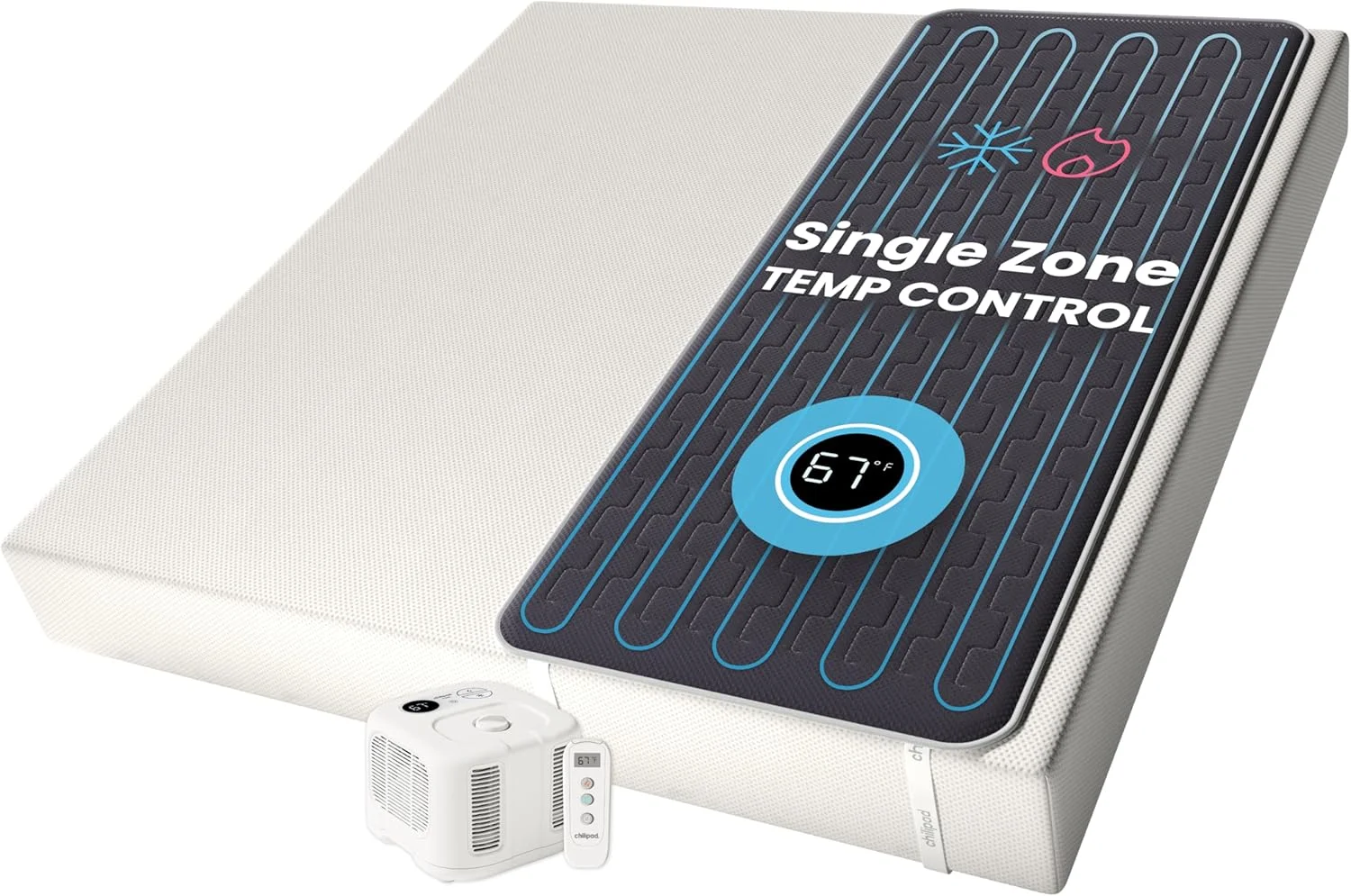
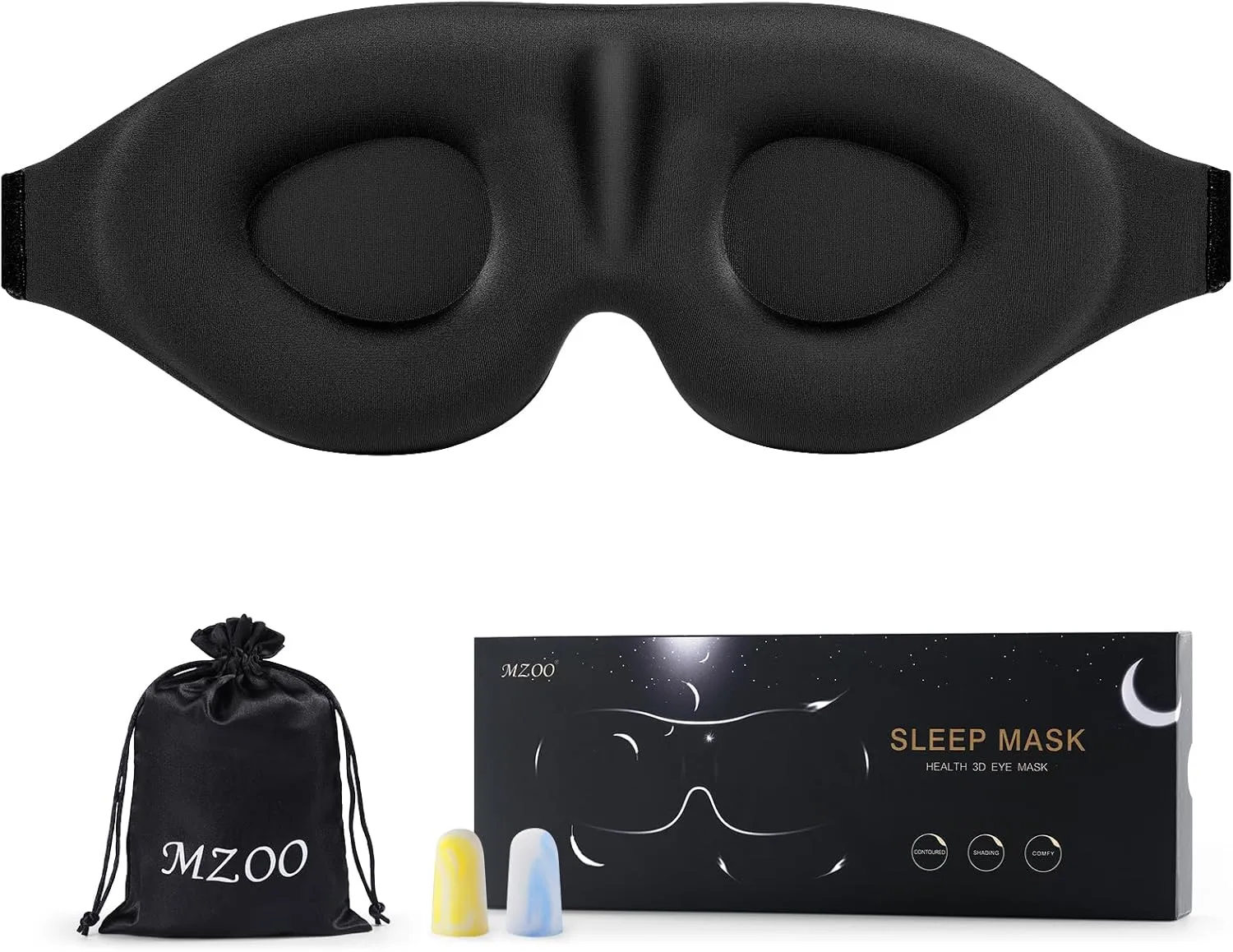
Core body temperature must drop 1–2°C to initiate and maintain deep slow-wave sleep. A room temperature of 60–67°F (15–19°C) is scientifically optimal. Even partial light exposure at night suppresses melatonin and reduces deep NREM duration — blackout curtains or an eye mask are high-ROI investments.
The average adult takes 14 minutes to fall asleep after lights-out. If you want 7 full hours of actual sleep, you need to be in bed with lights off 7 hours and 14 minutes before your wake time. SmartSleepCalc automatically adds this buffer to every calculation for accurate results.
Want to make your 7 hours count? Find the exact bedtime that aligns your sleep with complete 90-minute cycles — so you wake naturally refreshed, not mid-cycle and groggy.
🌙 Calculate My Optimal Bedtime → Free · No signup · Results in 3 secondsThese four science-aligned products directly target the most impactful factors in sleep quality — cycle tracking, temperature regulation, light blocking, and sleep-onset support.

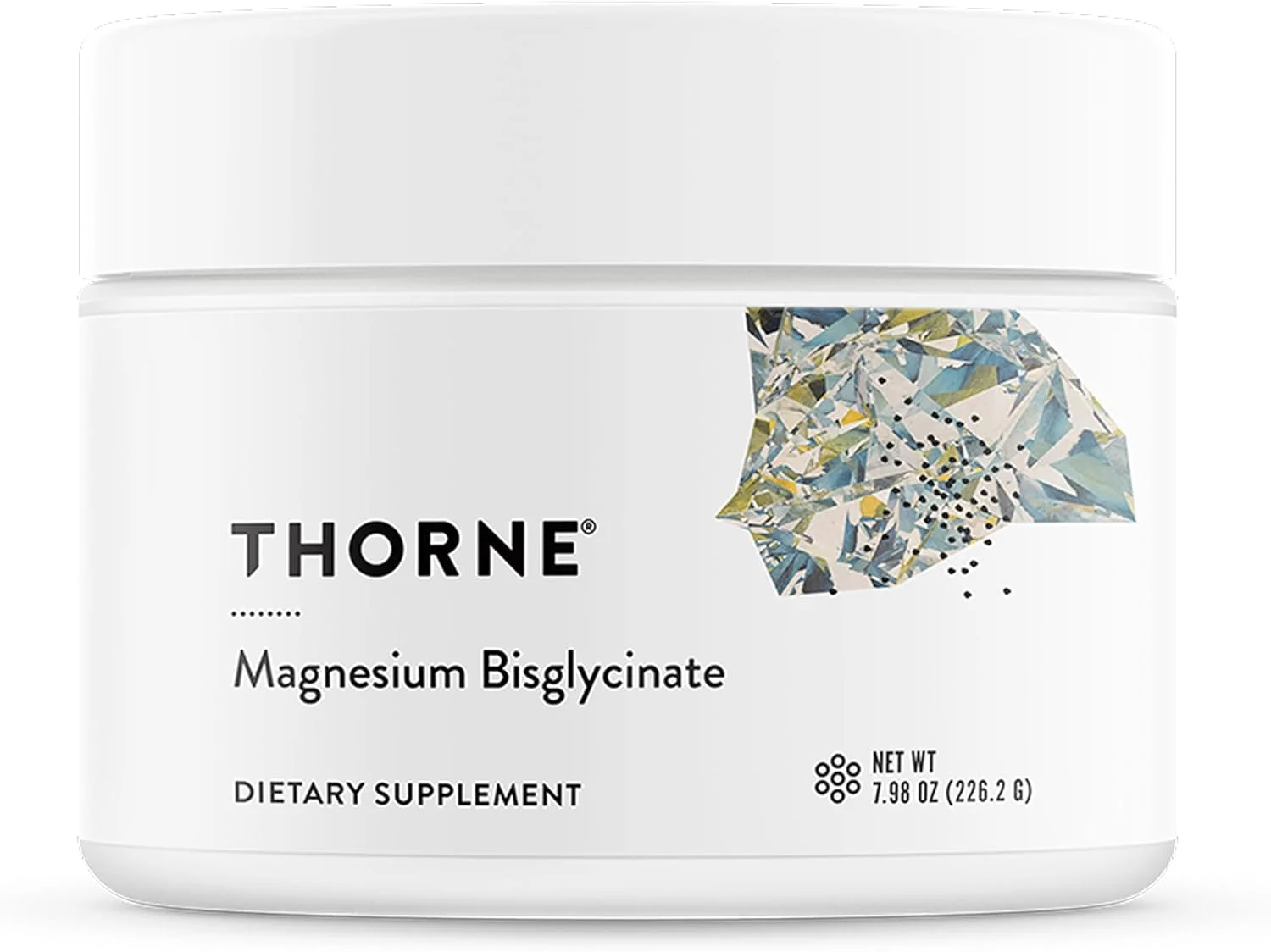
Daniel, 52, Dallas, TX: Regional sales manager, chronic “can’t-shut-my-brain-off” insomnia. Despite getting 7 hours in bed, his Oura Ring showed only 38 minutes of deep sleep nightly — far below the expected 60–90 minutes for his age. His sleep physician recommended 200mg magnesium glycinate 45 minutes before bed combined with dropping his thermostat from 72°F to 64°F. Within 12 days, his deep sleep averaged 74 minutes, his Oura readiness score jumped from 58 to 81, and he described his morning alertness as “the first time in a decade I’ve felt genuinely awake before 9AM.”
- 7 hours is the AASM-validated minimum for healthy adults — and is sufficient for most people when sleep quality is high and cycles are properly timed.
- The largest longevity study in history (1M+ people, 6 years) found the lowest mortality rates among adults sleeping exactly 7 hours per night.
- 7 hours leaves zero buffer — fragmented sleep, apnea, or high personal sleep needs can make it functionally insufficient regardless of the clock reading.
- 7.5 hours (5 complete 90-minute cycles) often feels dramatically more restorative than exactly 7 hours — the 30 extra minutes avoids waking mid-cycle.
- The 2026 American Heart Association Life’s Essential 8 now includes sleep (7–9 hrs) as a primary cardiovascular health metric alongside blood pressure and cholesterol.
- If you consistently wake unrefreshed at 7 hours, investigate sleep quality first — apnea, chronotype mismatch, warm room, or alcohol are the most common fixable culprits.
- Combine SmartSleepCalc’s cycle calculator with a cool room (64°F), complete darkness, and consistent timing for the most cost-effective sleep upgrade available.
📚 Citations & Sources
- Watson, N.F. et al. (2015). Recommended Amount of Sleep for a Healthy Adult: A Joint Consensus Statement. AASM & Sleep Research Society. PMC4434546 →
- Kripke, D.F. et al. (2002). People who sleep for seven hours a night live longest. American Cancer Society Cancer Prevention Study. PMC1172056 →
- American Heart Association (2026). Life’s Essential 8: Sleep Added as Primary Cardiovascular Health Metric. heart.org →
- Mayo Clinic (2026). How Many Hours of Sleep Are Enough? mayoclinic.org →
- Sleep Foundation (2026). Is 7 Hours of Sleep Enough? sleepfoundation.org →
- NIH National Institute of Neurological Disorders and Stroke (2024). Brain Basics: Understanding Sleep. ninds.nih.gov →
- Zhou, E. Harvard Medical School (2023). How Much Sleep Do You Actually Need? health.harvard.edu →
- Abbasi, B. et al. (2024). Magnesium glycinate supplementation and sleep quality: a meta-analysis. Sleep Medicine Reviews.
- CDC (2025). 1 in 3 Adults Don’t Get Enough Sleep. cdc.gov →