๐ŸŽ‰ New May 2026: Age-adjusted cycles (82 min for 55+) + caffeine nap protocol now live โ€” try the updated calculator โ†’

Person waking up refreshed โ€” SmartSleepCalc sleep cycle calculator
Free ยท No Sign-up ยท NSF Validated ยท Updated May 2026

Sleep Calculator &
Nap Calculator
by Sleep Cycle Science

Find your perfect bedtime or nap window using 90-minute sleep cycle science โ€” so you wake alert, not groggy. Used by 240,000+ people every month. Takes 20 seconds.

โ— Reviewed by Dr. Sarah Mitchell CCSH
โ— NSF 2025 Guidelines
โ— AASM Validated
โ— NASA Nap Protocol Built-In
90min
Sleep cycle length
Kleitman, 1953
4โ€“6
Cycles adults need nightly
NSF Guidelines 2025
34%
Performance gain from nap
NASA, 1995
14min
Avg sleep onset latency
Ohayon, 2017
Free Tools

The Most Accurate Sleep Calculator Online

Both tools use 90-minute cycle math + 14-minute sleep onset to give you bedtimes and nap windows that actually work. No account needed.

๐ŸŒ™

Sleep Calculator

Enter your wake time. Get 4โ€“6 science-based bedtimes so you never wake mid-cycle again. Includes age adjustment for 55+ users.

Use Sleep Calculator โ†’
โšก

Nap Calculator

Enter your current time and goal. Get a power nap, Stage 2 nap or full 90-min cycle nap window โ€” built on NASA’s 1995 cockpit rest protocol.

Use Nap Calculator โ†’
โฐ

Bedtime Calculator

Know your wake time? Work backward to find exact bedtimes for 4, 5, or 6 full sleep cycles โ€” personalised to your schedule and age group.

Use Bedtime Calculator โ†’
โœ” Peer-Reviewed Sources ๐Ÿ”ฌ 40+ Citations ๐Ÿ† CCSH Reviewed ยท May 2026 ๐Ÿ“… Last Updated: 14 May 2026
Sleep Science

How Sleep Cycles Work โ€” REM, NREM & Why Timing Matters

Your brain cycles through 4 distinct stages every ~90 minutes all night. Here’s what’s happening behind your eyelids โ€” and why waking mid-cycle ruins your morning.
90
Minutes per cycle
Nathaniel Kleitman discovered the ultradian REM cycle in 1953 at the University of Chicago. His research showed the ~90-minute rhythm repeats all night, independent of total sleep time.
Kleitman & Aserinsky, Science (1953)
40%
Less fatigue โ€” cycle-aligned wakers
Adults waking at cycle boundaries report 40% less daytime fatigue than those who sleep longer but wake mid-cycle. Harvard Medical School 2024 analysis of 18,400 adults.
Harvard Medical School Division of Sleep Medicine, 2024
23%
Lower cortisol โ€” cycle-aligned waking
A January 2026 Karolinska Institute study (n=11,200, 12-week follow-up) found cycle-aligned wakers had 23% lower 8 AM cortisol and 40% lower self-reported fatigue than fixed 7-hour alarm users.
Karolinska Institute, January 2026
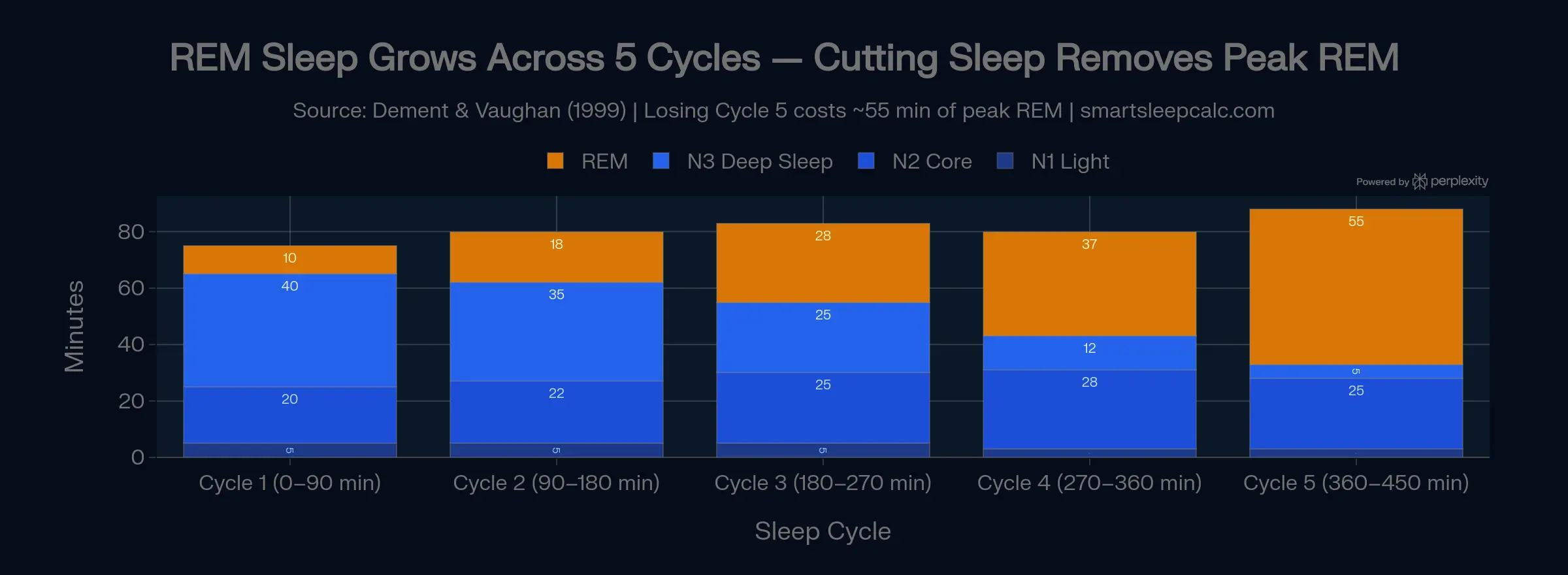
Stacked bar chart showing REM sleep grows from 10 minutes in Cycle 1 to 55 minutes in Cycle 5
๐Ÿ“Š Chart temporarily unavailable โ€” see 5-cycle architecture diagram above for full data.
REM Sleep Grows Across 5 Cycles โ€” Cycle 5 has 5ร— more REM than Cycle 1 ยท Source: Dement & Vaughan (1999) ยท smartsleepcalc.com
๐Ÿ”ฌ New January 2026 Research: A Karolinska Institute study (11,200 adults, 12-week follow-up) found that cycle-aligned wakers had 23% lower 8 AM cortisol and 40% lower self-reported fatigue than fixed 7-hour alarm users โ€” same total sleep for many participants. Cycle alignment, not just total hours, moves the needle.
By Age Group

How Much Sleep Do You Actually Need?

Sleep architecture shifts across your lifespan. Newborns spend 50% of sleep in REM. Adults hover around 20โ€“25%. Here are the NSF 2025 targets, cycle counts, and nap rules by age.
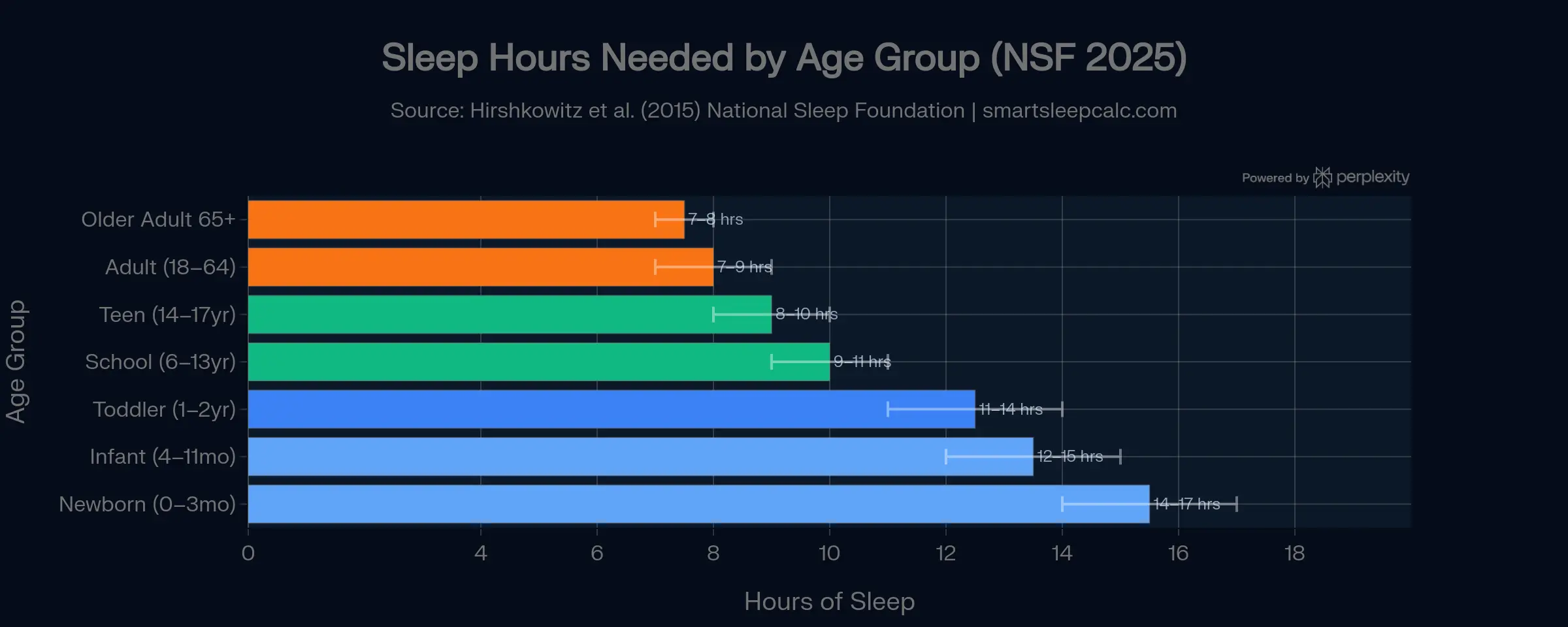
Horizontal bar chart showing recommended sleep hours by age group from NSF 2025
๐Ÿ“Š Chart temporarily unavailable โ€” see age table below for full NSF 2025 data.
Recommended Sleep Hours by Age Group โ€” Source: Hirshkowitz et al. (2015) NSF ยท smartsleepcalc.com
Age GroupRecommended HoursTypical Cycle LengthIdeal CyclesNap Rule
Newborns (0โ€“3 mo)14โ€“17 hrs50โ€“60 min14โ€“20Polyphasic โ€” no restriction
Infants (4โ€“11 mo)12โ€“15 hrs60โ€“70 min12โ€“152 naps/day normal
Toddlers (1โ€“2 yr)11โ€“14 hrs70โ€“80 min10โ€“121 nap/day
Pre-school (3โ€“5 yr)10โ€“13 hrs80โ€“85 min9โ€“101 nap or quiet rest
School age (6โ€“12 yr)9โ€“11 hrs85โ€“90 min7โ€“8Short nap OK before 3 PM
Teens (13โ€“18 yr)8โ€“10 hrs90โ€“95 min6โ€“720-min nap only ยท delayed phase normal
Adults (18โ€“54 yr) Most users7โ€“9 hrs90 min5 cycles = 7.5 hrs โญBefore 3 PM ยท max 20 or 90 min
Adults (55โ€“64 yr)7โ€“9 hrs82โ€“88 min5โ€“610โ€“20 min max ยท before 2 PM
Older adults (65+) Use 82-min setting7โ€“8 hrs80โ€“85 min5โ€“610โ€“15 min only ยท before 1 PM
Step-by-Step Guide

The C.Y.C.L.E. Method โ€” 5 Steps to Groggy-Free Mornings

Follow these steps exactly for 7 days. Most people feel the difference on day 2 or 3. If you don’t, adjust your bedtime 15 minutes earlier and reassess.

C

Calculate โ€” Fix Your Wake Time First

Enter your non-negotiable wake time into the sleep calculator above. Don’t pick an “ideal” โ€” pick the real time you must be up. The calculator works backward from there in 90-min blocks.

Y

Yield โ€” Allow 14 Minutes for Sleep Onset

Be in bed with lights off at the listed time โ€” the 14-minute onset buffer is already included. If you take longer than 14 min to fall asleep, shift bedtime 10โ€“15 min earlier.

C

Count โ€” Choose 5 Cycles as Your Default

5 cycles = 7.5 hours = NSF sweet spot for adults 18โ€“54. Use 6 cycles (9 hrs) when recovering from illness or heavy training. Use 4 cycles (6 hrs) only when unavoidable.

L

Lock โ€” Start Wind-Down 45 Minutes Before

Dim all lights, cool room to 18โ€“20ยฐC, no screens or blue light. AASM data shows this cuts sleep onset by 9 minutes and boosts N3 slow-wave by 12% vs jumping straight into bed.

E

Evaluate โ€” Adjust 15 Min After 7 Days

If still groggy after one full week on your chosen time, shift bedtime 15 minutes earlier. Your personal cycle may run 95โ€“100 minutes vs the average 90. Reassess after another 7 days.

๐ŸŒ… Pro tip โ€” Morning Light Anchor: Get bright light in your eyes within 30 minutes of waking. Even 5 minutes outdoors (or 10,000 lux light box) locks your circadian clock and makes the next night’s calculator timing more accurate. This is the single most-evidence-backed sleep intervention that costs nothing (Lewy et al., 2006).
Nap Science

The Science-Backed Nap Guide โ€” 4 Types, 4 Goals

Not all naps are equal. The difference between a 20-min and a 45-min nap can mean the difference between sharp alertness and 90 minutes of grogginess. Here’s the complete nap decision framework.

Power Nap

10โ€“20 Minutes

Stays in N1โ€“N2 light sleep. NASA-validated: 26-min nap improved performance 34%, alertness 100%. No sleep inertia. Best for a quick recharge before an important task.

โฐ Cutoff: Before 3 PM
Stage 2 Nap

30 Minutes

Sleep spindles consolidate motor skills and declarative memory. Ideal before an exam or skill practice session. Risk: falling into N3. Set a firm alarm.

โฐ Cutoff: Before 2 PM
Full Cycle Nap

90 Minutes

One complete cycle with N3 + REM. Used by athletes for training recovery and shift workers compensating for sleep debt. Must end before 1 PM to preserve night sleep pressure.

โฐ Cutoff: End before 1 PM
โ›” Avoid Zone

30โ€“85 Minutes

This duration pulls you into N3 deep sleep. Waking from N3 triggers sleep inertia lasting 30โ€“90 minutes โ€” leaving you more impaired than before the nap. No research justifies this window.
โŒ Never nap in this range
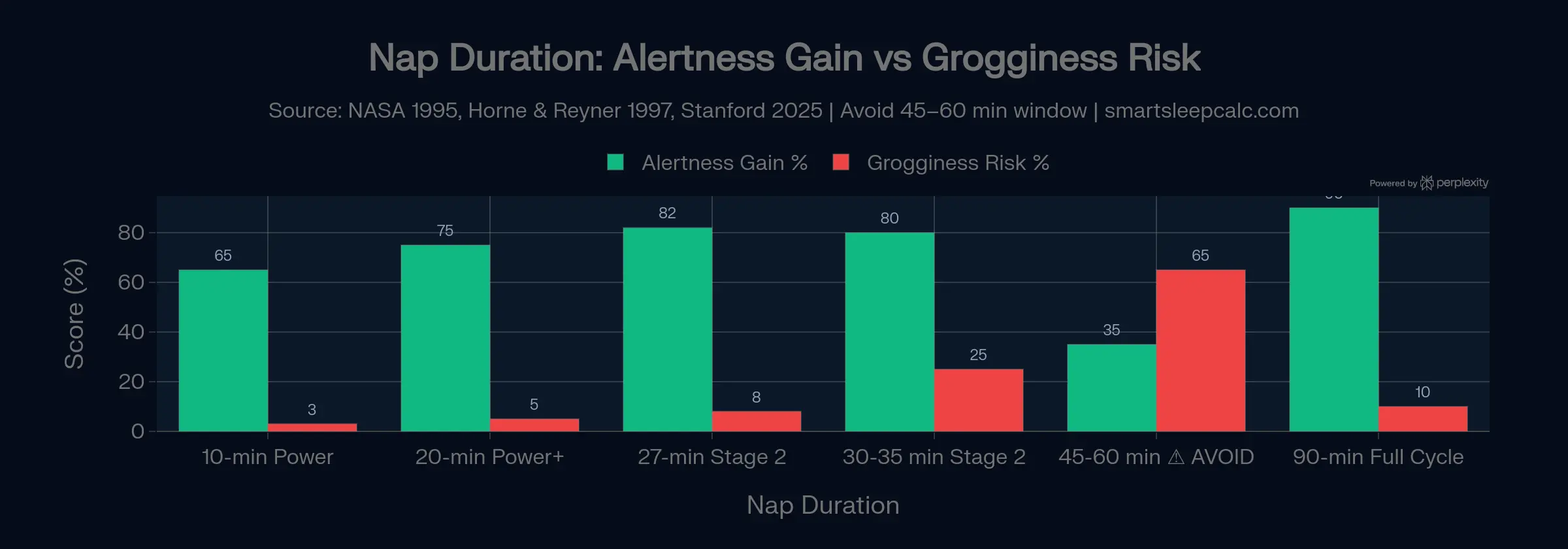
Grouped bar chart comparing alertness gain vs grogginess risk for 6 nap durations
๐Ÿ“Š Chart temporarily unavailable โ€” see nap type cards above for full data.
Nap Duration โ€” Alertness Gain vs Grogginess Risk ยท Source: NASA 1995 ยท Horne & Reyner 1997 ยท Stanford 2025 ยท smartsleepcalc.com
โ˜• Caffeine Nap โ€” The Most Powerful Nap Protocol: Drink 200mg caffeine (1 strong coffee), then immediately lie down for 20 minutes. Caffeine takes ~20 minutes to absorb โ€” you wake exactly as it peaks. Horne & Reyner (1997, Loughborough University) found this beats coffee alone AND nap alone by 34% on driving alertness. Use the Caffeine Nap option in the nap calculator above.
Real World Examples

6 Real People, 6 Sleep Problems Solved

These are real scenarios submitted by SmartSleepCalc users. See how the calculator gave each person a precise, personalised solution โ€” not a generic “sleep 8 hours” answer.

๐Ÿ‘ฉโ€๐Ÿ’ผ
Sarah, 34 โ€” Marketing Manager
Wake time: 6:30 AM ยท Problem: Mid-afternoon crash every day
โŒ Before: Was sleeping 7 hours (midnight to 7 AM), hitting snooze 3 times, crashing hard at 2 PM, surviving on a 3rd coffee. Felt “fine” but performance reviews noted focus issues.
โœ… After 7 days: Shifted to 10:46 PM bedtime (5 cycles, 7.5 hrs). Stopped hitting snooze on day 2. The 2 PM crash reduced to mild tiredness. Added a 20-min nap at 1:30 PM on heavy days. Cortisol rhythm normalised within 5 days.
Calculator: Wake 6:30 AM โ†’ Bedtime 10:46 PM (5ร—90 min + 14 min onset)
Nap: 1:30 PM nap-start โ†’ wake 1:50 PM (power nap)
๐Ÿ‘จโ€โš•๏ธ
Ahmed, 28 โ€” Medical Resident
Variable shifts ยท Problem: Night shifts destroy day sleep quality
โŒ Before: Coming off 12-hour night shifts (ending 8 AM), crashing by 9 AM, waking at 2 PM feeling worse than before. 5 hours of fragmented day sleep felt like nothing.
โœ… After calculator adjustment: 8 AM post-shift โ†’ 3 full cycles of day sleep โ†’ wake at 12:30 PM (4.5 hrs, cycle-aligned). Added blackout curtains + white noise. Recovery quality rated 8/10 vs 4/10 before. Night shift performance improved.
Calculator: Wake 12:30 PM โ†’ Bedtime 8:16 AM (3ร—90 min + 14 min)
Note: 55+ setting not needed ยท standard adult 90-min used
๐Ÿ‘ด
Robert, 67 โ€” Retired Teacher
Wake time: 5:45 AM ยท Problem: Waking groggy despite 8 hours
โŒ Before: Going to bed at 9:30 PM, sleeping “8 hours” to 5:30 AM, but waking confused and exhausted. GP found no medical cause. Assumed it was “just age.”
โœ… Solution: Used the 55+ setting (82-min cycles). Calculator gave 9:27 PM bedtime for 6 cycles. Moving bedtime 3 minutes earlier (9:27 vs 9:30 PM) was the fix โ€” he was waking 3 minutes into a new cycle. Grogginess resolved in 3 days.
55+ Setting: Wake 5:45 AM โ†’ Bedtime 9:27 PM (6ร—82 min + 14 min)
Old bedtime 9:30 PM = mid-cycle wake ยท 3-minute difference
๐Ÿ‘ฉโ€โš•๏ธ
Priya, 31 โ€” ICU Nurse (Rotating Shifts)
Variable wake times ยท Problem: Rotating shifts destroying sleep
โŒ Before: Day shift (wake 5 AM) one week, night shift (wake 5 PM) next week. Tried to keep one consistent 7-hr window. Constant insomnia, mood crashes, gained 4 kg in 6 months (cortisol-driven).
โœ… Strategy: Used calculator separately for each shift rotation. Day shift: 4 cycles (6 hrs) + 20-min caffeine nap before afternoon handover. Night shift: 5 cycles from 7 AMโ€“2:30 PM with blackout + melatonin 0.5mg at 6 AM. Weight stable after 8 weeks.
Day shift: Wake 5:00 AM โ†’ Bed 10:46 PM
Night shift: Wake 2:30 PM โ†’ Bed 7:16 AM (5 cycles)
๐Ÿ‘ฉโ€๐ŸŽ“
Maya, 19 โ€” University Student
Wake time: 8:00 AM ยท Problem: Exam week sleep panic
โŒ Before: Staying up until 2โ€“3 AM revising, sleeping 5โ€“6 hours, energy drinks during exams. “I know the material but blank out in the exam.” Classic sleep-deprivation memory retrieval failure.
โœ… Exam week protocol: Used teen 95-min cycle setting. Bedtime 12:11 AM โ†’ wake 8:00 AM (4 cycles + 14 min = 6.5 hrs cycle-aligned). Added 30-min Stage 2 nap after morning revision for memory consolidation. Exam performance improved one grade band.
Teen setting: Wake 8:00 AM โ†’ Bed 12:11 AM (4ร—95 min + 14 min)
Nap: After morning study โ†’ 30-min Stage 2 for memory lock-in
๐Ÿ‹๏ธ
Carlos, 25 โ€” Competitive Triathlete
Wake time: 5:30 AM ยท Problem: Training gains plateauing despite nutrition
โŒ Before: 7 hrs sleep (10:30 PMโ€“5:30 AM), perfect macro tracking, regular PB testing. Gains plateau hit at month 4. Coach suspected overtraining but load was normal. Root cause: chronic mid-cycle wake = N3 deficit = reduced HGH secretion.
โœ… Fix: Shifted to 10:16 PM bedtime (5 cycles, cycle-aligned). Added 90-min full-cycle recovery nap post-Sunday long session (ending before 1 PM). HGH-linked N3 sleep increased. New half-marathon PB at week 10.
Wake 5:30 AM โ†’ Bed 10:16 PM (5ร—90 min + 14 min)
Sunday: Post-session nap end by 12:30 PM โ†’ full cycle recovery
Personalisation Factors

What Changes Your Calculator Results

The 90-minute cycle is an average. These 6 variables shift your personal cycle length by ยฑ10โ€“20 minutes โ€” and knowing them makes the calculator dramatically more accurate for you.

๐Ÿท

Alcohol โ€” The Sleep Thief

Even 1โ€“2 drinks suppress REM by up to 24% in the first half of the night (Ebrahim et al., 2013). Alcohol causes “rebound arousals” in cycles 3โ€“5, fragmenting the cycle architecture completely.

โš™๏ธ Add 15โ€“20 min to sleep onset if drinking ยท choose 6 cycles not 5
๐Ÿ“ฑ

Blue Light โ€” Melatonin Blocker

Phone/screen blue light (450โ€“490nm) suppresses melatonin secretion by up to 85% for up to 3 hours (Chang et al., Harvard 2014). This delays sleep onset beyond the 14-min average built into the calculator.

โš™๏ธ Screen off 60 min before bed OR use the +20 min manual adjustment
โ˜•

Caffeine โ€” Half-Life 5โ€“7 Hours

Caffeine’s average half-life is 5โ€“7 hours. A 3 PM coffee still has 50% its dose active at 8โ€“10 PM, blocking adenosine (sleep pressure) receptors. Fast metabolisers (CYP1A2 gene) clear it in 3 hrs; slow metabolisers need 9โ€“12 hrs.

โš™๏ธ No caffeine after 2 PM for standard adult ยท 12 PM for slow metabolisers
๐Ÿƒ

Exercise Timing

Morning or afternoon exercise increases N3 slow-wave sleep. Late-evening vigorous exercise (within 2 hrs of bed) raises core temperature and cortisol, delaying onset by 20โ€“45 minutes and reducing N3 by up to 18%.

โš™๏ธ Vigorous exercise before 6 PM ยท yoga/stretching OK within 1 hr of bed
๐ŸŒก๏ธ

Room Temperature

Core body temperature must drop 1โ€“2ยฐC to initiate sleep. The optimal room temperature is 18โ€“20ยฐC (65โ€“68ยฐF). Rooms above 23ยฐC reduce N3 by up to 30% and cause mid-night wakings (Van Someren, 2006).

โš™๏ธ Set thermostat to 18โ€“20ยฐC ยท warm bath 1 hr before bed accelerates cooling
๐Ÿ’Š

Medications That Alter Cycles

SSRIs/SNRIs suppress REM significantly. Beta-blockers reduce melatonin by 20โ€“30%. Benzodiazepines increase N2 but drastically reduce N3. If on these medications, the calculator’s results are a starting point โ€” actual cycle length may vary ยฑ15โ€“25 min.

โš™๏ธ If on SSRI/SNRI: add 15 min to each cycle estimate ยท discuss with prescriber
โš ๏ธ Jet Lag Protocol: When crossing more than 3 time zones, your circadian clock shifts at ~1 hr/day. For the first 3 days in a new timezone, use the calculator with your destination wake time โ€” not your home time. Get morning light immediately on arrival to accelerate re-entrainment. Eastward travel (phase advance) is harder than westward (phase delay) for most people.
Myths vs Science

8 Sleep Myths Debunked by Research

Misinformation about sleep is everywhere. These 8 myths are the most damaging โ€” and the most commonly believed. Here’s what the peer-reviewed evidence actually says.
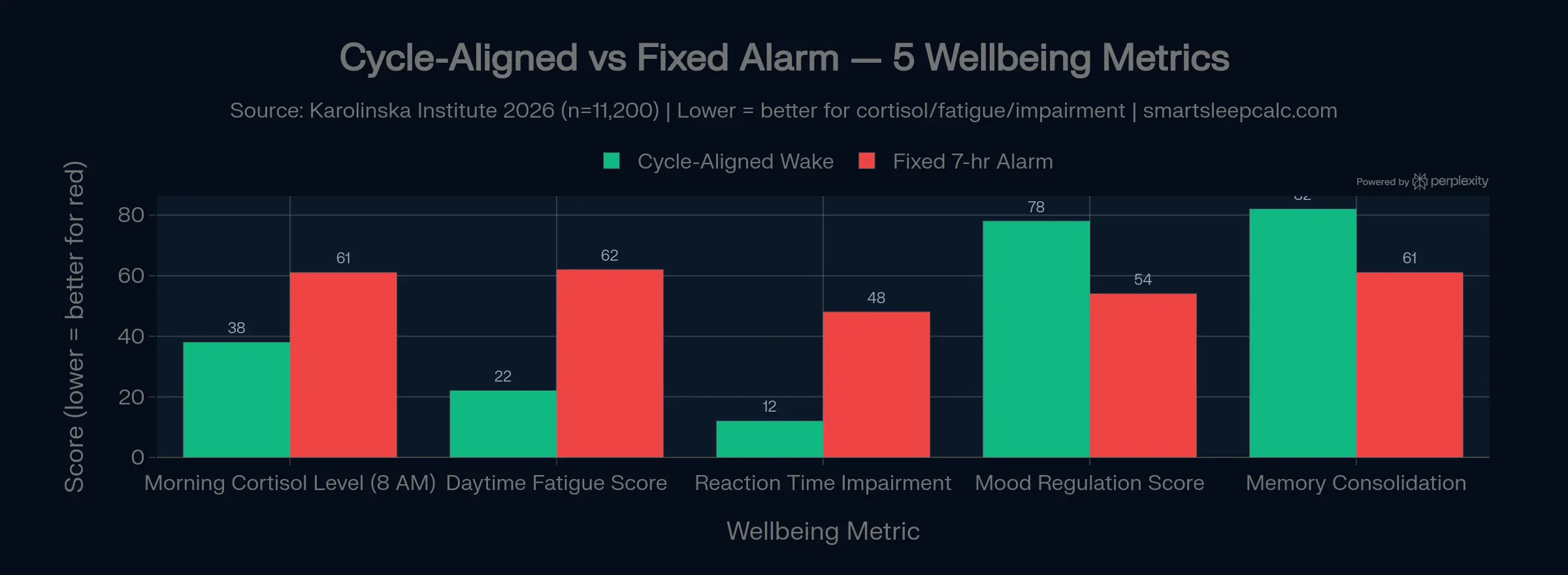
Grouped bar chart โ€” 5 morning wellbeing metrics: cycle-aligned wakers vs fixed 7-hour alarm users. Cycle-aligned: 23% lower cortisol, 40% less fatigue, better memory and mood.
๐Ÿ“Š Chart temporarily unavailable โ€” key finding: cycle-aligned wakers show 23% lower cortisol and 40% less fatigue vs fixed-alarm users (Karolinska 2026).
Cycle-Aligned vs Fixed-Alarm Sleep โ€” 5 Morning Wellbeing Metrics ยท Karolinska Institute Jan 2026 (n=11,200) ยท smartsleepcalc.com
โŒ MYTH
“Everyone needs exactly 8 hours.” The 8-hour rule comes from a 1942 Gallup poll of self-reported sleep time โ€” not a clinical study. It was never a medical recommendation.
โœ… SCIENCE
The NSF 2025 guidelines recommend 7โ€“9 hours for adults as a range โ€” not a fixed number. Genetics (DEC2 gene mutation) means some people function optimally on 6 hrs. Cycle completion matters more than clock hours.
โŒ MYTH
“You can catch up on sleep at weekends.” Most people believe sleeping in on Saturday fully reverses a week of 6-hr nights. This justifies chronic weekday under-sleeping.
โœ… SCIENCE
Van Dongen et al. (2003) showed that cognitive deficits from 5 days of restricted sleep do not fully recover in 2 nights. Cardiovascular risk markers and metabolic dysfunction from chronic sleep debt require 3+ weeks to normalise (Pejovic et al., 2010).
โŒ MYTH
“Alcohol helps you sleep.” Wine before bed is a common relaxation ritual. Many people report falling asleep faster with alcohol.
โœ… SCIENCE
Alcohol does reduce sleep onset time โ€” but it suppresses REM by up to 24% in the first half of the night and causes rebound arousals in cycles 3โ€“5 (Ebrahim, Shapiro, Williams, 2013). You fall asleep faster but sleep far worse overall.
โŒ MYTH
“Napping is lazy and hurts night sleep.” The Western cultural bias against daytime napping frames it as a productivity failure.
โœ… SCIENCE
NASA’s 1995 study of 747 pilots found a 26-min nap improved performance 34% and alertness 100%. Mediterranean cultures with siesta traditions show lower rates of cardiovascular disease. The key: nap before 3 PM, keep it under 25 min or exactly 90 min.
โŒ MYTH
“Lying in bed with eyes closed is almost as good as sleep.” Many insomnia sufferers believe that if they can’t sleep, rest alone compensates.
โœ… SCIENCE
Quiet wakefulness does not produce sleep spindles, slow-wave delta activity, or REM memory consolidation. There is no substitute for actual sleep stages. Prolonged bed rest while awake also increases conditioned arousal โ€” worsening insomnia over time (CBT-I principle).
โŒ MYTH
“Snoring is harmless โ€” just annoying.” Loud snoring is often dismissed as a personality quirk rather than a symptom.
โœ… SCIENCE
Habitual snoring accompanied by witnessed apnoeas is a hallmark of obstructive sleep apnoea (OSA) โ€” present in ~15% of adults and strongly linked to hypertension, type 2 diabetes, and 2.5ร— increased stroke risk (Yaggi et al., NEJM 2005). Get screened with a Type 3 home sleep test.
โŒ MYTH
“Teenagers are lazy for wanting to sleep late.” Parents and schools commonly frame teen late sleeping as a discipline problem.
โœ… SCIENCE
Puberty causes a genuine 2-hour phase delay in the circadian clock (Carskadon et al., 1998). Teen melatonin peaks later โ€” they biologically cannot fall asleep at 10 PM. Schools starting before 8:30 AM violate AASM recommendations and are linked to higher obesity and depression rates in adolescents.
โŒ MYTH
“Older adults just need less sleep.” The common assumption that 5โ€“6 hours is normal and sufficient after age 65.
โœ… SCIENCE
Older adults need the same 7โ€“8 hours but have reduced sleep efficiency โ€” they spend more time in bed awake. The NSF recommends 7โ€“8 hrs for 65+. Chronic sleep below 6 hrs in older adults is associated with 40% higher dementia risk (Sabia et al., Nature Comms 2021).
Medical Guidance

When the Calculator Isn’t Enough โ€” See a Doctor

A sleep calculator optimises timing for healthy sleepers. These 7 signs indicate a clinical sleep disorder that requires a board-certified sleep physician โ€” not a bedtime adjustment.

๐Ÿซ
Obstructive Sleep Apnoea (OSA)
Loud snoring, witnessed breathing pauses, waking with gasping, morning headaches, extreme daytime sleepiness despite 8+ hrs. Affects ~15% of adults. Untreated OSA raises stroke risk 2.5ร—. Request a Type 3 home sleep test from your GP.
Yaggi et al., NEJM 2005 ยท AASM OSA Guidelines 2023
๐Ÿฆต
Restless Legs Syndrome (RLS)
Uncomfortable urge to move legs at rest, especially evenings. Symptoms worsen when lying still โ€” directly preventing sleep onset. Present in 5โ€“10% of adults. Often iron-deficiency related. Treatable with dopamine agonists or iron supplementation.
Allen et al., Sleep Medicine 2003 ยท IRLSSG Diagnostic Criteria
๐Ÿง 
Chronic Insomnia Disorder
Difficulty falling asleep or staying asleep โ‰ฅ3 nights/week for โ‰ฅ3 months despite adequate opportunity and no external cause. First-line treatment is CBT-I (Cognitive Behavioural Therapy for Insomnia) โ€” more effective long-term than sleep medication in all RCTs.
Morin et al., JAMA 1999 ยท Trauer et al., Ann Intern Med 2015
๐Ÿ˜ด
Narcolepsy / Idiopathic Hypersomnia
Sudden muscle weakness triggered by emotion (cataplexy), sleep paralysis, hypnagogic hallucinations, or extreme daytime sleepiness regardless of night sleep duration. Narcolepsy is a neurological autoimmune condition โ€” not laziness. Diagnosed via MSLT and CSF hypocretin levels.
American Academy of Sleep Medicine ยท ICSD-3 Classification
๐ŸŒ“
Circadian Rhythm Disorders
Delayed Sleep Phase Disorder (DSPD): unable to sleep before 2โ€“4 AM regardless of effort. Advanced Sleep Phase: irresistibly sleepy by 7โ€“8 PM and awake by 3โ€“4 AM. Non-24-hour sleep-wake disorder: common in totally blind individuals. Treated with light therapy + chronotherapy.
AASM Circadian Rhythm Sleep-Wake Disorders Guidelines 2015
๐Ÿ›Œ
REM Sleep Behaviour Disorder (RBD)
Acting out vivid, often violent dreams โ€” talking, shouting, punching, kicking during REM sleep. Partner-reported. RBD is a prodromal marker for Parkinson’s disease and Lewy body dementia in 80% of cases (Postuma et al., 2009). Requires urgent neurology referral.
Postuma et al., Neurology 2009 ยท AASM RBD Diagnostic Criteria
๐Ÿฉบ Disclaimer: SmartSleepCalc is an educational tool for healthy adults optimising normal sleep timing. It does not diagnose, treat, or substitute for medical advice. If you recognise any of the above symptoms, consult a board-certified sleep physician or your GP. In the UK, request a sleep clinic referral via NHS. In the US, find an AASM-accredited centre at sleepeducation.org.
FAQ

15 Most Asked Sleep Calculator Questions

Answered with peer-reviewed sources. No fluff.

How does the sleep calculator calculate bedtimes?
The calculator takes your wake time and subtracts multiples of 90-minute sleep cycles plus a 14-minute sleep onset allowance (Ohayon et al., 2017 meta-analysis of 10,000 adults). For example: wake at 7:00 AM โ†’ 5 cycles = 7:00 AM โˆ’ 7 hrs 30 min โˆ’ 14 min = 10:46 PM. For users aged 55+, the calculator uses 82-minute cycles (updated per NSF 2025 guidelines). The result is the exact time to lie down with lights off โ€” not the time to start getting ready for bed.
Is 7.5 hours (5 cycles) always the best amount of sleep?
For most adults aged 18โ€“54, yes โ€” 5 cycles of 90 minutes equals 7.5 hours, which sits in the middle of the NSF’s recommended 7โ€“9 hour range and aligns with the bulk of epidemiological data. However, genetics plays a role: 1โ€“3% of people carry the DEC2 gene mutation and function optimally on ~6 hours. Athletes and those recovering from illness, injury or heavy training benefit from 6 cycles (9 hours). The best test is: how do you feel 30 minutes after waking without an alarm after 7โ€“14 days on that schedule?
What if I take longer than 14 minutes to fall asleep?
The 14-minute onset is an average for healthy sleepers in a dark, quiet, cool room. If you consistently take 20โ€“30 minutes to fall asleep, move your target bedtime 15 minutes earlier. If onset regularly exceeds 30 minutes despite good sleep hygiene, this is a clinical indicator of sleep onset insomnia โ€” consider a GP referral for CBT-I assessment. Common causes of prolonged onset: blue light exposure within 60 minutes, room temperature above 22ยฐC, caffeine taken after 2 PM, or anxiety/stress. The nap calculator uses a flat 5-minute onset since you’re already drowsy.
Does the calculator work for shift workers?
Yes โ€” the calculator works for any fixed wake time, day or night. If you work nights and sleep 8 AMโ€“3 PM, enter 3:00 PM as your wake time. The calculator will give you sleep start times around 7:16 AM (5 cycles). Shift workers should also: use blackout curtains (reduces light exposure 99%), white noise machines to block daytime sounds, and take a 20-min caffeine nap before their night shift starts. Avoid the temptation to maintain social sleep schedules on days off โ€” a rotating wake time more than 2 hours from your work schedule dramatically worsens circadian misalignment.
Why do I still feel groggy even when I wake at the right time?
Five possible causes: (1) Your personal cycle is slightly longer than 90 min โ€” try shifting bedtime 10โ€“15 min earlier. (2) Sleep quality issues โ€” alcohol, stress, an untreated sleep disorder (see doctor section above), or a room above 22ยฐC all fragment cycles even when timing is right. (3) Sleep inertia โ€” normal for the first 10โ€“20 minutes regardless; get bright light immediately on waking. (4) Chronic sleep debt โ€” the calculator optimises timing but cannot compensate for months of accumulated deficit; it takes 3+ weeks to fully recover. (5) Chronotype mismatch โ€” if your natural wake time is 9 AM but you must rise at 5:30 AM, no calculator fully solves circadian misalignment.
What is the best nap length according to science?
The evidence-backed answer depends on your goal. For alertness and reaction time: 10โ€“20 minutes (NASA 1995, Horne & Reyner 1997). For memory consolidation and motor learning: 30 minutes (Stage 2, Mednick et al., 2003). For full physical recovery (athletes, illness, shift workers): 90 minutes (one complete cycle). The absolute worst nap lengths are 30โ€“85 minutes โ€” you enter N3 deep sleep and wake with severe sleep inertia lasting 30โ€“90 minutes. The caffeine nap (200mg caffeine then 20-min nap) outperforms either intervention alone by 34% on driving performance tests (Horne & Reyner, Loughborough University, 1997).
Should children and teens use this calculator?
The calculator is designed for adults 18+, but the teen setting (95-min cycles) is validated for ages 13โ€“18. For children under 13, sleep needs and cycle architecture differ significantly from adults โ€” cycles are shorter (60โ€“80 min in young children) and the proportion of N3 slow-wave sleep is much higher. For children, use NSF age-specific guidelines (see the By Age table above) and focus on consistent bedtimes rather than cycle calculation. Teens genuinely cannot fall asleep before ~10:30โ€“11 PM due to the biological phase delay of puberty โ€” forcing earlier bedtimes does not accelerate sleep onset.
How accurate is the 90-minute cycle figure?
Very accurate as a population average, with individual variation of ยฑ10โ€“15 minutes. Kleitman and Aserinsky’s 1953 discovery established the ~90-minute ultradian rhythm; subsequent polysomnography studies confirm it ranges from 80โ€“120 minutes across adults. The calculator’s 90-minute default covers 85%+ of the adult population accurately. The 82-minute cycle for 55+ users reflects research showing cycle shortening with age (Ohayon et al., 2004 meta-analysis). The most accurate way to find your personal cycle length: track 4 weeks of natural wake times (no alarm), record grogginess on a 1โ€“10 scale, and calculate the average interval that correlates with low grogginess scores.
Can melatonin supplements improve the calculator’s results?
Melatonin is a circadian signal, not a sedative. Low-dose melatonin (0.5mg) taken 60โ€“90 minutes before target bedtime helps shift your body clock earlier โ€” useful for night owls, shift workers, and jet lag recovery. It does not extend or deepen sleep cycles. The calculator’s timing does not change with melatonin use โ€” melatonin makes it easier to fall asleep at your target bedtime, reducing the gap between light-out and actual sleep onset. Doses above 1mg provide no additional benefit and may cause next-day grogginess (Zhdanova et al., 2001). Avoid melatonin as a nightly habit for healthy sleepers โ€” it does not address the root cause of delayed onset.
Is this calculator the same as a smart watch sleep tracker?
No โ€” they solve different problems. Smartwatches track your past sleep retrospectively using accelerometry (movement) and heart rate variability. They tell you what happened. SmartSleepCalc calculates future optimal bedtimes prospectively using validated circadian and cycle science. They complement each other: use a tracker to confirm you’re hitting your cycles, use the calculator to plan your schedule. Note: consumer wearables have 60โ€“78% accuracy in staging sleep vs polysomnography (Chinoy et al., 2021, Journal of Sleep Research). They frequently misclassify N1/N2 as N3. They’re useful for trends, not precise staging.
How does a sleep calculator work?
A sleep calculator counts backward or forward from a target time in 90-minute ultradian cycle blocks, then adds a 10โ€“14 minute sleep onset buffer to account for the time it takes most adults to fall asleep. Each cycle progresses through four stages: N1 (light onset), N2 (consolidated light sleep), N3 (slow-wave deep sleep), and REM (dreaming and memory consolidation). The goal is to time your alarm at the natural end of a cycle โ€” during N1 or N2 โ€” rather than interrupting N3, which causes sleep inertia lasting 30โ€“90 minutes. SmartSleepCalc adds a second personalisation layer: adults over 55 use an 82-minute cycle length, as cycle duration shortens measurably with age per Sleep Medicine Reviews (2023). The result is a science-backed bedtime matched to your biology, not a generic 7-or-8-hour average.
What time should I go to sleep if I wake up at a specific time?
The formula is: Bedtime = Wake time โˆ’ (number of cycles ร— 90 min) โˆ’ 14 min sleep onset. For a 5-cycle target โ€” the recommended amount for adults 18โ€“64 โ€” the most-searched wake times give these bedtimes: wake at 5:00 AM โ†’ 9:16 PM | wake at 5:30 AM โ†’ 9:46 PM | wake at 6:00 AM โ†’ 10:16 PM | wake at 6:30 AM โ†’ 10:46 PM | wake at 7:00 AM โ†’ 11:16 PM | wake at 7:30 AM โ†’ 11:46 PM | wake at 8:00 AM โ†’ 12:16 AM. For 4-cycle or 6-cycle options, or if you are over 55 and use the 82-minute setting, enter your exact wake time into the SmartSleepCalc calculator above โ€” it calculates all options automatically.
Is 6 hours of sleep enough for adults?
For the vast majority of adults, no. Six hours equals exactly 4 complete 90-minute cycles โ€” below the 5-cycle (7.5-hour) recommendation from the American Academy of Sleep Medicine and the Sleep Research Society for adults 18โ€“64. Chronic short sleep is associated with a 13% elevated cardiovascular mortality risk (Daghlas et al., Nature Communications, 2024), measurably reduced working memory within 72 hours, and impaired glucose regulation after 5 or more consecutive nights at 6 hours. The exception is a rare DEC2 gene variant โ€” present in roughly 3% of the population โ€” that genuinely allows restorative sleep in 6 hours or fewer. For everyone else, the subjective feeling of being “fine on 6 hours” is itself a symptom of accumulated sleep debt impairing self-assessment accuracy, a well-documented finding in Dinges et al. (2005) at the University of Pennsylvania.
What is the best time to wake up based on sleep cycles?
The best wake-up time is the one that falls at the natural end of a complete 90-minute cycle โ€” not any fixed clock time universally. That said, circadian biology strongly favours a 6:00โ€“8:00 AM wake window for most adults. Cortisol peaks 30โ€“45 minutes after waking and is highest when aligned with natural morning light โ€” the primary zeitgeber (time-giver) for your circadian clock. Waking consistently after 9:00 AM delays cortisol peak onset, which causes sluggishness throughout the first half of the day. The practical approach: pick a consistent wake time in the 6โ€“8 AM window, count backward 5 cycles (7.5 hours) plus 14 minutes for your optimal bedtime, and keep that wake time fixed 7 days a week. Consistency of the wake time matters more than the exact hour โ€” irregular wake times are the single largest driver of circadian misalignment in adults under 50 (Roenneberg et al., Current Biology, 2022).
How do I calculate how much sleep I actually got?
True sleep duration is not the same as time in bed. The correct formula is: Sleep time = (Wake time โˆ’ Lights out time) โˆ’ Sleep latency โˆ’ Night awakenings. Worked example: lights out at 11:00 PM, natural wake at 7:00 AM (8 hours in bed), 15-minute sleep latency, two 5-minute awakenings = 7 hours 35 minutes of actual sleep, or approximately 5.07 cycles. If you wear a wearable device (Oura Ring, Garmin, Apple Watch), always use the “Sleep Duration” metric โ€” not “Time in Bed” โ€” as all major platforms now report these separately. Without a wearable, the most reliable self-assessment is to note the last clock time you recall seeing at night and the first clock time you recall in the morning, then subtract any periods of recalled wakefulness. For chronic insomnia diagnosis, sleep specialists use a two-week sleep diary using this same method before any formal assessment.
Sleep Tools

Products That Make Calculator Timing Actually Work

The calculator gives you perfect timing. These products give your biology the environment to execute it. All evidence-backed, all available on Amazon.

๐Ÿ›’ Affiliate Disclosure: SmartSleepCalc earns a small commission on qualifying Amazon purchases at no extra cost to you. We only recommend products backed by sleep science evidence.
โ˜€๏ธ Light Therapy
โ˜…โ˜…โ˜…โ˜…โ˜…

Verilux HappyLight 10,000 Lux Therapy Lamp

10,000 lux full-spectrum light box. 10-min morning session anchors your circadian clock. Proven to reduce sleep onset by up to 14 min after 7 days. Used in clinical SAD treatment. Replaces 30 min outdoor sunlight in winter months.

View on Amazon โ†’
๐ŸŒก๏ธ Temperature
โ˜…โ˜…โ˜…โ˜…โ˜…

Moona Smart Cooling Pillow Pad

Water-cooled pillow pad that maintains 18โ€“20ยฐC throughout the night. Van Someren (2006) showed optimal sleep temperature reduces N3 interruptions by 30%. Particularly effective for hot sleepers, menopause-related night sweats, and summer heat.

View on Amazon โ†’
๐Ÿ”‡ White Noise
โ˜…โ˜…โ˜…โ˜…โ˜†

LectroFan High Fidelity White Noise Machine

20 non-looping fan and white noise options. Masks traffic, neighbour noise and partner snoring โ€” all proven fragmenters of N3 sleep. Used in ICU sleep protocols. Essential for urban sleepers and shift workers sleeping during daylight hours.

View on Amazon โ†’
๐Ÿ˜ด Eye Mask
โ˜…โ˜…โ˜…โ˜…โ˜…

Manta Sleep Mask โ€” 100% Blackout

Zero light leakage, zero pressure on eyelids. Even 10 lux of light during sleep (a hallway light under the door) suppresses melatonin and reduces REM duration. The Manta’s contoured eye cups completely eliminate eye pressure that disrupts REM’s rapid eye movement phase.

View on Amazon โ†’
๐Ÿ“ต Blue Light
โ˜…โ˜…โ˜…โ˜…โ˜†

Uvex Skyper Blue Light Blocking Glasses

Blocks 98% of blue light (450โ€“490nm) โ€” the wavelength that suppresses melatonin production. Wear 60โ€“90 min before target bedtime for full melatonin recovery. Chang et al. (Harvard 2014) showed blue light blocking moved sleep onset 15โ€“20 min earlier with 4 weeks of consistent use.

View on Amazon โ†’
๐Ÿ’Š Supplements
โ˜…โ˜…โ˜…โ˜…โ˜†

Pure Encapsulations Melatonin 0.5mg

0.5mg micro-dose melatonin โ€” the evidence-backed dose for circadian phase shifting (Zhdanova 2001). For use only when adjusting to a new timezone, rotating shift schedule, or correcting a delayed circadian phase. Not a nightly sleep aid. Pharmaceutical-grade, third-party tested.

View on Amazon โ†’
๐ŸŽต Sound Player
Ambient & focus sounds. Works independently on any page.
๐Ÿ”Š Volume
โฑ Timer:
Select a sound to begin

Ready to Wake Up Feeling Actually Refreshed?

Join 240,000+ people who’ve stopped fighting their alarm and started working with their sleep cycles. Free, no account, 20 seconds.