How to Reset Your Sleep Schedule
Reset your sleep schedule by fixing a realistic wake time, using light at the right part of the day, and shifting sleep timing gradually enough that you can repeat it. Bedtime usually becomes easier to move when your mornings, light exposure, and daily routine stop changing from day to day.
This updated guide combines SmartSleepCalc’s schedule-planning intent into one page, so you can understand the reset process and build a seven-day timing plan without bouncing between overlapping articles.
Educational content based on current research — not a substitute for medical advice.
How do you reset a sleep schedule?
A practical sleep schedule reset starts with one wake time you can keep most days. Pair that wake time with daytime light, reduce bright light late at night, protect enough time for sleep, and move your target schedule in small steps instead of trying to force sleep in one night.
The goal is not perfect clockwork. It is a repeatable pattern. A 2023 National Sleep Foundation consensus panel reviewed 63 full-text publications and reached consensus that regular sleep timing matters for health and performance. That does not mean everyone must sleep at identical times to the minute. It means large, frequent swings in sleep timing deserve attention alongside total sleep duration.
Choose the reset approach that matches your situation
A sleep schedule can be late, irregular, travel-shifted, or built around night work. Those are different problems. Pick the closest situation below. The panel changes without reloading the page.
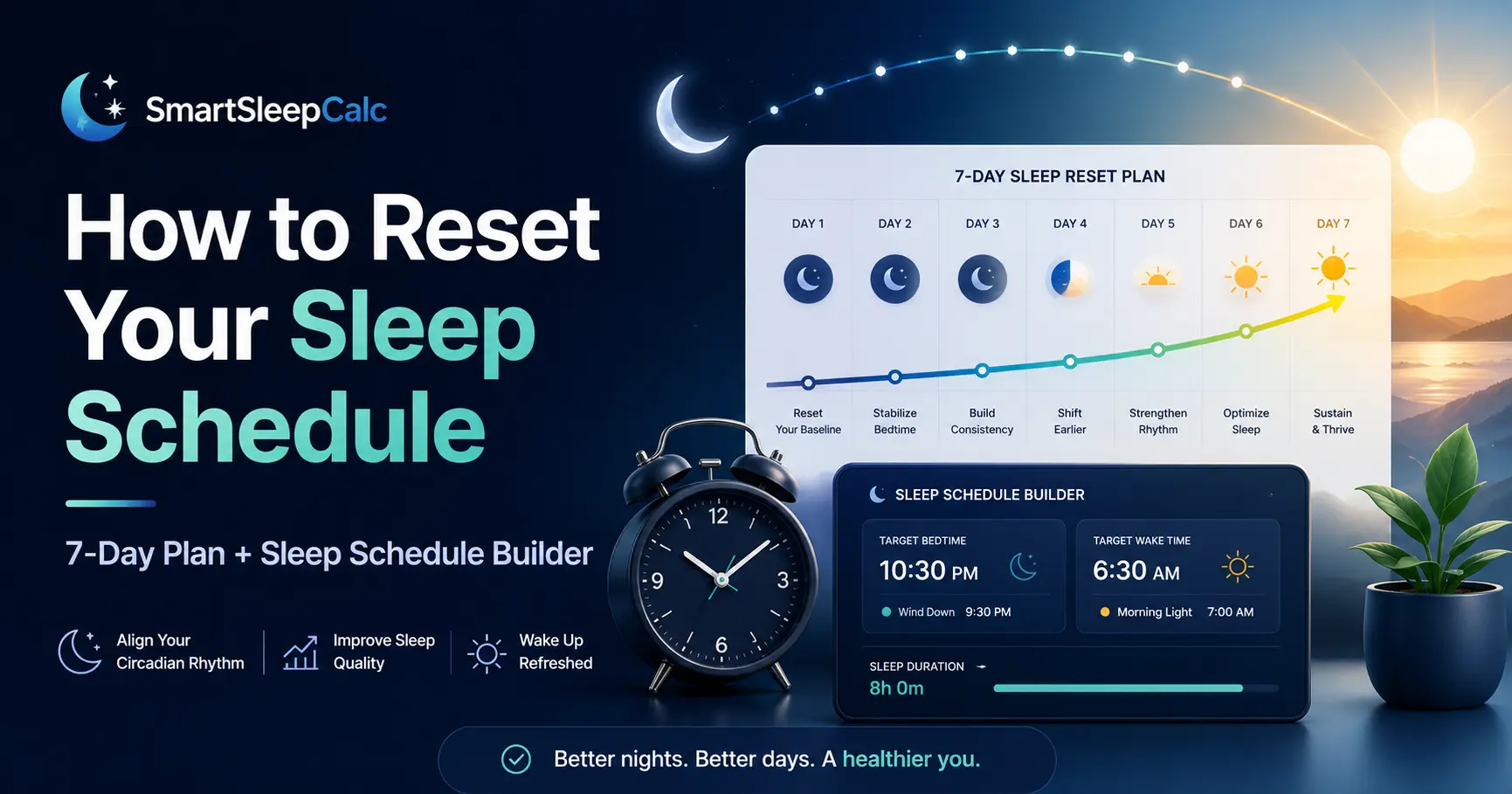
Build your 7-day sleep schedule
Use this planner after choosing a target wake time. It turns your inputs into a repeatable week so the reset is easier to follow.
Why your sleep schedule moves in the first place
Your sleep timing reflects both circadian timing and sleep pressure. Circadian timing is the roughly 24-hour biological system that organizes when your body tends to feel alert or sleepy. Sleep pressure is the drive to sleep that generally grows across time awake and falls during sleep.
Light is the strongest environmental signal for the circadian clock. St Hilaire and colleagues mapped a phase-response curve in 18 participants exposed to one hour of bright white light at different circadian phases. The same light could move circadian timing earlier or later depending on when it was delivered. That is why generic advice to “get more light” misses the most useful detail: timing matters.
Regularity matters too. Sletten and colleagues’ 2023 consensus statement concluded that daily regularity in sleep timing is important for health and performance. For people who sleep later on free days than work days, researchers often use the term social jetlag to describe the mismatch between biological and social timing. Wittmann and colleagues introduced this framing in a 501-person study in 2006.
How to reset your sleep schedule step by step
A reset works best when you change the signals around sleep, not when you try to command yourself to fall asleep. Use this sequence for ordinary schedule drift. If you have persistent insomnia, severe daytime sleepiness, bipolar disorder, seizure risk, or safety-critical work, use the medical section below before trying any aggressive sleep restriction.
Use light as a timing signal, not a generic sleep hack
Light can advance or delay circadian timing depending on when it reaches the eyes. In controlled research, bright light given at different biological times produces different phase shifts. Morning light often supports an earlier schedule, while evening or nighttime light can push timing later.
Shifting earlier
Get outdoor light after your target wake time when practical. Keep evenings calmer and dimmer as bedtime approaches. The aim is consistency across several days, not one extreme light session.
Shifting later
People adapting to night work may need strategically timed evening or nighttime light and reduced morning light. This is harder to personalize safely because work hours, commute light, and days off all matter.
What about melatonin?
Melatonin is not a simple “take it at bedtime” circadian tool. Research shows that its phase-shifting effect changes with timing, and it can cause sleepiness. Because supplements also vary in formulation and may interact with medicines, this page does not give a universal dose or timing prescription. For jet lag, delayed sleep-wake phase disorder, pregnancy, children, or regular medication use, ask a clinician or pharmacist for individualized guidance.
A realistic 7-day sleep schedule reset example
A seven-day plan is a practice window, not a promise that every circadian clock fully shifts in one week. This example is for an adult whose recent sleep has drifted later and who wants a 7:00 AM wake time. Adjust the sleep window to your actual sleep need.
| Days | Morning | Daytime | Evening |
|---|---|---|---|
| 1–2 | Wake near 7:00 AM. Get daylight after waking. | Keep meals and activity on the new daytime schedule. Watch late caffeine. | Dim the environment before bed. Do not force sleep far before you feel sleepy. |
| 3–4 | Repeat the same wake anchor. | Use a short early nap only if needed for function or safety. | Move the sleep window earlier in a manageable step if your body is responding. |
| 5–6 | Keep morning timing stable, including the weekend if possible. | Notice alertness and sleepiness patterns rather than chasing a perfect score. | Keep the wind-down routine boring, familiar, and repeatable. |
| 7 | Review the week. | Check whether you protected enough total sleep. | Keep the pattern that worked; adjust one variable at a time if it did not. |
Habits do not become automatic on a fixed 21-day clock. Lally and colleagues followed 96 volunteers for 12 weeks; among participants with usable model fits, the time to reach 95% of the modeled automaticity plateau ranged from 18 to 254 days. Missing one opportunity did not materially derail the process. That is a better reason to use the 21-day tracker in the planner as a consistency aid, not as a biological deadline.
Five mistakes that make a sleep reset harder
Staying awake all night increases sleep pressure, but it does not precisely set circadian phase. It also creates acute sleep loss, which can impair attention, judgment, and driving safety.
Time in bed is not the same as sleep. If you are wide awake, lying there for hours can add frustration without moving your clock the way you intended.
An earlier wake time is not a win if the plan repeatedly leaves too little sleep opportunity. Protect duration while changing timing.
Bright evenings can work against an earlier schedule. Morning and evening light are not interchangeable circadian signals.
If you have adequate opportunity for sleep but still cannot sleep well for months, schedule advice alone may not address the problem.
Real-world scenario: your weekend moved bedtime to 2:00 AM
Suppose you normally need to wake at 7:00 AM, but a vacation week moved sleep to roughly 2:00 AM–10:00 AM. The first goal is not to “win” by getting into bed at 10:00 PM tonight. Start by restoring daytime cues around the 7:00 AM target while protecting enough sleep opportunity.
Get up near the target when it is safe, get daylight after waking, eat breakfast and start activity on the desired schedule, and reduce bright light later in the evening. If you are not sleepy at the target bedtime yet, use a modest shift rather than spending hours awake in bed. Over the next several days, track whether natural sleepiness is moving earlier.
If the pattern is very stable at a much later time and repeatedly returns despite consistent routines, especially if you can sleep normally on the late schedule, delayed sleep-wake phase disorder becomes one possible explanation. That is different from occasional weekend drift and deserves a clinical discussion rather than endless self-resets.
When to talk with a doctor or sleep specialist
Schedule changes are not a substitute for evaluating persistent or dangerous sleep symptoms. Consider professional assessment if any of the following applies:
- Loud habitual snoring, witnessed breathing pauses, gasping, or marked morning headaches.
- Excessive daytime sleepiness that affects driving, work, school, or safety.
- Insomnia symptoms at least several nights a week for months despite enough opportunity to sleep.
- A stable sleep pattern that is hours later or earlier than required and is very difficult to shift.
- Rotating or night work causing persistent sleep loss or severe fatigue.
- Episodes of unusually elevated mood, reduced need for sleep, seizures, or other conditions where intentional sleep loss can be risky.
For chronic insomnia, the AASM gives its strongest behavioral recommendation to multicomponent cognitive behavioral therapy for insomnia (CBT-I). Sleep hygiene by itself is not recommended as the only treatment for chronic insomnia.
Frequently asked questions
How long does it take to reset your sleep schedule?
A reset can start improving within days, but there is no reliable one-size-fits-all deadline. The amount and direction of the shift, light timing, sleep debt, chronotype, travel, shift work, and sleep disorders all affect the timeline. Judge progress by steadier timing and better daytime function rather than a promised three-day or seven-day cure.
What is the fastest safe way to fix a late sleep schedule?
The safest practical starting point is a consistent wake target, enough sleep opportunity, appropriate morning light for an earlier shift, and smaller repeatable changes. Avoid using an all-nighter as a reset shortcut. If severe sleepiness makes the plan unsafe, prioritize recovery and professional advice over speed.
Should I change bedtime or wake time first?
Wake time is often the easier behavioral anchor because you can choose when to get out of bed, while sleep onset cannot be forced on command. Bedtime still matters because late bedtimes can reduce total sleep and can influence circadian timing. Keep the two goals connected: a steadier wake time plus enough time for sleep.
Can an all-nighter reset my circadian rhythm?
An all-nighter increases sleep pressure but does not precisely reset circadian timing. Light exposure and the timing of sleep-wake behavior are stronger phase-setting signals. An all-nighter also causes acute sleep deprivation, so it is a poor default strategy when driving, work performance, school, or health could be affected.
How much should weekend sleep differ from weekdays?
There is no universal minute-by-minute limit that fits everyone. Large and repeated shifts between work days and free days create social jetlag, while some extra sleep can help when you are sleep deprived. Aim for a schedule that is reasonably stable without using consistency as a reason to stay chronically short on sleep.
Does melatonin reset a sleep schedule?
Melatonin can shift circadian timing, but its effect depends heavily on when it is taken relative to your biological clock. It can also cause sleepiness and interact with medicines. Because timing and dose are not universal, use clinician or pharmacist guidance when melatonin is being used specifically to shift circadian phase.
Research sources
- Sletten TL, et al. (2023). The importance of sleep regularity: a consensus statement of the National Sleep Foundation sleep timing and variability panel. Sleep Health. PubMed.
- St Hilaire MA, et al. (2012). Human phase response curve to a 1 h pulse of bright white light. Journal of Physiology. n=36 total, with 18 participants in the bright-light group. PubMed.
- Watson NF, et al. (2015). Recommended Amount of Sleep for a Healthy Adult: A Joint Consensus Statement of the AASM and Sleep Research Society. J Clin Sleep Med. PubMed.
- Paruthi S, et al. (2016). Recommended Amount of Sleep for Pediatric Populations: A Consensus Statement of the AASM. J Clin Sleep Med. AASM PDF.
- Edinger JD, et al. (2021). Behavioral and psychological treatments for chronic insomnia disorder in adults: AASM clinical practice guideline. J Clin Sleep Med. PMC full text.
- Lally P, et al. (2010). How are habits formed: Modelling habit formation in the real world. European Journal of Social Psychology. 96 volunteers followed for 12 weeks. DOI.
- Wittmann M, et al. (2006). Social jetlag: misalignment of biological and social time. Chronobiology International. 501 volunteers. PubMed.
- Spitschan M, et al. (2026). Can Morning Light Phase Advance Human Melatonin Rhythms in Less Than 24 h? Narrative review of same-cycle light studies. PubMed.