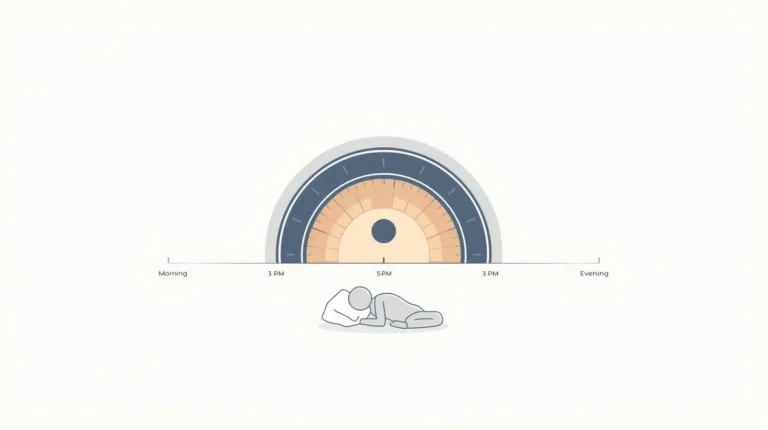

Your circadian rhythm is a 24-hour internal biological clock embedded in virtually every cell of your body — not just your brain. It governs when you feel alert, when you feel sleepy, when your core temperature peaks, when your organs perform their best, and most critically for sleep, when your brain releases melatonin and begins preparing for rest. Sleep at the wrong time relative to your circadian clock and you get fragmented, shallow, unrestorative sleep — even if the total hours are technically sufficient. Sleep at the right time and the same number of hours produces dramatically deeper, more efficient, more restorative rest.
Understanding your circadian rhythm is not a lifestyle optimization hack. It is the foundation of every other sleep improvement you can make. Light exposure, meal timing, exercise, napping, caffeine — all of these either reinforce or disrupt your circadian clock. This guide explains exactly how the system works, what it controls at every hour of the day, how your chronotype determines your personal optimal timing, and how to realign a disrupted clock with precision.
Your circadian rhythm is a 24-hour biological clock controlled by the suprachiasmatic nucleus (SCN) in the hypothalamus and synchronized primarily by light. It determines the optimal timing for sleep, peak alertness, physical performance, digestion, and immune function. Working against it — through shift work, irregular schedules, or late light exposure — produces measurable impairment equivalent to jet lag every single day.
What Is the Circadian Rhythm?
The word “circadian” comes from the Latin circa diem — “about a day.” The discovery that this clock exists in individual cells — not just as a brain-level phenomenon — earned Jeffrey Hall, Michael Rosbash, and Michael Young the 2017 Nobel Prize in Physiology or Medicine. Their work established that virtually every cell in the human body contains its own molecular timekeeping mechanism, synchronized to a master clock in the brain that coordinates them all.
That master clock is the suprachiasmatic nucleus (SCN) — a tiny paired structure of approximately 20,000 neurons sitting directly above the optic chiasm in the hypothalamus. The SCN receives direct light input from specialized photoreceptive retinal ganglion cells containing melanopsin, which are particularly sensitive to short-wavelength blue light (around 480nm). Morning light exposure activates the SCN, suppresses melatonin, elevates cortisol, and anchors the entire 24-hour cycle to the solar day. Evening darkness triggers the opposite: melatonin rises, cortisol falls, core body temperature drops, and the brain begins preparing for sleep.[1]
The circadian clock runs on a genetic feedback loop involving clock genes — CLOCK, BMAL1, PER1, PER2, CRY1, CRY2 — that take approximately 24 hours to complete one activation-suppression cycle. This loop is self-sustaining: even in total darkness, with no external time cues, the human clock continues to run on its approximately 24-hour period. But without daily light input, it drifts — typically running about 24.2 hours per cycle — which is why light is essential for keeping the biological clock aligned with the actual 24-hour solar day.[2]
Your Circadian Rhythm Across 24 Hours
The circadian rhythm does not simply produce a binary “awake” and “asleep” signal. It generates a precise, predictable sequence of hormonal, neurological, and physiological events across every 24 hours — each optimized for a specific function. The chart below maps these events against clock time for a person with a standard 7:00 AM wake time:
Your Circadian Rhythm — Hour by Hour (7 AM Wake Time)
Times shown for a standard 7:00 AM wake time. All windows shift proportionally with your personal wake and sleep times. Shift by ±1 hour for every hour your wake time differs from 7:00 AM.
Each event in this sequence is not merely a preference — it reflects a cascade of hormonal and physiological changes that the body performs on a strict biological schedule. The Cortisol Awakening Response (a 50–100% cortisol spike in the first 30 minutes after waking) prepares the immune system and metabolism for the day. The DLMO (dim-light melatonin onset) ~2 hours before sleep signals the brain to begin reducing core temperature and alertness. Disrupting any of these signals — through irregular wake times, evening light exposure, or shift work — cascades through the entire 24-hour sequence.[3]
Chronotypes: Why Your Circadian Timing Is Personal
The concept of “morning person” versus “night owl” is not a personality quirk or a matter of discipline — it is a measurable biological phenomenon. Chronotype is primarily determined by genetic variation in clock genes, particularly PER3, and produces real, physiologically measurable differences in the timing of melatonin onset, core body temperature nadir, and peak cognitive performance between individuals.
Till Roenneberg’s large-scale population studies (spanning 65,000+ participants) found that chronotypes are normally distributed across the population, with most people falling in a broad intermediate range and meaningful minorities at either extreme. Forcing a late chronotype to operate on an early schedule — as school and work systems routinely do — creates what Roenneberg termed “social jet lag”: a chronic misalignment between biological clock time and social clock time that produces sleep debt, health impairment, and reduced performance.[4]
Early Chronotype (Morning Type)
DLMO occurs earlier than average — typically around 8:00–9:00 PM. Natural sleep drive arrives early in the evening. Peak cognitive performance in the morning. Roughly 25% of adults.
Peak focus: 8:00–11:00 AM
Best exercise: Morning or early afternoon
Avoid: Late evening caffeine, social obligations past 9 PM
Intermediate Chronotype
DLMO around 9:30–10:30 PM. Represents the population average. Adapts most easily to standard work/school schedules. Roughly 50% of adults.
Peak focus: 9:30 AM–12:30 PM
Best exercise: Late morning or afternoon
Avoid: Inconsistent wake times on weekends
Late Chronotype (Evening Type)
DLMO occurs later — around 11:00 PM–1:00 AM. Natural sleep drive arrives late. Peak cognitive performance in late afternoon or evening. Roughly 25% of adults.
Peak focus: 12:00 PM–3:00 PM or later
Best exercise: Late afternoon
Avoid: Early morning commitments, alarm-forced 6 AM wake-ups
Roenneberg et al. found that social jet lag — the misalignment between biological clock time and required social schedule — affects approximately 69% of the working population by at least 1 hour, with 30% experiencing misalignment of 2+ hours every workday. Each hour of chronic social jet lag is associated with a 33% increased odds of being overweight, significantly elevated rates of depression, and reduced cognitive performance — entirely independent of total sleep duration.
Zeitgebers: What Resets Your Circadian Clock
Your circadian clock does not synchronize itself — it requires daily input from the environment to stay aligned with the 24-hour day. These synchronizing signals are called zeitgebers (German for “time givers”), and they work by directly influencing the molecular clock gene feedback loops in your SCN and peripheral tissues. Understanding which zeitgebers you are inadvertently disrupting is essential for diagnosing why your sleep timing may have drifted:
Light — The Master Zeitgeber
Morning bright light (preferably 10,000 lux outdoor, within 30 minutes of waking) advances the circadian clock and suppresses melatonin. Evening light (especially blue light, 400–500nm) delays the clock and pushes melatonin onset later. A single evening of bright screen exposure can delay DLMO by 1.5–3 hours. Light is the single most powerful lever you have over your circadian timing.
⚡ Strongest signal — acts in minutesMeal Timing — Peripheral Clock Setter
The timing of the first meal and largest meal of the day synchronizes peripheral clocks in the liver, pancreas, and digestive system. Eating at irregular times — or late at night — desynchronizes peripheral clocks from the SCN master clock, creating internal misalignment. Time-restricted eating (eating within a consistent 8–10 hour window, ideally ending 3 hours before bed) powerfully reinforces circadian alignment.
🍴 2nd most powerful — works over daysExercise Timing
Morning and early afternoon exercise advances the circadian clock — reinforcing early wake times and improving sleep onset that night. Late evening intense exercise (within 2 hours of bed) delays sleep onset by elevating core temperature, cortisol, and sympathetic nervous system activity. Exercise is a significant zeitgeber but its direction (advance or delay) depends entirely on when it occurs.
⏰ Direction depends on timingTemperature
Environmental temperature cues reinforce circadian timing. Cold morning showers advance the clock; warm baths 1–2 hours before bed facilitate sleep by accelerating core body temperature drop (the bath raises skin temperature, increasing heat dissipation, which lowers core temperature). Sleeping in a room cooler than 18–20°C significantly improves N3 deep sleep quality by supporting the circadian-driven nighttime temperature nadir.
🛁 Hot bath 90 min before bed = faster sleep onsetMelatonin (Exogenous)
Low-dose exogenous melatonin (0.5mg, not the standard 10mg) taken 5–6 hours before desired sleep onset advances the circadian clock — useful for jet lag recovery or shifting an evening chronotype earlier. Higher doses (5–10mg) saturate receptors and act primarily as a sedative rather than a clock-shifting agent. Melatonin’s zeitgeber effect is most powerful when taken 5–6 hours before your current DLMO, not at bedtime.
💡 0.5mg is more effective than 10mg for timingSocial Interaction & Routine
Consistent wake times, meal times, and social contact provide weak but cumulative zeitgeber signals that stabilize circadian rhythms — particularly important for people with weaker light exposure (indoor workers, winter climates, elderly). A fixed morning routine — waking at the same time, eating at the same time — provides powerful zeitgeber reinforcement even on days with poor light access.
📅 Consistency is the mechanismCaffeine — A Zeitgeber Disruptor
Caffeine is not a circadian zeitgeber itself, but it disrupts the adenosine signaling that integrates with the circadian system. Consumed after 2:00 PM, caffeine delays sleep onset, reduces N3 deep sleep, and — by keeping the brain awake beyond its natural DLMO window — indirectly causes circadian phase delay over time. Caffeine consumed within 90 minutes of waking may also blunt the full expression of the cortisol awakening response.
⚠️ Disrupts alignment — cut off at 2 PMAlcohol — A False Sleep Aid
Alcohol suppresses REM sleep in the first half of the night and causes rebound arousal in the second half, fragmenting the circadian-governed sleep architecture. It also reduces the amplitude of circadian temperature rhythms, flattening the nighttime temperature nadir that drives deep sleep. Even moderate alcohol (1–2 drinks) measurably reduces sleep quality and disrupts the circadian timing of REM sleep cycles.
❌ Disrupts REM and temperature rhythmWhat Happens When Your Circadian Rhythm Is Disrupted?
Circadian disruption is not merely an inconvenience — it is a recognized health risk documented in thousands of studies. The evidence is sufficiently strong that the International Agency for Research on Cancer (IARC) classified night shift work as a probable human carcinogen (Group 2A) in 2007, based on the mechanistic link between circadian disruption and tumor suppressor gene expression.[5]
| System Affected | Effect of Circadian Disruption | Severity | Reversible? | Key Source |
|---|---|---|---|---|
| Cognitive performance | Impaired attention, memory, decision-making — equivalent to sleep deprivation | Severe | Yes | Van Dongen et al. 2003 |
| Metabolic function | Insulin resistance, glucose dysregulation, increased obesity risk | Moderate–High | Partial | Scheer et al., PNAS 2009 |
| Cardiovascular | Elevated blood pressure, inflammation markers, increased cardiac event risk | Severe (long-term) | Partial | Vyas et al., BMJ 2012 |
| Immune function | Reduced vaccine response, suppressed T-cell activity, increased infection risk | Moderate–High | Yes | Besedovsky et al. 2019 |
| Mental health | Increased rates of depression, anxiety, bipolar disorder episodes | Severe | Partial | Lyall et al., Lancet Psych 2018 |
| Cancer risk | Night shift work classified as probable carcinogen (IARC Group 2A) | Severe (chronic) | Unknown | IARC Monograph 98, 2010 |
| Hormonal balance | Cortisol dysregulation, testosterone suppression, leptin/ghrelin disruption | Moderate | Yes | Spiegel et al. 1999 |
Effects shown for chronic circadian disruption (weeks to months). Acute disruption (jet lag, single night shifts) produces reversible effects that resolve within days of circadian realignment.
How to Realign Your Circadian Rhythm: 6-Step Protocol
- 1Get bright light within 30 minutes of waking — every single morning
This is the most powerful single intervention for circadian realignment. Ten minutes of direct outdoor light (no sunglasses — through glass does not count) on a clear morning delivers 10,000–100,000 lux, which immediately suppresses melatonin, triggers the cortisol awakening response, and anchors your SCN to the solar day. On overcast days or in winter, a 10,000-lux light therapy lamp positioned 40–50cm from your face for 20–30 minutes provides a functional substitute. The earlier in the morning this occurs, the stronger the phase-advancing effect on your clock.
- 2Fix your wake time — including weekends — within a 30-minute window
Your circadian clock anchors primarily to wake time, not bedtime. A consistent wake time — within 30 minutes on every day of the week — is the single most stabilizing intervention for circadian consistency. Variable wake times (sleeping 2–3 hours later on weekends) reset the clock’s phase each week, producing perpetual mild jet lag. Pick a wake time you can maintain 7 days per week and protect it with the same commitment you would a flight departure time.
- 3Eliminate blue light and screens 60–90 minutes before your target bedtime
Evening screen exposure is the most common cause of delayed DLMO and circadian phase delay in the modern world. Blue light (400–500nm) from phones, tablets, and laptops suppresses melatonin by 50% or more for 2–3 hours after exposure, directly delaying sleep onset. Switch to warm lighting (amber/red spectrum) in the evening, use night mode and blue-light filters on devices, or eliminate screens entirely for the 60–90 minutes before bed. Red-spectrum lights in the bedroom are ideal as they have virtually no effect on melatonin production.
- 4Eat your first meal within 60 minutes of waking and close your eating window 3 hours before bed
Consistent meal timing reinforces peripheral circadian clock alignment in your liver, gut, and metabolic tissues. Eating breakfast within 1 hour of waking sends a strong “morning has arrived” signal to peripheral clocks. Ending food intake 3 hours before bed prevents the digestive activity and insulin response that interfere with the nighttime temperature drop needed for deep sleep. Irregular meal timing — eating at random times each day — is one of the most underappreciated causes of circadian drift.
- 5Exercise before 3:00 PM — or at least before 5:00 PM
Morning and midday exercise advances the circadian clock and promotes earlier sleep onset. Late evening intense exercise (within 2 hours of bed) elevates cortisol and core body temperature, delaying the thermal drop needed to initiate sleep. If evening exercise is unavoidable, finish by 7:00 PM and take a warm shower afterward — the post-shower temperature drop accelerates sleep onset despite the prior exercise-induced warming.
- 6Keep your bedroom below 18–19°C (65–67°F)
Sleep onset is triggered in part by the body’s need to drop its core temperature by 1–2°C. A cool bedroom facilitates this temperature drop, enabling faster sleep onset and deeper N3 sleep. A hot bedroom forces the body to spend its first sleep cycles fighting ambient temperature rather than achieving the nighttime thermal nadir. This is one of the most evidence-backed and most overlooked environmental interventions for sleep quality — and it costs nothing except a thermostat adjustment.
Frequently Asked Questions About Circadian Rhythm and Sleep
The best sleep schedule is one that is consistent (same bedtime and wake time within 30 minutes every day, including weekends), aligned with your personal chronotype, and timed to allow 7–9 hours of sleep ending naturally before the alarm. For an intermediate chronotype, this typically means sleeping 10:30–11:00 PM to 6:30–7:00 AM. For early chronotypes, 9:30–10:00 PM to 5:30–6:00 AM. For late chronotypes, midnight to 8:00 AM if schedule permits. The most important single variable is consistency — irregular schedules cause circadian drift regardless of the total hours slept.
A mildly disrupted circadian rhythm — from one or two nights of irregular sleep or mild jet lag — can realign within 2–4 days of consistent sleep-wake timing, morning light exposure, and proper zeitgeber management. A significantly disrupted clock — from months of shift work, chronic night-owl behavior, or long-haul jet lag — typically requires 2–3 weeks of consistent protocol adherence before the clock stabilizes at its new phase. The rate of phase shift is approximately 1–1.5 hours per day in the advance direction (going to sleep earlier) and up to 2 hours per day in the delay direction (going to sleep later), with morning light and melatonin timing being the most powerful accelerators.
Yes — significantly. Harvard research by Charles Czeisler and colleagues found that blue light (400–500nm wavelength) is approximately twice as disruptive to the circadian system as green light of the same intensity. This is because melanopsin-containing retinal ganglion cells — which directly connect to the SCN — have peak sensitivity at 480nm. Evening blue light exposure suppresses melatonin for 2–3 hours after exposure and delays dim-light melatonin onset (DLMO) by 1.5–3 hours in some individuals. The practical implication: 90 minutes of evening phone use can delay your biological sleep gate by as much as 3 hours, making 10:00 PM your body’s new midnight.
You can shift your circadian phase within a range, but you cannot fundamentally change your genetically determined chronotype. A confirmed late chronotype can shift their DLMO 1–2 hours earlier with disciplined morning light exposure, consistent early wake times, and reduced evening light — but they will always have a naturally later biological clock than an early chronotype. Attempting to force a strong late chronotype into an early morning schedule without circadian management produces chronic social jet lag, not chronotype change. The most sustainable approach is to structure your schedule around your chronotype where possible, and use light and timing protocols to make the smallest necessary adjustment rather than forcing a major phase shift.
The post-lunch dip at 1:00–3:00 PM is a genuine circadian phenomenon, not a consequence of eating — it occurs in people who skip lunch and in cultures without a lunch break. It represents the second, weaker of two daily troughs in the circadian alertness drive (the first and deeper trough occurring at 2:00–4:00 AM). Research suggests it may be an evolutionary vestige of biphasic sleep patterns — the natural human tendency to sleep in two segments, with a brief rest period in the early afternoon. The dip is caused by a temporary decline in the alerting signal from the circadian system, producing increased adenosine sensitivity and a drop in core body temperature relative to the morning peak.
Social jet lag is the circadian misalignment caused by the difference between your biological clock and your required social schedule — typically expressed as sleeping later on weekends than weekdays. Roenneberg’s research found that 69% of working adults experience at least 1 hour of social jet lag, and 30% experience 2+ hours. Each hour of chronic social jet lag is independently associated with a 33% increased likelihood of being overweight, significantly elevated depression risk, higher rates of metabolic syndrome, and measurable cognitive impairment — entirely independent of total sleep duration. Unlike real jet lag, social jet lag does not resolve after a few days because the misalignment is repeated every week, preventing the clock from ever fully stabilizing.
Expert Takeaway
“Most people approach sleep as a quantity problem — they need more hours. But the more fundamental issue is often timing. You can sleep 8 hours and still feel terrible if those 8 hours are misaligned with your circadian phase. And you can sleep 7 hours at the biologically correct time and feel dramatically better than someone sleeping 9 hours at the wrong time. Light, consistency, and meal timing are the three levers that matter most. Get morning light, fix your wake time, and dim your evenings — those three changes alone realign the clock for the majority of people with circadian disruption.”
The circadian rhythm is the foundation beneath every other aspect of sleep health. Nap timing, sleep debt recovery, sleep stage quality, and even the effectiveness of sleep hygiene practices — all of them depend on whether your circadian clock is aligned, consistent, and properly synchronized. The biology is not complicated: morning light, fixed wake times, dim evenings, and consistent meal timing are the four pillars. The challenge is consistency — because the clock never takes a day off, and neither can the habits that keep it on time.
To understand how your circadian rhythm interacts with the sleep stages it governs, read our guide on the 4 stages of sleep. To find your personal optimal sleep and wake times based on your chronotype, use our Sleep Cycle Calculator. And for the circadian science behind afternoon napping, see our best time to nap guide.
- Provencio, I. et al. (2000). A novel human opsin in the inner retina. Journal of Neuroscience, 20(2), 600–605. [Melanopsin discovery]
- Czeisler, C.A. et al. (1999). Stability, precision, and near-24-hour period of the human circadian pacemaker. Science, 284(5423), 2177–2181.
- Leproult, R. & Van Cauter, E. (2010). Role of sleep and sleep loss in hormonal release and metabolism. Endocrine Development, 17, 11–21.
- Roenneberg, T. et al. (2012). Social jetlag and obesity. Current Biology, 22(10), 939–943.
- IARC Working Group. (2010). Painting, firefighting, and shiftwork. IARC Monographs on the Evaluation of Carcinogenic Risks to Humans, Vol. 98. Lyon: IARC Press.
- Scheer, F.A.J.L. et al. (2009). Adverse metabolic and cardiovascular consequences of circadian misalignment. PNAS, 106(11), 4453–4458.
- Hatori, M. et al. (2012). Time-restricted feeding without reducing caloric intake prevents metabolic diseases in mice fed a high-fat diet. Cell Metabolism, 15(6), 848–860.
- Chang, A.M. et al. (2015). Evening use of light-emitting eReaders negatively affects sleep, circadian timing, and next-morning alertness. PNAS, 112(4), 1232–1237. [Blue light study]
Find Your Circadian-Optimal Sleep & Wake Times
Enter your chronotype and target wake time — our free calculator generates your ideal bedtime, sleep window, and nap timing based on your personal circadian phase.
Similar Posts
Best Time to Nap: Personalised Calculator Based on Your Wake Time
Best Time to Nap — Personalised Calculator When Is the Best Time to Nap?Your Personal Nap Window Calculator Generic advice says “nap at 1–3pm.” That is correct only for people who wake at 6–7am. Enter your wake time and get your actual optimal nap window — calculated from your circadian clock, not a population average….