Waking Up at 3AM: Why It Happens and When to Get Help
Waking around 3:00 AM can be frustrating, especially when it happens night after night. The clock time itself does not point to one disease, hormone problem, sleep stage, or hidden medical meaning. What matters more is how often you wake, how long you stay awake, whether something else is disturbing your sleep, and how you feel during the day.
There is no special medical rule about waking at exactly 3:00 AM. Nighttime awakenings can happen because sleep naturally becomes easier to interrupt, but stress, insomnia, menopause symptoms, reflux, sleep apnea, alcohol, pain, bathroom trips, noise, light, temperature, medications, or a mismatched schedule can also contribute. A repeated pattern and its daytime effects tell you more than one number on the clock.
Why Awakenings Occur Overnight
Sleep changes through the night. Your brain moves through non-REM and REM sleep repeatedly, and brief awakenings can occur between or within these periods. You may never remember many of them because you fall back asleep quickly.
An awakening becomes more noticeable when you stay awake long enough to check the time, start thinking, get out of bed, use the bathroom, feel physical discomfort, or become frustrated about being awake.
You can move closer to wakefulness several times during a night. A clock cannot tell which sleep stage you were in when you woke.
Noise, light, a pet, another person, room temperature, or a phone notification may be enough to turn a brief arousal into a full awakening.
Pain, reflux, hot flashes, breathing disruption, needing to urinate, stress, or other symptoms may interrupt sleep repeatedly.
Circadian Rhythm and Sleep-Pressure Context
Two broad processes help shape when you sleep. Sleep pressure builds while you are awake and eases while you sleep. At the same time, your circadian system helps organize periods of sleepiness and alertness across roughly 24 hours.
This means the same clock time can represent a very different point in the night for different people. Someone who fell asleep at 8:30 PM has already been asleep much longer by 3:00 AM than someone who went to bed after midnight.
Bedtime, wake schedule, shift work, recent travel, light exposure, sleep opportunity, and your normal routine all change how a 3:00 AM awakening should be interpreted.
A 3:00 AM awakening may occur after many hours of sleep, especially if your sleep period started early.
The same 3:00 AM awakening may happen after only a short sleep opportunity, which changes the practical concern.
NHLBI notes that circadian clocks are influenced by light, darkness, and other environmental cues. Shift work, travel, or an irregular sleep schedule can move sleep and wake timing away from the schedule you are trying to keep.
Stress, Menopause, Reflux, Sleep Apnea and Environment
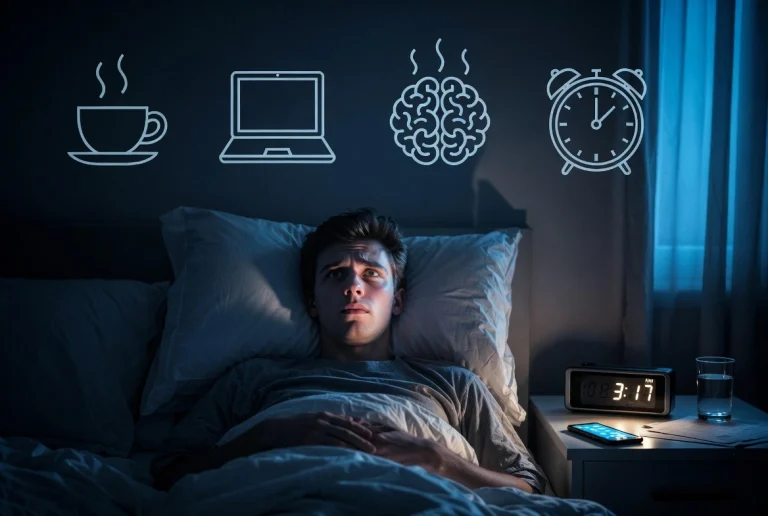
Repeated nighttime waking can have many explanations, and more than one may be present at the same time. The pattern around the awakening often provides better clues than the hour shown on the clock.
| Possible contributor | What you might notice | What it does not prove |
|---|---|---|
| Stress or insomnia | Racing thoughts, worry about sleep, trouble returning to sleep, or repeated awakenings during stressful periods. | Waking at 3AM alone does not diagnose insomnia or an anxiety disorder. |
| Menopause | Hot flashes, night sweats, temperature changes, or sleep difficulty during the menopausal transition. | The clock time cannot tell you whether hormones caused the awakening. |
| Reflux | Heartburn, sour taste, throat irritation, coughing, or discomfort that is worse when lying down. | Night waking without reflux symptoms does not establish GERD. |
| Sleep apnea | Loud snoring, gasping, choking, witnessed breathing pauses, unrefreshing sleep, morning headaches, or marked daytime sleepiness. | A 3AM awakening cannot identify apnea or tell which sleep stage you were in. |
| Environment | Traffic, a partner, pets, room temperature, dawn light, electronics, or other recurring disturbances. | You do not need an underlying sleep disorder for the environment to fragment sleep. |
| Alcohol or stimulants | Alcohol may make you sleepy initially yet contribute to lighter, disrupted sleep later. Caffeine and nicotine can also interfere with sleep. | One awakening cannot tell you which substance caused it. |
| Pain or medical symptoms | Pain, coughing, breathing symptoms, urinary urgency, itching, or other discomfort that repeatedly interrupts sleep. | The wake time itself cannot identify the underlying condition. |
| Schedule mismatch | Shift work, jet lag, inconsistent bedtimes, sleeping unusually early, or a schedule that conflicts with your body clock. | It does not necessarily mean your circadian rhythm is medically abnormal. |
If your awakenings include choking, heartburn, or reflux symptoms, the Sleep Apnea & Acid Reflux guide explains how nighttime breathing and reflux symptoms can overlap without assuming one automatically causes the other.
What You Should Not Infer From Waking at One Clock Time
Exactly 3:00 AM does not have a unique medical meaning. There is no reliable rule that says waking at this hour proves a cortisol problem, blood-sugar crash, liver issue, hormone disorder, REM transition, depression, or spiritual event.
A clock cannot determine whether you were in REM, N1, N2, or N3 when you woke. Sleep-stage timing varies through the night and between people.
Circadian hormones change across the night, but an awakening time is not a hormone test.
Do not assume a nighttime awakening is hypoglycemia without relevant symptoms, medical history, or appropriate clinical testing.
An occasional remembered awakening can happen without a sleep disorder, especially when you return to sleep and function normally the next day.
What Wearables and Sleep Apps Cannot Tell You From a 3AM Awakening
A wearable may estimate when you were awake or assign a sleep stage around that time. That can be useful for spotting broad trends, but consumer sleep technology should not be treated as a substitute for validated clinical assessment or used to diagnose why you woke.
Looking for repeated patterns in bedtime, wake time, estimated sleep duration, or nights with more disruption.
Using one stage label or readiness score to decide that a specific disease, hormone change, or apnea event caused your awakening.
What to Track for 1–2 Weeks
NHLBI recommends a sleep diary when evaluating insomnia symptoms. A short record can help you and a healthcare professional see patterns that are easy to miss when you focus only on the clock.
Write down when you went to bed and roughly when you think you actually fell asleep.
Note approximately when you woke, how often it happened, and whether you returned to sleep easily or stayed awake for a long time.
Record when you woke for the day rather than focusing only on one middle-of-the-night awakening.
Examples include hot flashes, reflux, pain, cough, gasping, choking, bathroom urgency, nightmares, racing thoughts, or no obvious symptom at all.
Note timing rather than assuming any one item is responsible.
Include shift changes, travel, weekends, sleeping in, unusually early bedtimes, and daytime naps.
Track sleepiness, concentration, mood, energy, headaches, and whether tiredness affects work, school, driving, or normal daily activities.
When Recurrent Nighttime Waking Needs Evaluation
Consider talking with a healthcare professional when repeated awakenings are making it hard to function during the day, when you regularly cannot get enough restorative sleep, or when another symptom points toward a condition that needs assessment.
An occasional awakening without major daytime effects can often be observed. Keep a simple diary and look for schedule, environment, stress, alcohol, caffeine, pain, or symptom patterns.
Get medical input when awakenings persist, interfere with daytime life, or occur with loud snoring, gasping, witnessed breathing pauses, frequent reflux, significant hot flashes, pain, restless legs symptoms, or concerning mood changes.
If sleep loss or excessive sleepiness makes driving or operating equipment unsafe, do not push through it. Arrange safer transportation and seek professional advice about the underlying sleep problem.
The Insomnia Severity Index can help organize symptoms over the previous two weeks. It is a published screening instrument, not a diagnosis.
Check your insomnia symptom score →What You Can Do Without Guessing the Cause
You do not need to identify a hormone, sleep stage, or precise biological event before making basic sleep-supportive changes.
A reasonably consistent daily schedule gives your circadian system a more stable timing cue.
Reduce recurring light, noise, uncomfortable temperature, and device interruptions where practical.
Both can affect sleep, though the effect varies by person, amount, timing, and other factors.
Watching every minute pass can increase frustration. You need the overall pattern, not a perfect timestamp.
Repeated reflux, pain, breathing symptoms, hot flashes, or urinary symptoms deserve attention rather than being dismissed as “bad sleep.”
A one- to two-week record gives your clinician much more context than simply saying, “I always wake up at 3AM.”
Waking Up at 3AM FAQs
Why do I keep waking up at 3AM every night?
There is no single cause. Repeated nighttime waking may be related to insomnia, stress, an irregular schedule, menopause symptoms, reflux, apnea, pain, alcohol, bathroom trips, medications, or environmental disturbances. The repeated pattern and accompanying symptoms are more informative than the exact time.
Is waking up at 3AM a sign of high cortisol?
Not by itself. Cortisol follows a daily rhythm, but a clock time is not a hormone measurement. You cannot diagnose abnormal cortisol from the time you wake during the night.
Can waking at 3AM be insomnia?
It can be part of an insomnia pattern if you repeatedly have difficulty staying asleep despite adequate opportunity for sleep and the problem affects how you function. One nighttime awakening by itself does not diagnose insomnia.
Can menopause cause middle-of-the-night waking?
Menopause can be associated with sleep problems, and hot flashes or night sweats may interrupt sleep. That does not mean every awakening during menopause is caused by hormonal changes, so persistent symptoms are worth discussing with a healthcare professional.
Is waking up at 3AM a sign of sleep apnea?
Sleep apnea can cause repeated arousals, but it cannot be identified from one wake time. Loud snoring, gasping, choking, witnessed breathing pauses, unrefreshing sleep, or excessive daytime sleepiness are more useful reasons to ask about an apnea evaluation.
Why can I fall asleep easily but wake up in the middle of the night?
Falling asleep and staying asleep are related but different problems. Stress, insomnia, alcohol, health symptoms, menopause, apnea, reflux, pain, environment, and schedule timing can affect sleep continuity even when sleep onset is easy.
Should I check my sleep tracker when I wake at 3AM?
A tracker can help you notice broad timing and duration trends, but its stage labels should not be used to diagnose why you woke. If checking data in the middle of the night makes you more alert or anxious, review it later instead.
Sources
- National Heart, Lung, and Blood Institute. Insomnia Symptoms . Nighttime awakenings, early waking, daytime tiredness and sleep-diary guidance.
- National Heart, Lung, and Blood Institute. Your Sleep/Wake Cycle . Circadian clocks, environmental timing cues and disruption of the sleep-wake schedule.
- National Heart, Lung, and Blood Institute. Insomnia Causes and Risk Factors . Stress, schedule changes, caffeine, nicotine, alcohol, nighttime interruptions and menopause-related sleep problems.
- Mayo Clinic. Insomnia: Symptoms and Causes . Stress, schedules, reflux, medications, sleep apnea, alcohol, aging and menopause as possible sleep-disrupting factors.
- Mayo Clinic. Insomnia: How Do I Stay Asleep? . Middle-of-the-night waking, environment, clock-watching and general sleep-supportive practices.
- American College of Obstetricians and Gynecologists. Sleep Health and Disorders . Menopause-related hot flashes, nighttime waking, early waking and sleep-disorder context.
- American Academy of Sleep Medicine. Consumer Sleep Technology: Position Statement . Consumer wearables can support discussion and trend tracking but should not be used to diagnose or treat sleep disorders.
- Cleveland Clinic. Up at 3 a.m.? This Could Be Why . Consumer sleep-medicine discussion of nighttime awakenings, environment, bathroom trips, stress and related contributors.
Start With the Pattern, Not the Clock
For the next one to two weeks, record your bedtime, estimated sleep time, awakenings, final wake time, relevant symptoms, substances or medicines, and daytime effects. If a clear trigger appears, that gives you something practical to work on. If the pattern persists or affects your daytime function, bring the diary to a healthcare professional.
Use the Insomnia Severity Index to organize your recent symptoms, then treat the score as screening context rather than a diagnosis.
Open the Insomnia Severity Calculator →