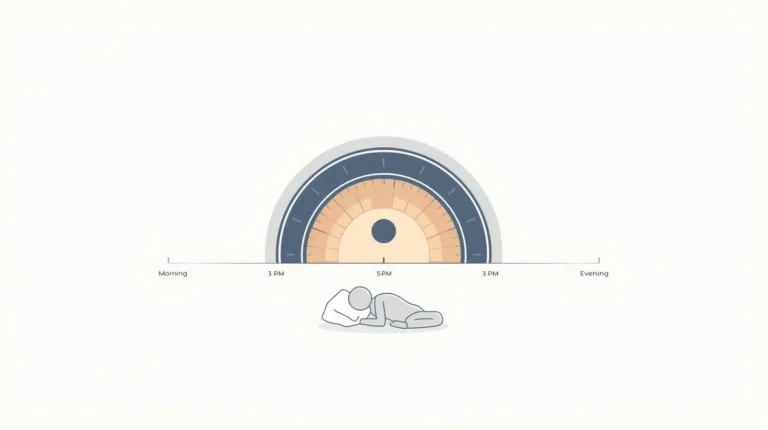
The 90-Minute Nap:
One Complete Sleep Cycle. Less Grogginess Than 60 Minutes.
Counterintuitive but true: a 90-minute nap produces less grogginess than a 60-minute nap. It is also the only nap duration that provides both N3 deep sleep and REM sleep — and it uses the identical cycle logic as the Sleep Cycle Calculator. Here is exactly why, and who should use it.
The Paradox: Why 90 Minutes Is Less Groggy Than 60 Minutes
The relationship between nap duration and grogginess is not linear. Adding 30 minutes to a 60-minute nap does not add more grogginess — it eliminates it. A 90-minute nap wakes you from light N1 sleep at cycle end, producing 8–10% grogginess risk. A 60-minute nap wakes you mid-N3, producing 20–30 minutes of severe sleep inertia. This is not an individual variation — it is a direct consequence of sleep cycle architecture, and it is predictable for almost every adult.
The reason is simple once you understand sleep cycle structure. A full nap cycle follows N1 → N2 → N3 → N2 → REM → N1. At 60 minutes, you are deep in N3. At 90 minutes, you have completed the entire cycle and returned to light N1 — the same natural waking point your body targets at the end of every night sleep cycle.
The 90-minute nap is, literally, one sleep cycle — the same unit the Sleep Cycle Calculator uses to calculate optimal night sleep times. When the calculator recommends 7.5 hours (5 cycles) over 8 hours, it is applying the identical principle: waking at cycle end, in light N1 sleep, minimises sleep inertia. The 90-minute nap and the Sleep Cycle Calculator are the same algorithm applied to different sleep durations. → See how cycles apply to your night sleep
Who Should Take a 90-Minute Nap: 5 Justified Use Cases
The 90-minute nap is not a casual power nap. It requires 90 minutes of actual sleep time plus preparation and a brief recovery buffer. These are the five situations where that investment is warranted — and produces qualitatively better outcomes than any shorter alternative.
The 90-Minute Nap Timing Rules
The 90-minute nap provides its full benefit only when timed correctly. The critical constraint is not how long the nap lasts — it is how much time remains between nap end and your night sleep. Get this wrong and the nap trades daytime restoration for night-time disruption.
Quick Reference: Nap Timing by Bedtime
| Your bedtime | Ideal nap end time | Latest safe nap end | Risk if later |
|---|---|---|---|
| 9:00 pm | 11am – 12pm | 3:00 pm | Delayed sleep onset |
| 10:00 pm | 12pm – 2pm | 4:00 pm | Reduced N3 at night |
| 11:00 pm | 1pm – 3pm | 5:00 pm | 30–60 min later onset |
| 12:00 am | 2pm – 4pm | 6:00 pm | Borderline disruption |
Why 90 Minutes Is Less Groggy Than 60 Minutes
The relationship between nap duration and grogginess is not linear. A 90-minute nap produces significantly less sleep inertia than a 60-minute nap — because of where each alarm falls in the sleep cycle.
The sleep cycle follows a predictable progression: N1 → N2 → N3 → N2 → REM → N1. The cycle ends with a brief return to N1 before the next cycle begins or before waking. When the 90-minute alarm fires, most adults are at or near this N1 transition point — the same natural waking point the body targets at the end of each night sleep cycle. This is the identical principle behind why 7.5 hours of sleep (5 full cycles) feels better than 8 hours for many people.
The Full 90-Minute Cycle: Stage by Stage
A 90-minute nap traces the identical architecture as a night sleep cycle — compressed into one pass. Understanding each stage explains why this duration is uniquely restorative.
▼ View stage table (text version)
| Time | Stage | Neural activity | Primary function |
|---|---|---|---|
| 0–7 min | N1 | Theta waves (4–8 Hz), alpha fading | Sleep onset; hypnic jerks possible |
| 7–25 min | N2 | Sleep spindles (12–15 Hz), K-complexes | Memory consolidation; adenosine clearance |
| 25–50 min | N3 Deep sleep | Delta waves (<2 Hz), high amplitude | GH pulse; immune; glymphatic clearance |
| 50–61 min | N2 return | Spindles re-emerge; delta fading | Transition back toward lighter stages |
| 61–76 min | REM | Near-waking EEG; rapid eye movements | Emotional processing; creative integration |
| 76–90 min | N1 (cycle end) ⏱ | Theta; near-waking state | Optimal alarm point — minimal inertia |
N3 + REM: The Only Nap That Provides Both
No other common nap duration reaches REM sleep. The 20-minute nap provides N1–N2 alertness benefits. The 60-minute nap provides N3 physical restoration. Only the 90-minute nap completes a full cycle and delivers both major restorative stages.
The 90-minute nap is, literally, one sleep cycle. Everything the sleep cycle calculator applies to night sleep applies here — the 90-minute architecture, the N3-to-REM progression, the importance of waking at cycle end. The night sleep recommendation of 7.5 hours (5 cycles) or 6 hours (4 cycles) uses the same unit of measurement.
When to Use (and Avoid) a 90-Minute Nap
- Significant sleep debt from the previous night
- Post-illness recovery (immune + GH benefits maximised)
- Pre-night shift prophylactic napping
- Weekend afternoon restoration (schedule allows 90-min commitment)
- After intensive physical training (N3 GH pulse accelerates recovery)
- Before a long drive or extended high-demand task
- Busy weekday schedule (90-min commitment often impractical)
- Bedtime within 6 hours — significant night sleep disruption risk
- Need immediate full alertness post-nap (allow 10–15 min recovery)
- Casual daily recharging — 20-min nap is more practical and equally effective for alertness
- History of insomnia — reduces night sleep pressure significantly
Night Sleep Risk Calculator
A 90-minute nap reduces homeostatic sleep pressure by approximately 90 minutes of sleep time — the equivalent of retiring 90 minutes earlier than usual. Use this calculator to check whether your planned nap timing is safe for your night sleep.
Frequently Asked Questions
Is a 90-minute nap good?
Yes — for the right situations. A 90-minute nap is the only nap duration that provides both N3 deep sleep (growth hormone, physical repair, immune consolidation) and REM sleep (emotional processing, creativity, memory integration). It produces less grogginess than a 60-minute nap because it wakes you at cycle end in light N1 sleep rather than mid-N3. The trade-off is the time commitment: 90 minutes of sleep plus a 10–15 minute recovery window, plus a 6-hour minimum gap before bedtime. For shift workers, athletes, new parents, and people recovering from sleep debt, the investment is well justified. For casual daily recharging or busy weekdays, a 20-minute nap is more practical and nearly as effective for alertness.
Will I wake up groggy from a 90-minute nap?
Not if the alarm is set precisely at 90 minutes. The 90-minute mark corresponds to the end of a complete sleep cycle, when most adults are in light N1 sleep — the same stage the body targets for natural waking. Sleep inertia from a well-timed 90-minute nap is approximately 8–10%, comparable to waking from a 20-minute nap, and clears within 5–15 minutes with light exposure and gentle movement. Two situations increase grogginess risk: (1) setting the alarm late — if you delay by even 10 minutes you may re-enter a second N1→N2 descent, and the 100-minute alarm could fire in N2; and (2) waking naturally before the alarm — do not delay waking or attempt to fall back asleep. Natural early waking often means you completed the cycle slightly faster than average. Get up immediately.
Can I take a 90-minute nap every day?
Occasionally, yes — daily, it may be a symptom rather than a solution. An occasional 90-minute nap (a few times per week, or during periods of high physical demand or acute sleep debt) is physiologically healthy and well-supported by research. If you find yourself needing a 90-minute nap every day to function normally, this strongly suggests your night sleep is insufficient in quality, quantity, or both. The body should not require a full compensatory sleep cycle each afternoon if night sleep is adequate. Investigate nighttime sleep quality: sleep onset latency, night wakings, sleep environment temperature, and total time in bed. A 90-minute nap treats the symptom; improving night sleep architecture treats the cause.
How does the 90-minute nap connect to the Sleep Cycle Calculator?
They use identical logic. The Sleep Cycle Calculator recommends night sleep durations that are multiples of 90 minutes (6 hours = 4 cycles, 7.5 hours = 5 cycles) because waking at the end of a complete cycle — in light N1 sleep — produces far less grogginess than waking mid-cycle. The 90-minute nap applies the same principle to daytime sleep: one complete cycle, waking at cycle end, minimal inertia. When the calculator shows that 7.5 hours feels better than 8 hours for many people, it is the same phenomenon explaining why a 90-minute nap feels better than a 60-minute nap. In both cases, the extra time does not add more sleep — it moves the alarm from inside a sleep stage to outside it.
What is the best time of day for a 90-minute nap?
1pm–3pm for most adults with standard 10–11pm bedtimes. This window aligns with the natural post-lunch circadian dip — a biologically programmed drop in core body temperature and alertness that exists independently of food intake and is present even in cultures without a napping tradition. Napping during this window produces the deepest N3 sleep, the largest growth hormone pulse, and the cleanest cycle-end waking. For earlier bedtimes (9–10pm), shift the window to 11am–1pm to maintain the critical 6-hour gap. Never take a 90-minute nap after 5pm for a standard bedtime — the homeostatic sleep pressure reduction will delay night sleep onset and compress the first N3 period of the night, partially negating the benefits of the nap itself.