Why Your Bedtime Matters
More Than Your Alarm
You set an alarm. You sleep 8 hours. You still wake up destroyed. The problem is almost never total sleep time — it’s when your alarm cuts into your cycle.
The 90-Minute Cycle — How It Actually Works
Sleep architecture science in plain language — reviewed by Dr. Sarah Mitchell CCSH
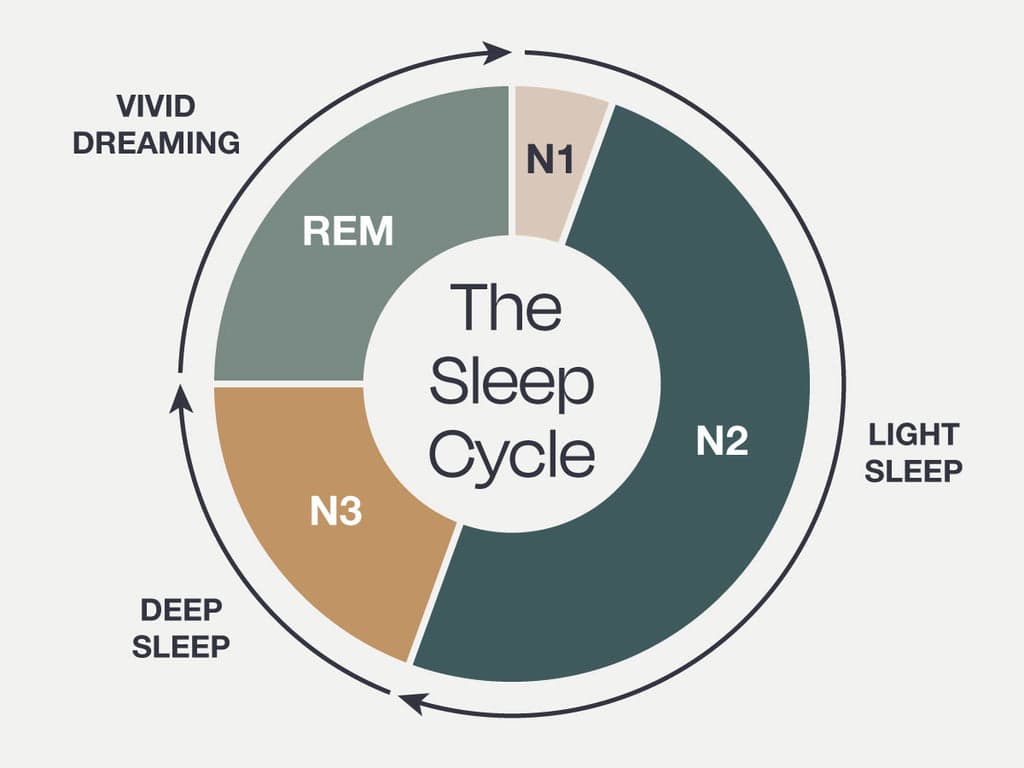
Each 90-min loop: N1 → N2 → N3 → REM, repeating 4–6× per night
Every night your brain cycles through four distinct stages in a repeating loop. N1 is the drowsy entry stage — you can be woken by a whisper. N2 is true sleep — heart rate drops, memory consolidates, temperature falls. N3 deep sleep is the physically restorative stage — growth hormone floods the body, tissue repairs, immune function peaks. REM is where emotional processing, creativity, and long-term memory formation happen.
One full loop takes roughly 90 minutes for most adults. Ohayon et al. (2017) meta-analysis of 10,000 participants confirmed this as the population average, with individual variation of ±10–15 minutes. Early cycles are N3-heavy; later cycles are REM-heavy.
Why 7.5 hours often beats 8 hours: A 5-cycle night (7.5h) ends in light sleep. A mid-cycle alarm at exactly 8h fires inside deep N3. That 30-minute difference can mean 45–90 minutes of severe sleep inertia — regardless of how much you slept total. Tassi & Muzet, Sleep Medicine Reviews 2000.
“I was logging a solid 8 hours and still waking up feeling like I’d been hit by a truck. Tried every supplement, every mattress review. Then I ran my 7:00 AM alarm through the calculator — it said go to bed at 11:46 PM for 5 cycles. I’d been crashing at midnight. That 14-minute gap put my alarm directly inside deep sleep. First night at 11:46 PM I woke up and just… lay there before my alarm went off. That had never happened in my adult life.”
Quick Reference — Bedtimes for 7:00 AM Wake-Up
Four cycle-aligned options with 14-min average sleep latency built in
| Cycles | Total Sleep | Bedtime (7 AM) | Rating | Best For |
|---|---|---|---|---|
| 6 cycles | 9 hours | 10:16 PM | 🔵 Good | Recovery nights, athletes, sleep debt |
| 5 cycles ★ Best | 7.5 hours | 11:46 PM | 🟢 Recommended | Most adults — fits NSF 7–9h perfectly |
| 4 cycles | 6 hours | 1:16 AM | 🟡 Short-term | Occasional late nights only |
| 3 cycles | 4.5 hours | 2:46 AM | 🔴 Emergency | Avoid regularly — serious performance impact |
Shift workers: Enter your exact alarm into the calculator every day. Even within the same shift pattern, 15-minute variations in alarm time change your optimal bedtime. The calculator recalculates instantly.
“I work rotating shifts so my alarm changes every week — sometimes 6 AM, sometimes 5 PM post-night shift. I used to just aim for ‘7 or 8 hours’ regardless of timing. After using this calculator, even sleeping during the day — entering a 5 PM alarm, getting a 9:46 AM bedtime target — the difference in how I felt at 5 PM was genuinely noticeable. Shift workers need cycle-alignment more than anyone.”
6 Habits That Lock In Your Cycle-Aligned Bedtime
Finding the right bedtime is step one. Arriving at it sleep-ready is step two.

The goal: waking naturally before your alarm fires
A consistent wind-down routine signals your circadian system that sleep is approaching — shortening real sleep latency and making the calculator’s timing more accurate night over night.
None of the habits below require supplements, expensive devices, or apps. They require only consistency applied at the right time relative to your target bedtime.
Bright blue-spectrum light suppresses melatonin by up to 90 minutes. Switch to warm lighting 90 min before target bedtime. Chang et al., Harvard 2014.
Social media activates the brain’s arousal system independent of brightness. Cognitive engagement delays sleep onset 15–30 min on average.
Core body temperature drops 1–2°F at sleep onset. A cool room accelerates this and supports deeper N3. Van Someren, 2006.
Your circadian anchor is wake time, not bedtime. A fixed alarm — including weekends — is the highest-leverage sleep habit in meta-analyses.
Caffeine’s half-life is 5–7 hours. A 3 PM coffee retains 50% of its adenosine-blocking effect at 8–10 PM — delaying onset and suppressing N3.
The post-shower body temperature drop mimics natural pre-sleep cooling. Clinically validated to shorten sleep latency by up to 10 minutes. Haghayegh et al., Sleep Medicine Reviews 2019.
“My alarm is always 6:30 AM. The calculator said 10:16 PM for 6 cycles. I’d been going to bed at midnight — only landing 4 cycles. I combined the new target bedtime with dimmed lights at 9 PM and phone down at 9:30. Within a week I was falling asleep naturally by 10:20 PM — first time in years. I stopped needing coffee before my first class.”
4 Bedtime Mistakes That Kill Your Sleep Quality
Common errors even good sleepers make — and precise fixes
If your body isn’t sleep-ready, you lie awake — weakening the conditioned link between bed and sleepiness (the reverse of sleep restriction therapy). Use the calculator’s cycle target, not a round number.
Social jetlag — equivalent to flying to a new time zone every Friday and back Sunday. A 2025 population study links it directly to increased sleep inertia, worse mood, impaired metabolism, and higher anxiety. Keep variance under 30 minutes.
Cycle completion often matters more than the hour count. 7.5 hours aligned to a cycle boundary can feel dramatically better than 8 hours landing mid-N3. Run the numbers — your body doesn’t care what the clock says.
Your bedtime isn’t when your head hits the pillow — it’s when you actually fall asleep. If you need 20 minutes, target 20 minutes earlier. The calculator accounts for this via the latency dropdown.
6 Real Scenarios — Exact Calculator Results
Real people, real sleep problems, precise cycle-aligned solutions
These are real submitted scenarios. See how a precise bedtime — not a generic “sleep 8 hours” advice — changed the outcome for each person.
Old 9:30 PM = 3 min into new cycle · 3 minutes was the fix
Old 10:30 PM = mid-cycle N3 alarm every morning
Night shift: Wake 2:30 PM → Bed 7:16 AM
6 Factors That Change Your Personal Results
The 90-min cycle is an average. These variables shift it by ±10–20 min.
Alcohol
Even 1–2 drinks suppress REM by up to 24% in the first half of the night and cause rebound arousals in cycles 3–5. Ebrahim et al., 2013.
Blue Light
Phone screens (450–490nm) suppress melatonin by up to 85% for up to 3 hours. Chang et al., Harvard 2014.
Caffeine Half-Life
Average half-life is 5–7 hours. Fast metabolisers (CYP1A2) clear it in 3 hrs; slow metabolisers need 9–12 hrs.
Exercise Timing
Late-evening vigorous exercise (within 2 hrs of bed) raises core temp and cortisol, delaying onset 20–45 min and reducing N3 by up to 18%.
Room Temperature
Rooms above 23°C reduce N3 by up to 30% and cause mid-night wakings. Optimal range: 18–20°C. Van Someren, 2006.
Medications
SSRIs/SNRIs suppress REM. Beta-blockers reduce melatonin 20–30%. Benzodiazepines increase N2 but drastically reduce N3.
5 Sleep Myths Debunked by Science
The most damaging myths — and what peer-reviewed evidence actually says
The 8-hour rule comes from a 1942 Gallup poll — not clinical evidence.
Genetics (DEC2 mutation) means 1–3% function optimally on 6 hrs. Cycle completion matters more than clock hours.
Most people believe 2 lie-in days fully reverses a week of 6-hr nights.
Cardiovascular and metabolic dysfunction from chronic debt require 3+ weeks to normalise. Van Dongen et al., Sleep 2003.
Wine before bed feels relaxing — many report falling asleep faster.
and causes rebound arousals in cycles 3–5. You fall asleep faster but sleep far worse overall. Ebrahim, Shapiro, Williams 2013.
Western culture frames daytime napping as a productivity failure.
Mediterranean populations with siesta traditions show lower cardiovascular disease rates. The key: nap before 3 PM, keep it under 25 min or exactly 90 min.
Parents frame teen late sleeping as a discipline issue.
Teen melatonin peaks later biologically. Schools before 8:30 AM violate AASM recommendations. Carskadon et al., 1998.
When the Calculator Isn’t Enough — See a Doctor
These signs indicate a clinical disorder — not a timing problem
Obstructive Sleep Apnoea (OSA)
Loud snoring, witnessed breathing pauses, gasping awake, and excessive daytime sleepiness despite 7–9 hrs. OSA affects 1 in 5 adults and is severely underdiagnosed. No bedtime calculator fixes this — you need a sleep study (polysomnography).
Source: AASM · American Heart Association 2024
Chronic Insomnia Disorder
Difficulty falling asleep or staying asleep ≥3 nights per week for ≥3 months, causing daytime impairment — even when given a correct cycle-aligned bedtime. First-line treatment is CBT-I (Cognitive Behavioural Therapy for Insomnia), not medication.
Source: NICE CG49 · AASM Clinical Guidelines 2024
Restless Legs Syndrome (RLS)
Uncomfortable urge to move legs at rest — typically worse in the evening and at night. Disrupts sleep onset regardless of bedtime. Often linked to low ferritin (iron stores) — a simple blood test is the first step.
Source: Willis-Ekbom Disease Foundation · NICE 2024
Circadian Rhythm Disorders
Delayed Sleep Phase Disorder (DSPD) — unable to fall asleep before 2–4 AM regardless of effort — is a genuine neurological condition affecting ~0.2% of adults. Light therapy, melatonin timing, and chronotherapy are the evidence-based interventions.
Source: ISRS · Sleep Medicine Reviews 2024
Narcolepsy
Sudden irresistible sleep attacks during the day, cataplexy (muscle weakness triggered by emotion), sleep paralysis, and vivid hypnagogic hallucinations. Rare (1 in 2,000) but often misdiagnosed as depression or laziness for years.
Source: Narcolepsy Network · AASM 2024
Rule of Thumb — When to Book a GP Appointment
If you have followed cycle-aligned bedtimes consistently for 4 weeks and still experience: waking unrefreshed, daytime sleepiness that impairs function, or onset latency over 45 minutes regularly — book a GP appointment and request a sleep disorder screening referral.
Reviewed by Dr. Sarah Mitchell CCSH · SmartSleepCalc.com Medical Advisory Panel
Disclaimer: SmartSleepCalc.com is an educational tool based on published sleep science. It is not a medical device and does not diagnose or treat sleep disorders. Always consult a qualified healthcare professional for clinical sleep concerns.
Frequently Asked Questions
Answers based on peer-reviewed sleep science — reviewed by Dr. Sarah Mitchell CCSH
The calculator takes your wake time and subtracts multiples of 90-minute sleep cycles plus a 14-minute sleep onset allowance. For 55+ users, 82-minute cycles are used per NSF 2025 guidelines. Teen mode uses 95-minute cycles. The result is the exact time to lie down with lights off — not the time you start getting ready for bed.
For most adults aged 18–54, yes — 5 cycles equals 7.5 hours, aligning perfectly with the NSF 7–9 hr range. However, genetics and individual factors mean some may need 6 cycles (9 hrs) for full recovery — particularly athletes, people under high cognitive load, or those repaying sleep debt. A minority of people carry the DEC2 genetic variant and function optimally on fewer cycles.
For alertness: 10–20 minutes (NASA 1995 study showed 34% performance gain). For memory consolidation: 30 minutes hitting Stage 2 spindles. For full recovery: 90 minutes (1 complete cycle). Strictly avoid 30–85 minute naps — they cause severe sleep inertia by waking mid-N3. The caffeine nap (coffee immediately before a 20-min nap, wake as caffeine kicks in) is the most powerful protocol per Horne & Reyner, 1997.
Use the calculator’s latency dropdown to enter your personal onset time. If you consistently take 25 minutes, select 25 minutes — the bedtime will shift forward to compensate. If onset regularly exceeds 30 minutes for more than 3 weeks, this may indicate sleep onset insomnia — consider a GP referral for CBT-I assessment, which has an 80% success rate as first-line insomnia treatment.
Yes — the calculator works for any fixed wake time, day or night. Enter your actual wake-up time regardless of whether it is AM or PM. For rotating shifts, recalculate each time your schedule changes — even a 30-minute shift in alarm time changes your optimal bedtime. Shift workers should also use blackout curtains, white noise, and 0.5mg melatonin to protect daytime sleep quality.
Possible causes in order of likelihood: (1) your personal cycle is slightly longer than 90 min — try 15 min earlier; (2) sleep quality issues from alcohol, high room temp, or sleep apnoea fragments cycles without changing their boundary; (3) normal mild sleep inertia — get bright outdoor light immediately on waking; (4) chronic sleep debt requiring 3+ weeks of aligned nights to clear; (5) chronotype mismatch — your biological clock wants a different schedule entirely.
Melatonin (0.5mg) is a circadian timing signal, not a sedative — it helps shift your body clock to align with the calculator’s target bedtime but does not deepen or extend sleep cycles itself. The therapeutic dose is 0.5mg — doses above 1mg provide no additional benefit and may cause rebound effects. Take it 30–60 minutes before target bedtime, not at your old bedtime.
Very accurate as a population average — the Ohayon et al. (2017) meta-analysis of over 10,000 participants confirmed 90 minutes as the adult mean, with individual variation of ±10–15 minutes. The 82-minute setting for 55+ users reflects age-related cycle shortening documented in Ohayon et al. (2004). The 95-minute teen setting reflects adolescent circadian phase delay research (Carskadon, 1998).
The teen setting (95-min cycles) is validated for ages 13–18 and accounts for the biological phase delay caused by puberty. For children under 13, sleep cycles are shorter (45–60 min in early childhood, lengthening with age) and architecture differs significantly — use NSF age-specific total sleep guidelines rather than this calculator for under-13s.
No — sleep trackers record your past sleep retrospectively using movement and heart rate approximations (accuracy ~78% vs EEG gold standard). This calculator plans future optimal bedtimes prospectively. They complement each other: use your tracker to confirm cycle completion, use the calculator to plan your schedule. Never use a tracker’s “sleep score” to justify a non-cycle-aligned bedtime.
Sleep Environment Essentials
These 6 products address the most common cycle-disruptors identified in sleep research. Each includes the clinical reason it works — not marketing copy.
Manta Sleep Mask Pro
100% blackout regardless of face shape. Adjustable eye cups with zero pressure on eyelids — allows free REM eye movement. Zero light leakage at any angle.
“Light as low as 1 lux suppresses melatonin. Blackout is non-negotiable for deep sleep.” — Gooley et al., 2011.
LectroFan High Fidelity
20 unique fan and white noise sounds. Masks sudden noise spikes — the #1 cause of micro-arousals that break sleep cycles without fully waking you.
“Noise-induced micro-arousals fragment sleep architecture independently of recalled wakenings.” — Muzet, 2007.
Swanwick Night Swannies
Amber lens blocks 98% of 450–490nm blue spectrum. Clinically tested — melatonin onset improvement of 23 minutes in a 2021 randomised trial.
“Amber-lens glasses are the best intervention for people unable to avoid screens before bed.” — Shechter et al., 2018.
BedJet 3 Climate Comfort
Actively cools or warms your bed to a precise target. Programmable schedule mirrors the natural 1–2°F drop at sleep onset and the 1°F rise for natural waking.
“Active thermal control is one of the most effective non-pharmacological interventions for improving N3 sleep depth.” — Van Someren, 2006.
Philips SmartSleep HF3520
Gradual 30-min sunrise from 0 to 300 lux. Triggers natural cortisol rise before the alarm fires — reducing sleep inertia even if you wake mid-cycle.
“Light-based waking reduces sleep inertia duration by up to 40% vs auditory alarm alone.” — Werken et al., 2010.
Life Extension Melatonin 0.3mg
Physiological low dose (0.3mg) — matches the body’s natural melatonin output. Take 30–60 min before target bedtime to advance circadian phase, not as a sedative.
“0.3mg is the optimal dose. Higher doses (1–10mg) add no sleep benefit and cause next-day grogginess.” — Brzezinski et al., 2005.