Napping After Exercise: When to Nap, How Long, and the Temperature Conflict Explained
Exercise Recovery Science Napping After Exercise: The Timing Guide The challenge with napping after exercise is not tiredness — it is physiology. Vigorous exercise raises core body temperature by 1–2°C above baseline. Sleep onset requires a decline in core temperature. Attempting to nap too soon after training means trying to sleep while your body is…
Am I Napping Too Much? Normal vs Symptomatic | SmartSleepCalc
Excessive Napping — Health-Aware Guide Am I Napping Too Much?Normal Napping vs When to See a Doctor Daily napping is healthy for most adults — but irresistible daytime sleepiness despite adequate night sleep is a different situation that can have a medical cause. This guide helps you tell the difference. SmartSleepCalc • YMYL health-adjacent •…
60-Minute Nap: Who Needs It, Who Doesn’t & How to Recover From It
60-Minute Nap — Honest Situational Guide The 60-Minute Nap:Who Needs It, Who Doesn’t & How to Recover A 60-minute nap is rarely the right choice. It is not a longer power nap — it is a different tool entirely, with genuine N3 deep sleep benefits, significant grogginess risk, and a very specific set of situations…
15-Minute Nap: Built-In Timer, Fast-Sleep Science & Who It Works For
15-Minute Nap — Start Timer Now The 15-Minute Nap:Built-In Timer, Fast-Sleep Techniques & Science For fast sleepers only. Start the countdown immediately, learn how to fall asleep in under 5 minutes, and understand exactly what your brain does in 15 minutes — and whether this nap is even right for you. SmartSleepCalc • Tietzel &…
30-Minute Nap: N3 Grogginess Risk, Benefits & Who Should Use It
30-Minute Nap — Honest Risk Assessment The 30-Minute Nap:Benefits, Grogginess Risk & Who Should Use It Most guides list benefits without explaining the significant N3 entry risk. This page tells you exactly who should and should not use 30-minute naps — including a personalised risk estimator based on your sleep profile. SmartSleepCalc • AASM Polysomnography…
20-Minute Nap: Neurological Timeline, N2 Benefits & Exact Setup
20-Minute Nap — Neurological Science Guide The 20-Minute Nap:What Happens Every Minute A minute-by-minute neurological timeline, the N2 sleep spindle mechanism, 5 evidence-backed benefits, and exactly how to set it up — the most detailed 20-minute nap guide available. SmartSleepCalc • Tietzel & Lack 2001 • Horne & Reyner 1997 • AASM Polysomnography • Gujar…
7 Types of Naps: Power, Prophylactic, Recovery & More | SmartSleepCalc
Nap Science — Complete Type Guide 7 Types of Naps Explained:Power, Prophylactic, Recovery & More Most guides list durations. This guide covers the seven functionally distinct nap types — each with a different goal, mechanism, and evidence-based protocol. Includes expanded deep-dives on prophylactic, recovery, and appetitive naps, plus an interactive decision tree. SmartSleepCalc • NASA…
Benefits of Napping by Duration: Memory, Mood, Cardiovascular & More
Nap Science — Evidence-Based Benefits Guide The Real Benefits of Napping:Duration, Mechanism & Research Not all nap benefits are equal across durations. This guide specifies which benefits require which duration — cardiovascular, athletic, cognitive, and emotional — with mechanisms and studies behind every claim. SmartSleepCalc • Tietzel & Lack 2001 • Mednick 2003 • Naska…
Power Nap Science: 20-Min Guide, Caffeine Protocol & Alertness Timelines
Power Nap Guide — Science, Timing & Alertness Timeline | SmartSleepCalc Power Nap Science — Evidence-Based Guide Power Naps: The Science of20-Minute Alertness Restoration Adenosine mechanism, caffeine nap protocol, minute-by-minute alertness timeline, and duration guide — everything required to nap with the precision of a NASA pilot study. SmartSleepCalc • NASA 1995 • Horne &…
Nap science guides
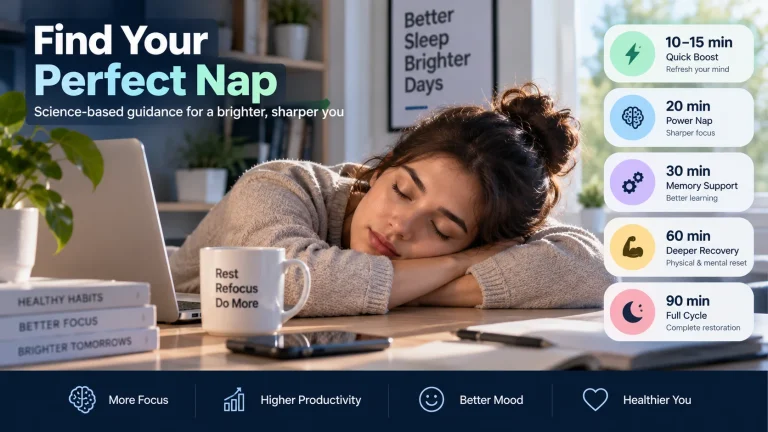
Napping is one of the most research-validated performance interventions available to any person, at any income level, with no equipment required — yet most workplace cultures still treat it as a sign of laziness. This hub covers the actual evidence. NASA’s 1995 study found a 26-minute nap improved pilot alertness by 100% and performance by 34%. Karolinska Institute research links regular napping habits to measurably lower cardiovascular risk. And granular neuroscience now maps exactly what your brain does at 10, 20, and 90 minutes of sleep — with meaningfully different outcomes at each threshold. Every guide in this hub cites primary research, not wellness summaries of it.
New to nap science? Follow this reading path. Start with Types of Naps to understand the taxonomy — not all naps are the same and the differences are biologically significant. Move to Best Time to Nap to find your personal optimal nap window based on your wake time and chronotype. Then read the Power Nap Guide for a complete breakdown of 20-minute nap science and technique. Finally, check Nap Hours by Age to understand how nap requirements shift from infancy through older adulthood. Then use the Nap Calculator to plan your first properly optimised nap.
Five findings that consistently surprise people: regular nappers show 37% lower cardiovascular mortality (Naska et al., 2007); a 20-minute nap outperforms 200mg of caffeine for sustained afternoon alertness; a 60-minute nap produces more post-sleep grogginess than either a 20-minute or a 90-minute nap; elite athletes napping between training sessions improve sprint performance by up to 3.6%; and your optimal nap window is not generically “1–3pm” — it is calculated from your individual wake time. Each of these findings is explored in full in the guides below.
A note on our standards: napping research is frequently overstated in popular media. We distinguish between single-study findings and meta-analysis consensus, between acute effects from one nap and chronic effects from a regular habit, and between findings in healthy adults and specific populations — shift workers, older adults, athletes. Where evidence is preliminary or the effect size is small, we say so directly.
