Waking Up During a Sleep Cycle
Why your alarm causes grogginess, how to fix it with cycle-aligned wake times, and how to estimate your personal cycle length if the standard 90-minute model does not fit you.
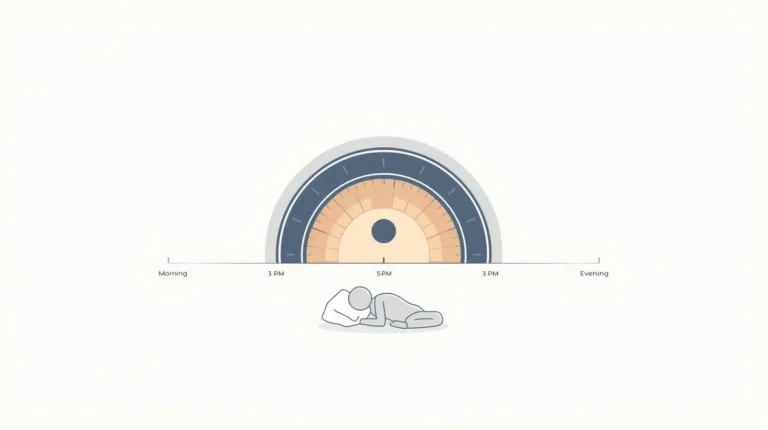
Sleep Inertia Duration by Stage
The severity of morning grogginess is determined by which sleep stage your alarm interrupts. N3 deep sleep produces the most severe and longest-lasting inertia. N1 and REM produce minimal impairment. This is why the same person can feel wide awake some mornings and heavily groggy others — the wake time relative to cycle position matters more than total sleep hours.
The goal of cycle-aligned waking is to catch yourself in N1 — the brief 3–5 minute light-sleep transition at the end of each 90-minute cycle. The sleep cycle calculator below finds bedtimes that place your alarm at these N1 transition points.
Why Fixed Alarms Cause Grogginess
Standard alarms do not know where you are in your sleep cycle. A fixed alarm set for 7:00am will wake you from wherever you happen to be in your current cycle — determined by your sleep onset time, your personal cycle length, and nightly variation. Small differences in when you fell asleep compound across 5–6 cycles into large differences in where the alarm lands.
Worked Example: The 7:00am Alarm
In this example, a 6:43am alarm would produce minimal grogginess. The 7:00am alarm catches N2 — producing 5–15 minutes of sleep inertia. If sleep onset were 30 minutes later (11:53pm), the 7:00am alarm could land mid-N3 — producing 20–40 minutes of significant inertia. The sleep cycle calculator estimates your personal cycle-end times from your bedtime and latency.
Cycle-Aligned Wake Times
Find Your Cycle-End Wake Times
Your cycle-aligned wake times
Open full sleep cycle calculator with all optionsEstimating Your Personal Cycle Length
The 90-minute average does not fit everyone. Sleep cycle length in adults ranges from approximately 75 to 105 minutes. If you consistently feel groggy at the times our calculator suggests, your personal cycle may be shorter or longer. The free-nap test can estimate it.
What to Do When You Wake Before Your Alarm
Spontaneous natural waking before your alarm is often a sign you are at or near a cycle end — the N1 transition window. What you do next determines whether you start the day feeling refreshed or create worse inertia than the alarm would have caused.
The 5 Most Common Causes of Waking Mid Sleep-Cycle — and the Specific Fix for Each
Not all mid-cycle waking has the same cause — and applying the wrong fix wastes time. The five causes below account for the vast majority of cases. Identifying which applies to you determines the correct intervention. Some causes are structural (alarm timing), some environmental (noise, temperature), and some physiological (alcohol, apnea, anxiety).
Alarm Timing Misaligned to Your Sleep Cycle
Most common · Most fixableThis is the most common cause of waking mid-cycle and — uniquely among the five — is entirely structural and addressable without lifestyle change. When your alarm is set to a fixed time that does not correspond to a cycle boundary, it fires during whichever sleep stage you happen to be in. Since N2 and N3 together occupy 60–75% of each cycle, the alarm statistically lands in a deep stage most mornings. The effect is compounded by nightly variability: even a 10-minute shift in how long it takes you to fall asleep changes where every subsequent cycle boundary falls, so the same alarm time produces different inertia severity night to night depending on sleep onset.
Noise and Environmental Disruption at Cycle Transitions
Common · Fixable overnightMid-cycle waking from external noise is most common at the N1/N2 transition windows between cycles — the lightest sleep stages that recur approximately every 90 minutes. During these transitions, the arousal threshold drops significantly: a sound that would not disturb you during N3 can fully wake you during the N1 transition. This timing-specific vulnerability explains why environmental noise sometimes wakes you and sometimes does not — the same sound has a dramatically different effect depending on which minute of the cycle it occurs in. Temperature fluctuations follow the same pattern: central heating activating, morning sunlight warming the room, or a partner’s movement can cause precisely timed awakenings at the predictable light-sleep windows.
Alcohol Rebound Waking in the Second Half of the Night
Very common · Immediately reversibleAlcohol sedates for 3–5 hours via GABA-A receptor enhancement, then its metabolism produces a stimulant rebound effect as acetaldehyde and other metabolites activate the sympathetic nervous system. This rebound causes waking in the second half of the night — typically 3–5 hours after consuming 2 or more standard drinks. The waking occurs precisely at a cycle transition, when sleep is already light, making return to sleep difficult. The characteristic experience is: falling asleep quickly and deeply, then waking around 2–4am feeling alert, anxious, or with a racing heart, and being unable to return to sleep effectively. Many people do not connect this pattern to the previous evening’s alcohol because the timing gap of 3–5 hours obscures the causal link.
Sleep Apnea Micro-Arousals
Requires medical evaluationSleep apnea causes repeated brief arousals when the upper airway partially or fully collapses during sleep, dropping blood oxygen saturation and triggering the brain to briefly activate and restore breathing. These arousals most often occur at the lightest point of each cycle — the N1 transition — and may not be consciously remembered as waking events. The result is sleep that feels non-restorative despite adequate duration: the person slept 7–8 hours but the repeated cycle-transition disruptions prevent deep N3 accumulation. Recognisable signs accompanying the mid-cycle waking pattern: loud or irregular snoring, a partner reporting witnessed breath pauses, morning headaches (from overnight CO₂ accumulation), significant daytime sleepiness despite apparently adequate sleep duration, and waking with a dry mouth or sore throat.
Anxiety and Chronic Hyperarousal
Common · Responds to CBT-IAnxious individuals have elevated overnight cortisol and a chronically lower arousal threshold — the normal brief arousal that occurs at every cycle transition becomes a full waking episode rather than the unremembered micro-arousal it is for most sleepers. The mechanism: the HPA axis maintains higher sympathetic nervous system tone overnight, meaning the slight lightening of sleep at each N1 transition is enough to cross the threshold into conscious waking. The characteristic pattern is early-morning waking — typically between 3:00–5:00am — with an inability to return to sleep, accompanied by rumination, worry, or a sense of alertness that feels inappropriate for the time. This is physiologically different from insomnia driven by sleep onset difficulty: it specifically targets the cycle transition windows in the second half of the night when cortisol naturally begins rising toward its early-morning peak.
Frequently Asked Questions
Why do I always feel terrible when my alarm goes off?
Your alarm is consistently catching you mid-cycle — most likely during N2 or N3 sleep. This happens because your bedtime and fixed wake time do not align to complete whole 90-minute cycles. The fix is calculating your cycle-end times and adjusting either your bedtime or your alarm by 15–30 minutes. Use the mini calculator above with your exact bedtime and latency — it shows your N1 transition windows. Small adjustments can shift the alarm from mid-N3 (20–40 minutes of heavy grogginess) to end-of-N1 (2–5 minutes of minimal grogginess). If the calculator times still produce significant grogginess, your personal cycle length may differ from the 90-minute average — use the free-nap test in the section above to estimate it. Cycles shorter than 90 minutes are common (some adults have 80–85 minute cycles) and the standard calculator will consistently miss the N1 window for these individuals.
How do I stop waking up in the middle of the night?
Waking mid-cycle during the night is a different problem from alarm-related grogginess and requires different solutions. Night wakings are typically caused by: environmental disruptions (bedroom too warm above 19°C, noise, light), physiological needs (nocturia — needing the bathroom, more common with age and in men with prostate issues), sleep apnea causing repeated micro-arousals that break into consciousness, or anxiety and cortisol-driven early-morning waking (typically between 3–5am) that is a common symptom of stress and depression. The sleep cycle calculator addresses alarm timing only — it does not prevent night wakings. For persistent unplanned night wakings, the primary interventions are temperature management, removing fluids 2 hours before bed, sleep apnea evaluation if snoring or breathing pauses are present, and stress management for early-morning cortisol waking.
Is waking between sleep cycles normal?
Brief waking at the end of each sleep cycle — during the N1 transition — is completely normal and happens to every adult every night. In most cases these micro-arousals last 30–120 seconds and are not remembered in the morning. What distinguishes normal cycle-transition arousal from problematic waking is: duration (seconds vs. minutes), whether return to sleep is immediate and effortless, and whether the waking is conscious and remembered. Adults typically have 4–6 of these transition arousals per night. They only become a problem when: the arousal threshold is lowered by anxiety or alcohol, the environment provides a stimulating signal at that moment (noise, light, temperature change), or sleep apnea extends the arousal into a full breathing event. The calculator and causes section above address all of these scenarios.