Power Naps: The Science of
20-Minute Alertness Restoration
Adenosine mechanism, caffeine nap protocol, minute-by-minute alertness timeline, and duration guide — everything required to nap with the precision of a NASA pilot study.
What a Power Nap Is — and How It Works
The term “power nap” was coined by social psychologist James Maas of Cornell University to describe a short sleep specifically designed to maximise alertness restoration with minimal sleep inertia. A power nap is defined not by an arbitrary duration but by its goal: to reach N2 sleep (gaining the cognitive benefits of sleep spindles) while ending before N3 deep sleep entry.
The adenosine mechanism — why power naps work
Power naps work by temporarily reducing adenosine — the sleep-pressure chemical that accumulates in the brain throughout the day, binding to adenosine receptors and creating the sensation of sleepiness. During a 20-minute nap, adenosine clearance reduces sleep pressure without fully depleting it — restoring alertness for 1.5–3 hours without disrupting your ability to sleep that night. This is the key distinction from a full sleep cycle: a power nap borrows against your sleep pressure without paying it back, while a full night’s sleep clears the adenosine debt completely.
Why power naps exist: the circadian alertness dip
A natural decline in alertness occurs in virtually all humans approximately 7–8 hours after waking — typically between 1pm and 3pm. This is a circadian phenomenon (a secondary oscillation in the alertness rhythm) independent of meal timing. The post-lunch dip is not caused by lunch; it occurs even when subjects fast. This dip creates a biological nap window during which sleep onset is accelerated and the benefits of a short nap are maximised.
Research evidence — what the studies show
NASA’s 1995 study of long-haul pilots found that a 40-minute scheduled nap improved performance by 34% and alertness by 100% compared to no-nap controls. Mednick et al. (2003) showed that a midday nap containing both slow-wave and REM sleep reversed performance deterioration across a full day of testing — to the same degree as a full night of sleep for specific cognitive tasks.
Power Nap Duration Guide
Three durations, three different risk/benefit profiles. Choosing the right one depends on your available time, tolerance for post-nap grogginess, and whether you need to perform immediately on waking.
The Caffeine Nap Protocol
The caffeine nap is the most evidence-based power nap enhancement — and it is the centrepiece of this guide, not a footnote. Here is the mechanism, the landmark study, and the exact protocol.
Horne & Reyner (1997) — published in Psychophysiology
Subjects in a driving simulator were given one of four conditions: (A) caffeine alone, (B) a 15-minute nap alone, (C) caffeine + nap immediately before the nap, or (D) placebo. Group C (caffeine nap) made significantly fewer driving errors than all other groups — outperforming caffeine alone, sleep alone, and placebo. The study used 150mg caffeine (roughly 1.5 standard cups of coffee). This is the only published study to demonstrate that a combination of caffeine and sleep outperforms each alone in a real-world performance task.
Post-Nap Alertness Timeline
How long does the alertness boost last after each nap duration? Each bar shows the grogginess window, peak alertness window, and gradual decline — proportional to real time.
Power Nap Alertness Timeline — Minute by Minute After You Wake
Most guides show how long a nap lasts. This section maps exactly what is happening neurologically in the first 30 minutes after a 20-minute power nap — phase by phase, neurotransmitter by neurotransmitter. Understanding this timeline tells you precisely when to schedule cognitive work, creative tasks, and physical performance relative to your nap end time.
Shift Work & Power Naps
For shift workers, power naps are not a convenience — they are a safety intervention. Studies of emergency medicine physicians, nurses, and air traffic controllers show that even brief naps during shifts measurably reduce medical errors, cognitive lapses, and accident rates.
Setting Up the Perfect Power Nap
Six environmental and behavioural factors with specific evidence notes. Each one is mechanistically justified — not a generic “tip”.
Best Time of Day to Nap
Nap timing affects both how quickly you fall asleep and whether the nap disrupts your night sleep. The circadian clock creates a narrow optimal window.
Frequently Asked Questions
How long should a power nap be?
For most adults, 20 minutes is the optimal power nap duration. It reliably reaches N2 sleep — where sleep spindles provide cognitive and alertness benefits — while consistently ending before N3 deep sleep entry (which causes sleep inertia). The 10-minute nap is better when you need to be functional immediately with zero grogginess risk. The 30-minute nap offers a longer alertness window but introduces a 30–40% chance of entering N3 and experiencing 15–20 minutes of post-nap grogginess. Individual variation exists — if 20 minutes causes grogginess, try 15 minutes or use a vibration-only alarm for a gentler wake.
How long after a nap do you feel the full benefit?
For a correctly timed 20-minute power nap: the full benefit arrives at minutes 9–15 post-wake. Minutes 1–3 involve minimal N2 sleep inertia. Minutes 4–8 show norepinephrine rising with reaction time approaching baseline and mood improving. The peak alertness window — minutes 9–15 — is when NASA (1995) measured 34% performance improvement and 100% alertness improvement. This window is sustained for 2–3 hours. The caffeine nap accelerates the benefit: caffeine arrives in minutes 4–8, amplifying the natural norepinephrine recovery and extending the alertness window into the early evening via its 5–6 hour half-life.
Does napping during the day affect night sleep?
A well-timed power nap (10–30 minutes, ending before 3pm) reduces sleep pressure modestly but not enough to meaningfully impair night sleep for most adults with regular schedules. Research consistently shows that brief afternoon naps do not delay sleep onset or reduce total night sleep duration. However, naps longer than 60 minutes, or naps taken after 4pm, carry a meaningful risk of delaying night sleep onset by 30–60 minutes. If you experience night sleep disruption after afternoon napping, reduce nap duration to 10–15 minutes or move the nap earlier — before 1pm. People with insomnia disorder are the exception: any daytime napping may reduce the homeostatic sleep pressure needed for CBT-I sleep restriction therapy and should be discussed with a clinician.
What is a caffeine nap and does it actually work?
A caffeine nap involves consuming 80–150mg of caffeine immediately before a 20-minute nap. Caffeine takes approximately 20–25 minutes to reach peak plasma concentration — it arrives just as you wake. During the nap, adenosine is partially cleared from receptors. When caffeine arrives, it blocks those now-cleared receptors rather than competing with full adenosine occupancy. The result is greater alertness than either caffeine or a nap alone. Horne & Reyner (1997) confirmed this in a driving simulator study: the caffeine nap group made significantly fewer errors than all other conditions including caffeine-only and nap-only groups. Use the caffeine nap before 2pm to avoid disrupting night sleep.
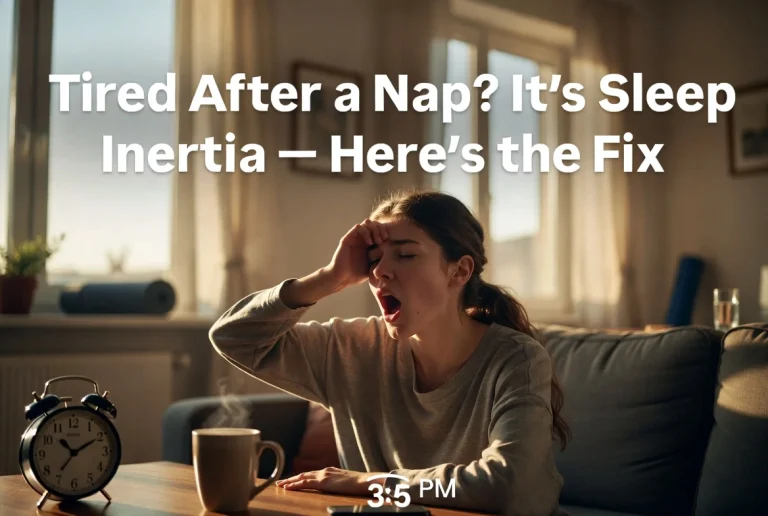
Why do I feel groggy after a nap?
Post-nap grogginess — sleep inertia — is caused by waking from N3 deep sleep. This happens when a nap extends beyond 25–30 minutes in adults with normal sleep latency. The brain is mid-way through a slow-wave sleep cycle, and the adenosine pressure is still suppressing arousal systems. The solution is strict 20-minute nap timing with an immediate alarm. If grogginess persists even after 20-minute naps, you are likely falling asleep faster than average (under 3 minutes) and reaching N3 within the 20-minute window — reduce to 15 minutes. Bright light immediately on waking compresses the grogginess window by accelerating cortisol rise and SCN re-stimulation.