The 30-Minute Nap:
Benefits, Grogginess Risk & Who Should Use It
Most guides list benefits without explaining the significant N3 entry risk. This page tells you exactly who should and should not use 30-minute naps — including a personalised risk estimator based on your sleep profile.
The 30-Minute Nap Problem: Why Most People Feel Worse
A 30-minute nap produces more grogginess than either a 20-minute or a 90-minute nap for most people. If you regularly feel worse after a 30-minute nap than before it — foggy, slow, difficult to think — this is exactly what sleep science predicts. It is not your imagination, it is not low caffeine, and it is not a sign you need more sleep. It is polysomnographic timing data. The question is not whether this effect is real. The question is: who are the few people for whom a 30-minute nap actually works?
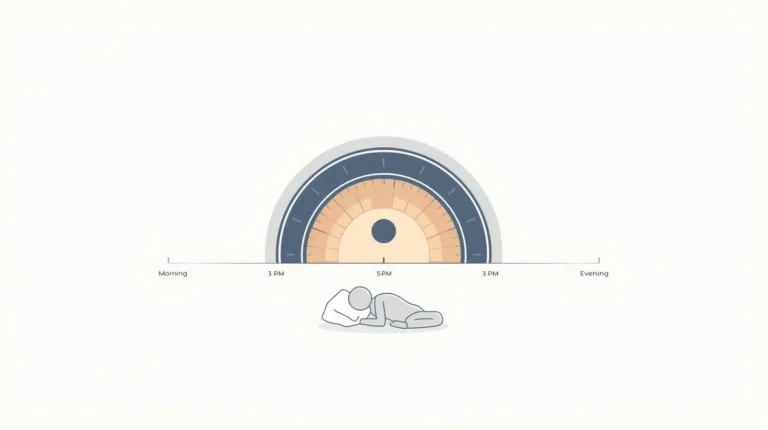
Population-level estimates based on AASM N3 onset timing data and average adult sleep latency of 7–14 min. Individual variation is significant — see risk estimator below.
Why 30 Minutes Causes Grogginess: The N3 Mechanism
Research comparing alertness after N2 waking vs N3 waking consistently shows: reaction time impaired by up to 30% in the first 20 minutes; working memory capacity reduced — you can recall information but processing speed drops; decision quality similar to 0.05% BAC — the legal drunk-driving threshold in most countries. In high-stakes contexts (surgery, driving, machinery, critical calls), this is not a minor inconvenience. This is why the 20-minute nap is the clinical default and the 30-minute nap requires individual assessment.
The 3 Justified Use Cases for a 30-Minute Nap
The 30-minute nap is not always wrong — it is wrong for most people, most of the time. These are the three sleep profiles where a 30-minute nap is genuinely appropriate.
Does the 30-minute nap work for your sleep architecture?
Take a 30-minute nap three times under the same conditions (1–3pm, same environment). Immediately upon waking, rate your grogginess on a 1–10 scale at the 10-minute post-wake mark — not immediately on waking (which includes normal sleep inertia for all durations), but 10 minutes later when that initial grogginess should have cleared. If you consistently score below 4 at the 10-minute mark, your sleep architecture likely keeps you in N2 for the 30-minute duration. If you score 5 or above consistently, switch to 20 minutes.
Better Alternatives If 30 Minutes Doesn’t Work for You
If you need more recovery than 20 minutes delivers, skip 30 and go to 90. A 90-minute nap completes a full sleep cycle — N1 → N2 → N3 → back to N1/N2 — and the alarm fires during light sleep exit, returning grogginess risk to below 10%, similar to the 20-minute nap.
The N3 Entry Risk: What Most Pages Don’t Tell You
A 30-minute nap sits at a physiological risk point for most adults. Approximately 30–40% of adults who nap for 30 minutes will enter N3 deep sleep within that window — and waking from N3 causes sleep inertia lasting 15–30 minutes. This does not make 30-minute naps bad. It means they require more planning than a 20-minute nap and are not appropriate when you need immediate post-nap alertness.
In healthy adults, N3 deep sleep typically begins 20–35 minutes after sleep onset. The documented range: earliest N3 in quick, deep-sleeping adults is approximately 15 minutes after sleep onset; average is 25–30 minutes; in older adults or light sleepers it may be 40+ minutes or may not occur at all in a short nap. A 30-minute alarm from lying-down means approximately 16–23 minutes of actual sleep (subtracting typical 7–14 minute latency) — placing the alarm near the N3 entry threshold for most adults.
N3 deep sleep is characterised by delta waves — the brain’s most energy-intensive repair state. Waking from N3 causes sleep inertia because adenosine levels remain elevated and the brain must transition from its most inactive state to wakefulness rapidly. Delta wave activity does not turn off instantly — the transition takes 20–40 minutes for full resolution. During this period, executive function, working memory, and reaction time are measurably impaired — in some research studies worse than being sleep-deprived.
If you factor in a 15-minute post-nap recovery buffer, the 30-minute nap can be highly effective — extended N2 time provides 3–4 hours of sustained alertness versus 1.5–2.5 hours from a 20-minute nap. The decision comes down to whether you can afford the recovery time. Total time investment: 45 minutes. Total alertness return: 3–4 hours. That is a better ratio than the 20-minute nap if you have the buffer available.
Your Grogginess Risk Estimator
Two factors determine whether you will enter N3 in a 30-minute nap: how quickly you fall asleep and how deeply you sleep. Answer both questions to see your personal risk level.
Benefits of a 30-Minute Nap (When N3 Is Avoided)
If your nap stays in N2 — or only briefly touches early N3 before the alarm sounds — the extended N2 time provides additional benefits beyond a 20-minute nap.
Who should use a 30-minute nap?
- Shift workers who benefit from extended alertness and can allow post-nap recovery
- Light sleepers or slow-to-sleep individuals (low N3 entry risk)
- Adults 55+ (N3 onset is later; grogginess risk lower)
- Anyone with 45+ minutes available and not under immediate post-nap pressure
- Students between study sessions with no immediate exam or performance task
- Quick, deep sleepers — high N3 entry probability (use 20-min instead)
- Anyone who needs to be fully alert immediately after waking
- Before driving, operating machinery, or critical safety tasks
- After 3pm (risk of disrupting night sleep is increased)
- During acute illness with fever (sleep architecture is altered; N3 entry unpredictable)
Post-Nap Protocol for 30-Minute Naps
If you experience grogginess after a 30-minute nap, these five steps clear it faster. Order matters — each step targets a different clearance mechanism.
Frequently Asked Questions
Is a 30-minute nap too long?
For many people, 30 minutes sits in an awkward zone — long enough to risk entering N3 deep sleep (and its associated grogginess), but not long enough to complete a full sleep cycle (90 minutes) and wake from light sleep naturally. Whether 30 minutes is “too long” depends on your sleep profile: quick, deep sleepers face high grogginess risk at 30 minutes and should use 20 minutes instead; light or slow-to-sleep individuals can nap for 30 minutes with low risk. Use the estimator above to find your personal risk level. If in doubt, the 20-minute nap is the lower-risk default for most adults.
How do I avoid feeling groggy after a 30-minute nap?
Three strategies reduce grogginess risk: (1) Shorten the nap — set your alarm for 25 minutes instead of 30, reducing N3 entry probability without significantly reducing N2 benefits; (2) Use a vibration or gradual-wake alarm — gentler transitions from sleep reduce inertia severity compared to sudden loud alarms; (3) Build in recovery time deliberately — accept that a 30-minute nap may need 10–15 minutes of grogginess clearance and plan accordingly. Do not attempt cognitively demanding tasks in the first 10–15 minutes after a 30-minute nap if you fell asleep quickly.
Will I always wake groggy from a 30-minute nap?
Not always — individual variation exists. But the probability is high enough (40–60% for average adults) that 30 minutes is not the recommended default. Whether you personally experience grogginess depends on your sleep latency and sleep depth profile. Use the grogginess risk estimator above and the three-nap self-test protocol to determine whether 30 minutes works for your specific sleep architecture before making it a routine.
Is a 30-minute nap better than a 20-minute nap?
For most adults, no — the 20-minute nap is the better default because it reliably delivers N2 sleep with a grogginess risk under 10%, requires no post-nap recovery buffer, and can be used in more contexts (including before driving). The 30-minute nap only outperforms the 20-minute nap when: your sleep latency is 15+ minutes (making actual sleep time equivalent), you have confirmed through experience that you do not enter N3 in 30 minutes, or you have 45 minutes total to invest and need 3–4 hours of alertness return. In all other cases, the 20-minute nap is the mechanistically superior choice.