Night Owls vs. Early Birds:
Intelligence, Creativity & What Science Really Says
You stay up late. You do your best thinking at night. But the world calls you lazy — and that label stings. Science tells a different story.
Are Night Owls Smarter and More Creative?
Yes — in some studies, and with important limits. A 2024 Imperial College London analysis of 26,000+ adults found evening types scored higher on memory, reasoning, and processing speed than morning types.
- Evening types scored +13.5% above morning types on cognitive tests
- Separate research links night owls to stronger divergent (creative) thinking
- But sleeping 7–9 hours had an even bigger effect than chronotype alone
What Is a Chronotype?
Your chronotype is your natural preference for when to sleep and be active. It is set by your biology — your genes, your age, your hormones. You did not choose it.
| Type | Peak Alert Window | Common Label |
|---|---|---|
| Morning type | Early morning (6–10 AM) | 🐦 Early bird / Morning lark |
| Intermediate | Mid-morning to afternoon | 😐 Neither type |
| Evening type | Late afternoon to night | 🦉 Night owl |
Most people sit in the middle. About 25% are true early birds. About 25% are true night owls.
Match your hardest tasks to your natural peak alert window whenever possible. A night owl doing deep work at 6 AM is working against biology — not with it.
The 4 Stages of Sleep — Why Each Matters
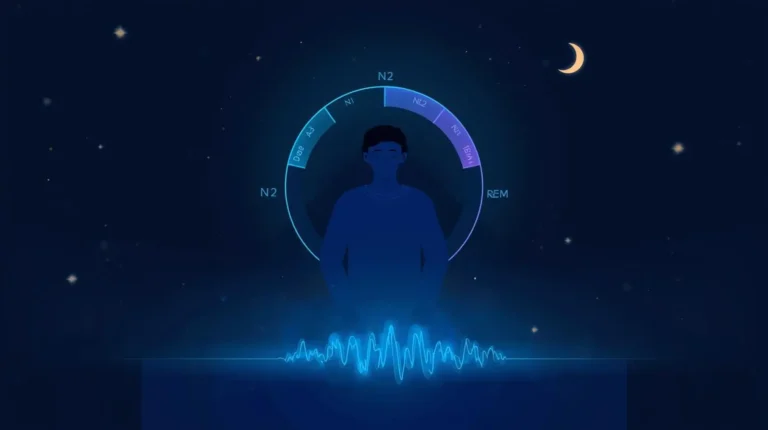
Whether you are a night owl or early bird, your brain needs all four sleep stages every night. Understanding them helps you protect the ones that matter most.
Stage 1 — N1
Light sleep. You drift in and out. Easy to wake. Lasts 1–7 minutes. Your body begins to relax — heart rate and breathing slow.
Stage 2 — N2
True sleep begins. Eye movements stop. Body temperature drops. Sleep spindles appear — key for memory consolidation.
Stage 3 — N3 (Deep)
Slow-wave deep sleep. Hardest to wake from. Body repairs tissue, builds muscle, strengthens immune system. Growth hormone released.
REM Sleep
Rapid Eye Movement. Brain is highly active. Dreams occur. Critical for creativity, emotional processing, long-term memory, and learning.
REM sleep is the phase most linked to creativity and intelligence. It peaks in the last 2 hours of a full 8-hour sleep window. Cutting sleep short by even 1 hour can eliminate up to 25% of your total REM. Use the REM Cycle Calculator to protect it.
What Science Says About Intelligence
2024 BMJ Public Health Study — 26,000+ Adults
Researchers at Imperial College London analysed UK Biobank data from over 26,000 adults. They tested memory, reasoning, and processing speed.
Evening types consistently outperformed morning types in both study cohorts. Intermediate types also scored above morning types. Morning types scored lowest overall.
The study controlled for age, sex, alcohol, smoking, and chronic disease.
| Chronotype | Cohort 1 Advantage | Cohort 2 Advantage |
|---|---|---|
| 🦉 Evening type | +13.5% | +7.5% |
| 😐 Intermediate | +10.6% | +6.3% |
| 🐦 Morning type | Baseline — lowest scores in both cohorts | |
The 10-Hour Wake Rule
One hour after waking, night owls and early birds perform equally on reaction speed tests. But after 10 hours of being awake, night owls perform significantly better — because their biological peak is still ahead, while early birds have already passed theirs.
Don’t judge a night owl’s intelligence by their 8 AM performance. Test them at 9 PM and the results look very different.
What Science Says About Creativity
Divergent Thinking
Studies tested morning and evening types on divergent thinking — the mental skill behind original ideas and creative problem-solving. Evening types scored higher on generating multiple unique solutions from a single prompt.
Drawing and Visual Creativity
A separate study used drawing tasks to test creative output. Night owls outperformed early birds on originality scores. Researchers attributed this to evening types’ tendency toward unconventional and novel solutions.
Reviews also found evening types showed stronger verbal creative abilities in some measures — directly challenging the idea that early rising equals better thinking.
If creative work is your priority, protect your late-night focused window. Don’t force creative output at 6 AM if your brain isn’t ready for it.
Find Your Perfect Sleep Timing
Your chronotype is fixed. Your sleep timing is not. Calculate your cycle-aligned bedtime in 10 seconds — free, no sign-up.
Try Sleep Calculator →The Most Important Finding Everyone Misses
The Imperial College study found sleep duration was a stronger predictor of cognitive performance than chronotype alone.
People who slept 7–9 hours scored best on all cognitive tests. People sleeping fewer than 7 hours or more than 9 hours scored significantly worse — regardless of whether they were night owls or early birds.
Being a night owl gives you a cognitive edge only if you also get enough sleep. A night owl running on 5 hours will score below a well-rested early bird every time. Check your sleep deficit with the free Sleep Debt Calculator.
Night Owls vs. Early Birds — Full Comparison
| Factor | 🦉 Night Owls | 🐦 Early Birds |
|---|---|---|
| Cognitive test scores | Higher in 2024 analysis | Lowest in same analysis |
| Peak alert window | Late afternoon to night | Early morning (6–10 AM) |
| Creativity research | Stronger divergent thinking | Excel at structured early tasks |
| After 10 hrs awake | Perform better | Performance fades |
| Optimal sleep duration | 7–9 hours | 7–9 hours |
| Main health risk | Social jetlag, mood issues | Evening performance drop |
| Scheduling advantage | Evening work + deep focus | Morning decisions + early meetings |
4 Common Myths — Busted
Early birds are always more successful
Not supported by cognitive research. Evening types consistently score higher on reasoning tests. Success depends on schedule fit and sleep quality — not wake time.
Night owls are just lazy
Chronotype is biological — set by genes and age. Teenagers are programmed to stay up late. Forcing early schedules creates measurable cognitive impairment.
You can just become a morning person
You can shift your schedule gradually with consistent wake times and morning light. But fully overriding your biological chronotype is not reliably achievable.
Less sleep means more productivity
Sleeping under 7 hours causes measurable decline in memory, reasoning, and speed — in both night owls and early birds. No chronotype thrives on chronic sleep restriction.
Tips and Best Practices by Chronotype
🦉 If You Are a Night Owl
- Schedule deep work from 8 PM–midnight
- Sleep 7–9 hours — non-negotiable for cognitive edge
- Fix your wake time daily — consistency anchors your clock
- Use 10 min of morning light to shift gradually earlier
- Protect REM sleep with the REM Calculator
🐦 If You Are an Early Bird
- Front-load hard decisions — 6 to 10 AM is your window
- Protect sleep before the evening arrives
- Use a strategic 20-min nap to restore afternoon alertness
- Avoid judging your output by your 8 PM performance
- Check debt with the Sleep Debt Calculator
Frequently Asked Questions
A 2024 study of 26,000+ people found evening types scored higher on memory, reasoning, and processing speed. But sleep duration of 7–9 hours had the strongest overall effect. A sleep-deprived night owl may score lower than a well-rested early bird.
Studies on divergent thinking found evening types produced more original and unconventional results. Visual drawing tests and verbal creativity reviews supported this pattern. The effect is strongest when night owls work during their natural peak hours.
Imperial College London’s 2024 study found 7–9 hours per night was optimal for memory, reasoning, and processing speed. Both under 7 and over 9 hours reduced performance significantly — for all chronotypes.
You can shift your schedule earlier with consistent wake times and morning bright light. Gradual 15-minute shifts over several weeks are realistic. But fully overriding your biological chronotype is not reliably achievable for most people.
Not inherently. The main health risks come from social jetlag — being forced into early schedules against your natural rhythm. Night owls on flexible schedules who sleep 7–9 hours can be just as healthy as early birds.
Tests are often given during or after morning types have already passed their natural peak alert window. It is not that they are less intelligent — their best hours arrive early and fade by afternoon. An early bird peaks at 7 AM but may be cognitively drained by 2 PM.
Yes. Adolescents have a biologically delayed circadian clock — melatonin peaks later than in adults. Forcing early school start times creates measurable cognitive impairment and mood problems in research studies. Later start times consistently improve grades and wellbeing.
Free Sleep Tools at SmartSleepCalc
Your chronotype is fixed. Your sleep timing is not. These tools help you work with your biology — not against it.
All tools free · No sign-up · No email · Results in 10 seconds
Your Brain Works Better With the Right Timing
Calculate your cycle-aligned bedtime in 10 seconds. Free. No sign-up. No email required.
🌙 Find My Perfect Bedtime📚 References
- Bhushan, B. et al. (2024). Sleep duration, chronotype, health and lifestyle factors affect cognition. BMJ Public Health, 2(1).
- Imperial College London. (2024). Being a ‘night owl’ is associated with mental sharpness.
- Kanazawa, S. & Perina, K. (2009). Why night owls are more intelligent. Personality and Individual Differences, 47(7).
- Kim, S. et al. (2024). Proper sleep hours to reduce cognitive decline by chronotype. PubMed / NCBI.
- Walker, M. (2017). Why We Sleep. Scribner.
- American Academy of Sleep Medicine. (2015). Recommended Sleep Duration Consensus Statement.