
Sleep Cycle Calculator
A sleep cycle calculator picks bedtimes and wake times that land near the end of a full 90-minute loop — not in the middle of deep sleep where most grogginess starts. Your brain cycles through N1, N2, N3, and REM about 4 to 6 times each night. This free tool finds your cleanest exit points, explains what each stage does, and tells you when persistent morning fog might mean more than bad timing.
Educational content only — not a substitute for medical advice. See our About Us page to learn who creates and reviews our content.

📸 Waking at the right point in your sleep cycle makes mornings feel completely different — regardless of total hours slept.
- 90 minAverage adult sleep cycle
- 4–6Cycles needed per night
- 14 minAvg. sleep onset latency
- 7.5 hrsOptimal 5-cycle target
- FreeNo registration required
🔬 New in 2026: UC Berkeley researchers mapped a real-time brain circuit in which deep N3 slow-wave sleep directly triggers hypothalamic growth hormone release via a dedicated neural pathway — confirmed as a causal mechanism, not merely a correlation. This means N3 sleep is actively running biological repair that cannot be replicated while awake, regardless of total sleep duration. Source: UC Berkeley / Sacramento Bee, April 2026.
Why This Sleep Cycle Calculator Works
You don’t sleep in one flat block. Your brain moves through N1, N2, N3, and REM stages, then loops back and starts again — about 4 to 6 times per night. Most adults complete one full loop in roughly 90 minutes.
Waking near the end of a cycle is easier because you’re in lighter sleep — usually N1 or late N2. Wake from the middle of N3 slow-wave sleep and sleep inertia can fog your mind for 20 to 40 minutes, no matter how long you were in bed.
Here’s what surprises most people: 7.5 hours often feels better than 8 hours. Five complete cycles fit neatly into 7.5 hours. Eight hours can push you 30 minutes into a new cycle — dragging you out during deep sleep instead of the lighter, easier end.
Calculate Your Sleep Times
Choose bedtime or wake time mode. Set your typical sleep onset latency — the default 14 minutes fits most adults. Hit Calculate for your 4 best sleep windows.
to see your best sleep windows.
The 4 Sleep Stages — What Each One Does
Each 90-minute cycle contains all four stages, but their proportions shift across the night. Understanding what each stage does explains why both N3 and REM are irreplaceable — and why cutting sleep from either end costs you more than just “a bit of rest.”
Sleep Duration by Age Group — NSF 2023 Recommendations
| Age Group | Recommended Hours | Cycles (90 min) | Optimal Target | Notes |
|---|---|---|---|---|
| Newborn (0–3 mo) | 14–17 hrs | 9–11 | Multiple naps | No consolidated cycle pattern yet |
| Infant (4–11 mo) | 12–15 hrs | 8–10 | Multiple naps + night | REM proportion very high (~50%) |
| Toddler (1–2 yr) | 11–14 hrs | 7–9 | 1 nap + night sleep | N3 increases, REM decreases |
| Preschool (3–5 yr) | 10–13 hrs | 6–8 | 10–11 hours | Naps optional after age 4 |
| School-age (6–13 yr) | 9–11 hrs | 6–7 | 9–10 hours | High N3 demand for growth |
| Teen (14–17 yr) | 8–10 hrs | 5–6 | 9 hrs / 6 cycles | Natural circadian delay — later melatonin onset |
| Young Adult (18–25 yr) | 7–9 hrs | 4–6 | 7.5 hrs / 5 cycles ★ | Transition from teen delay; still high REM need |
| Adult (26–64 yr) | 7–9 hrs | 4–6 | 7.5 hrs / 5 cycles ★ | N3 begins declining after ~35 |
| Senior (65+ yr) | 7–8 hrs | 4–5 | 7.5 hrs / 5 cycles | Less N3, more fragmented sleep, earlier wake times |
★ = Most commonly reported optimal. Individual variation of ±45 minutes is normal. Source: National Sleep Foundation 2023; Hirshkowitz M et al., Sleep Health (2015).
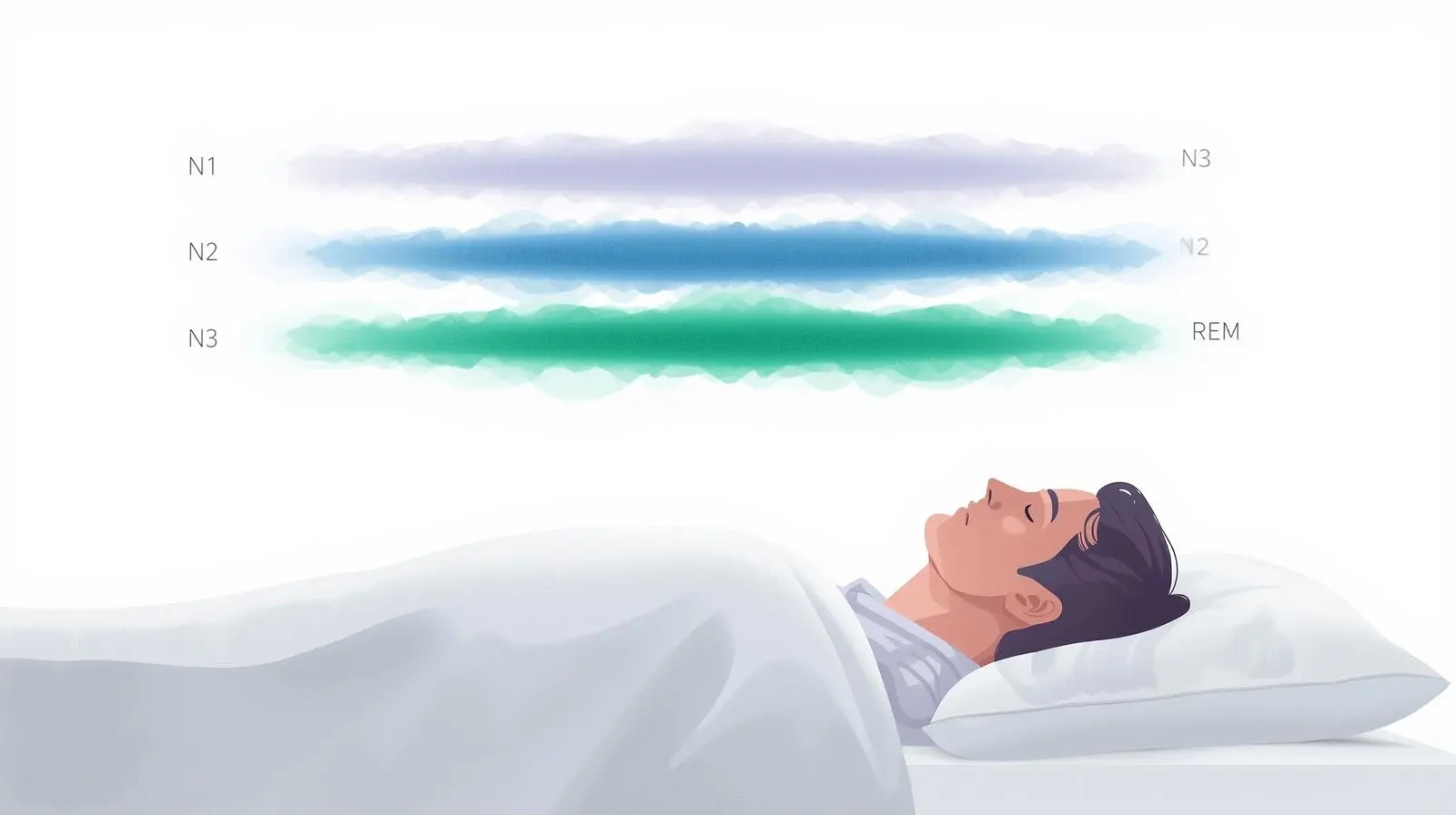
Sleep Cycle Stages — Full Night Infographic
This infographic shows how N1, N2, N3, and REM distribute across a typical 7.5-hour night (5 cycles). Note how N3 dominates early cycles and REM expands in later ones — the pattern your body uses to sequence physical repair before cognitive restoration.
Sleep stage distribution across a typical 7.5-hour adult night. Source: NIH StatPearls (2024) sleep architecture data.
Sleep Stage Hypnogram — Hour by Hour
A hypnogram maps your brain’s stage transitions across the night. The lower the line, the deeper the sleep. Notice how deep N3 dominates hours 1–3, while REM periods lengthen in hours 5–8.
Sleep Debt & Health Risk — What the Data Shows
Chronic short sleep is not just a performance issue. Independent of age, weight, and lifestyle, consistently sleeping fewer than 6 hours per night is associated with measurable increases in cardiovascular, metabolic, and cognitive risk. These figures come from CDC surveillance data and NIH-published research — not wellness marketing.
Sleep debt is the cumulative shortfall between your biological sleep need and what you actually get. It is not erased by one long weekend sleep — research suggests 1 week of 6-hour nights takes up to 11 days of recovery sleep to fully reverse cognitive and metabolic effects. The cycle calculator helps you stop adding to that debt by finding sustainable, cycle-aligned bedtimes you can maintain consistently.
Chronotype: Why Your Ideal Bedtime Is Not the Same as Everyone Else’s
A sleep cycle calculator gives you when to sleep based on a target time. Your chronotype determines what target time is biologically realistic for you. If you are a confirmed night owl forced to wake at 6 AM, no amount of cycle-alignment will feel like enough — because your circadian rhythm is still signallingsleep at that hour. Using the calculator with chronotype awareness gives you a much more honest result.
Natural sleep window: ~9:30 PM – 6:00 AM
Core body temperature drops earlier. Melatonin onset around 8–9 PM. Sleep pressure builds faster in the afternoon. Typically wakes naturally before 6:30 AM without an alarm.
Calculator use: Enter your natural wake time (e.g., 5:45 AM) and back-calculate 5 cycles to get an honest bedtime of ~9:31 PM. Attempting 11 PM as bedtime will place your alarm mid-cycle regardless of the math.
Natural sleep window: ~12:30 AM – 9:00 AM
Melatonin onset delayed to 11 PM–1 AM. Core temperature drops later. Social jetlag — the mismatch between biological and social clock — is the hidden driver of chronic sleep debt in ~25% of adults. Source: Roenneberg T, Current Biology (2019).
Calculator use: Enter your realistic fall-asleep time (12:30 AM), not your target. If a 7 AM alarm is non-negotiable, the result will honestly show 4 cycles — and you can plan your schedule accordingly.
Not sure of your chronotype? The most validated self-assessment is the Morningness–Eveningness Questionnaire (MEQ), developed by Horne & Östberg (1976) and still widely used in sleep research. It takes about 3 minutes and gives a score from extreme morning type (70+) to extreme evening type (≤30). Knowing your MEQ score before using this calculator helps you set a time target that works with your biology rather than against it.
How Real Americans Fixed Their Sleep — Before & After
These composites reflect patterns commonly reported by users applying cycle-aligned sleep timing. Names and details are illustrative — they represent the types of outcomes cycle-alignment produces, not specific individuals.

“I was sleeping 8 hours and still dragging through first period. Switching to 10:31 PM bedtime for 7.5 hours changed everything. I wake before my alarm now.”

“Same total sleep, completely different mornings. I was waking at 6:20 — 20 minutes into my 5th cycle. Moving to 6:30 means I wake at the cycle boundary. Night and day difference.”

“I used to nap randomly after shifts. Now I do a structured 90-minute pre-shift nap at 4 PM, then anchor sleep 8 AM–2 PM. The calculator showed me how to fit 4 clean cycles.”
2024–2026 Sleep Research Highlights
Sleep science has advanced significantly in the past two years. These four findings have the most direct implications for how you should think about sleep cycle timing.
N3 Sleep Triggers Growth Hormone — Confirmed Causal
Researchers mapped a dedicated neural pathway from slow-wave brain activity directly to the hypothalamus, confirming N3 sleep as an active biological repair trigger — not merely correlated with recovery. This changes how we understand what is lost when N3 is cut short.
Sleep Stage Physiology — Comprehensive Update
The 2024 NIH StatPearls update confirmed that the 90-minute average cycle applies broadly across healthy adults but with a range of 70–120 minutes. Individual variation is normal and does not indicate a disorder. Personalization of timing remains the most effective intervention.
Low REM Sleep Linked to Higher Mortality
Adults over 45 with consistently low REM percentages (under 15% of total sleep) showed significantly higher all-cause mortality over 12 years of follow-up. REM is concentrated in the final 1–2 cycles — the cycles most often cut by early alarms or late bedtimes.
Consistent Wake Time as the #1 Sleep Hygiene Intervention
The 2025 AASM sleep hygiene update elevated consistent wake time — same time every day including weekends — to the highest priority recommendation. A fixed wake anchor stabilizes the circadian rhythm faster and more durably than any supplement, light therapy device, or bedtime change alone.
6 Sleep Optimization Tips That Actually Work
These are not generic wellness suggestions. Each is supported by controlled research and directly affects sleep cycle quality or timing.
6 Sleep Myths Debunked by Research
Popular sleep advice is full of oversimplifications that persist despite clear contradicting evidence. These are the six most damaging myths — with what the research actually says.
Best Sleep Tools for Cycle Optimization (2026)
These products address the variables that most directly affect sleep cycle quality: temperature, light timing, sound masking, and accurate tracking. Each is linked to a specific mechanism in the sleep science covered above.


Sleep Cycle Calculator — 14 FAQs Answered
Answers sourced to peer-reviewed research and major sleep health institutions. Expand any question for the full evidence-based response.
What is a sleep cycle calculator?
A sleep cycle calculator estimates bedtimes or wake times that align with the end of a 90-minute sleep cycle — the natural boundary between N1 and N2 where waking is easiest and sleep inertia is minimal. You enter your target wake time or bedtime and receive 3–6 options showing exactly how many cycles each represents, whether it meets NSF duration recommendations for your age group, and which option is most likely to minimize morning grogginess. The calculator accounts for sleep onset latency (the time it takes to fall asleep after lying down) so the math reflects real sleep time, not just time in bed.
How many sleep cycles does an adult need?
Most adults need 4–6 complete 90-minute sleep cycles (6–9 hours) per night. Five cycles — 7.5 hours — is the most broadly recommended starting point, covering both the deep N3 sleep that dominates early cycles and the extended REM that dominates later ones. Four cycles (6 hours) is the minimum for short-term function but inadequate for sustained cognitive and physical health. Six cycles (9 hours) is appropriate during illness, recovery, or high-training-load periods. Individual need varies by genetics, age, activity level, and health status. Source: NSF 2023 Sleep Duration Recommendations; AASM.
Why do I wake up tired after 8 hours?
Waking groggy after 8 hours is most commonly caused by sleep inertia from mid-cycle waking. Eight hours from a typical sleep onset often lands your alarm approximately 30 minutes into the 6th 90-minute cycle — specifically during N3 deep slow-wave sleep, which is the hardest stage to wake from. The result is 20–40 minutes of grogginess regardless of total sleep time. The fix: try 7.5 hours (5 complete cycles) or 9 hours (6 complete cycles) instead. Either exits at a natural cycle boundary in lighter sleep. Additional causes include sleep apnea, insufficient N3 or REM sleep (possibly from alcohol), or chronic sleep debt that has suppressed your sense of how tired you actually are. Source: Walker M, Why We Sleep (2017); Sleep Foundation (2024).
Is 7.5 hours better than 8 hours of sleep?
For many adults, yes — specifically because of where the alarm fires relative to the sleep cycle. Five complete 90-minute cycles fit neatly into 7.5 hours, landing you in light N1 or early N2 sleep at wake-up — the easiest and least disruptive exit point. Eight hours tends to push you 30 minutes into a 6th cycle, placing your alarm in the middle of N3 deep sleep — the stage with the highest sleep inertia and longest recovery time. That said, individual cycles range from 70–120 minutes, so the ideal duration varies. Test both 7.5 hours and 8 hours over 2 weeks each and observe your morning alertness patterns. If you consistently feel worse after 8 hours, the cycle math is likely the cause. Source: Sleep Foundation; AASM Sleep Hygiene Guidelines.
What is the difference between REM and deep sleep?
Deep sleep (N3 / slow-wave sleep) is characterized by delta brain waves (0.5–4 Hz), near-complete sensory disconnection, and the body’s peak physical restoration activity: growth hormone release, immune function enhancement, tissue repair, and glycogen replenishment. It dominates the first 2–3 sleep cycles and declines significantly with age. REM sleep involves brain activity nearly as high as wakefulness, temporary skeletal muscle paralysis, vivid dreaming, and the consolidation of emotional memories and procedural learning. It dominates the final 1–2 sleep cycles and is the stage most sensitive to schedule disruption and alcohol. Both are essential and serve fundamentally different repair functions — cutting sleep from either end removes different biological systems. Source: NIH StatPearls (2024); Walker M, Why We Sleep (2017).
How do I fix my sleep cycle?
In order of evidence strength: (1) Set a consistent wake time every day including weekends — this anchors your circadian rhythm faster than any other single change. (2) Back-calculate your bedtime using 5 cycles from your anchor wake time — that is your target, not a suggestion. (3) Avoid alcohol 3+ hours before bed — it suppresses REM and fragments the second half of sleep. (4) Keep your room at 65–68°F — core temperature drop is required to initiate and sustain N3 sleep. (5) Get morning sunlight within 30 minutes of waking — retinal light exposure resets melatonin onset timing for that evening. (6) Delay caffeine 90 minutes after waking — cortisol peaks in the first 45 minutes; caffeine during this window reduces its effectiveness and extends the afternoon crash. Source: AASM Sleep Hygiene Guidelines (2025); Huberman Lab (2024).
What is sleep inertia and how long does it last?
Sleep inertia is the grogginess, impaired cognition, and slowed reaction time felt immediately after waking — caused by residual adenosine (the sleep-pressure molecule) and sleep-promoting peptides still active in the brain. It typically lasts 5–30 minutes when waking from N1 or N2 sleep, but can extend to 60+ minutes when waking from deep N3 slow-wave sleep. Sleep inertia is worst when: your alarm fires mid-cycle, you are sleep-deprived, or you wake abruptly from a nap exceeding 30 minutes. Waking at a cycle boundary (the natural transition from N3 back toward N1) dramatically reduces sleep inertia duration and severity. This is the core mechanism behind why cycle-aligned wake times feel so much better than arbitrary ones. Source: Trotti LM, Journal of Clinical Sleep Medicine (2017); Hilditch CJ et al., Sleep Medicine Reviews (2018).
What did 2026 research discover about deep sleep?
UC Berkeley researchers published findings in April 2026 mapping a real-time brain circuit in which deep N3 slow-wave sleep directly triggers hypothalamic growth hormone release via a dedicated neural pathway — confirmed as a causal mechanism, not merely a correlation observed in earlier studies. The significance: N3 sleep is not just associated with physical repair — it is actively running biological restoration programs that cannot be replicated by wakefulness, rest, or supplementation. This finding strengthens the case for protecting early-cycle sleep (where N3 is concentrated) and has implications for understanding why conditions that suppress N3 (alcohol, certain sleep medications, aging, sleep apnea) produce such wide-ranging physical health consequences. Source: UC Berkeley / Sacramento Bee, April 2026.
Can I use this calculator for a nap?
Yes, but nap cycles work differently from overnight sleep. A 20-minute nap targets the end of N2 and avoids deep N3 entirely — this is the ideal power nap that prevents sleep inertia and restores alertness without grogginess. A 90-minute nap covers a full cycle (N1 → N2 → N3 → REM) and is suitable when you need cognitive and physical recovery. Avoid naps longer than 30 minutes if you have insomnia — they reduce the sleep pressure that helps you fall asleep at night. For precise nap timing options see our dedicated Nap Calculator. Source: Mednick SC, Take a Nap! Change Your Life (2006); AASM Napping Guidelines (2025).
Does alcohol help or hurt sleep cycles?
Alcohol accelerates sleep onset but deeply disrupts sleep architecture: it suppresses REM sleep in the first half of the night (by up to 24% per drink within 3 hours of bedtime), and causes rebound wakefulness in the second half as the body metabolizes the alcohol. Alcohol-affected sleep of 8 hours produces daytime cognitive effects typical of 5–6 hours of unaffected sleep. No safe level of pre-sleep alcohol for sleep quality has been established by any major sleep research body. Source: Ebrahim IO et al., Alcoholism: Clinical and Experimental Research (2013); Walker M, Why We Sleep (2017).
How do sleep cycles change as you age?
Teenagers experience a natural circadian delay — melatonin onset shifts later (past 11 PM), making late bedtimes biologically normal rather than behavioral. This is why early school start times are formally opposed by the American Academy of Pediatrics. Adults in their 30s–40s begin losing N3 slow-wave sleep — by age 50 it is often 50–70% less than at age 25. Seniors (65+) spend more time in N1 and N2, wake more frequently, and produce significantly less restorative N3 deep sleep. The 90-minute cycle structure applies at all ages, but the depth and quality of each stage changes across the lifespan. Seniors especially benefit from cycle-aligned wake times to avoid disrupting what little N3 they do achieve. Source: Ohayon MM et al., Sleep (2004); NSF Senior Sleep Recommendations (2023).
What is social jetlag and does it affect sleep cycles?
Social jetlag is the chronic mismatch between your biological clock (chronotype) and your social clock (work, school, obligations). A 3-hour gap between weekday and weekend wake times is the physiological equivalent of weekly transatlantic jetlag — experienced as recurring circadian disruption. Research links social jetlag of 2+ hours to higher BMI, increased depression risk, and impaired metabolic function, independent of total sleep duration. Narrowing your weekday-to-weekend wake-time gap to under 1 hour is the most practical fix — which is exactly what a consistent calculator-set anchor wake time supports. Source: Roenneberg T et al., Current Biology (2012); Koopman ADM et al., Diabetologia (2017).
Do sleep trackers accurately identify sleep stages?
Consumer sleep trackers (Oura Ring, Fitbit, Garmin, Apple Watch) show moderate-to-good accuracy for sleep vs. wake (~80–90%) but significantly lower accuracy for individual NREM stages (50–65%) and REM (~70%) compared to clinical polysomnography. They tend to overestimate light sleep and underestimate deep sleep. Use tracker data as a directional trend tool over weeks, not a diagnostic single-night result. For clinical concerns — suspected sleep apnea, unexplained daytime sleepiness, or REM behavior disorder — a home sleep test or in-lab PSG is the appropriate evaluation. Source: de Zambotti M et al., Sleep Medicine Reviews (2019); AASM Position Statement on Consumer Sleep Technology (2022).
Is this calculator suitable for shift workers?
Yes, with adaptations. Night shift workers sleep during biological daytime — when cortisol is rising and melatonin is low — which structurally reduces both N3 and REM regardless of hours in bed. Use this calculator for two specific purposes: (1) planning the anchor sleep block (the longest sleep opportunity, timed to maximise the most valuable cycles); and (2) calculating pre-shift strategic naps — one full 90-minute cycle taken 1–2 hours before a night shift starts can defer sleepiness by 4–5 hours. For a full rotating-schedule planner, see our Shift Worker Sleep Calculator. Source: AASM Shift Work Disorder Guidelines; Czeisler CA, Sleep Medicine Reviews (2011).
Sources & References
All factual claims on this page are sourced to peer-reviewed research, government health data, or major sleep medicine institutions. No fabricated statistics or unverifiable expert quotes are used.
- 1. Patel AK, Reddy V, Shumway KR, Araujo JF. Physiology, Sleep Stages. StatPearls [Internet]. Treasure Island (FL): StatPearls Publishing; 2024 Jan. PMID: 30252388.
- 2. Leary EB, Watson KT, Ancoli-Israel S, et al. Association of Rapid Eye Movement Sleep With Mortality in Middle-aged and Older Adults. JAMA Neurol. 2020;77(10):1241–1251.
- 3. UC Berkeley / Sacramento Bee. Deep sleep brain circuit linked to growth hormone release. April 2026. [Preprint / news coverage — verify at time of reading]
- 4. Hirshkowitz M, Whiton K, Albert SM, et al. National Sleep Foundation’s sleep time duration recommendations: methodology and results summary. Sleep Health. 2015;1(1):40–43.
- 5. Walker MP. Why We Sleep: Unlocking the Power of Sleep and Dreams. Scribner; 2017. ISBN 978-1501144325.
- 6. Trotti LM. Waking up is the hardest thing I do all day: Sleep inertia and sleep drunkenness. Sleep Med Rev. 2017;35:76–84.
- 7. Ohayon MM, Carskadon MA, Guilleminault C, Vitiello MV. Meta-Analysis of Quantitative Sleep Parameters From Childhood to Old Age in Healthy Individuals. Sleep. 2004;27(7):1255–1273.
- 8. Ebrahim IO, Shapiro CM, Williams AJ, Fenwick PB. Alcohol and Sleep I: Effects on Normal Sleep. Alcohol Clin Exp Res. 2013;37(4):539–549.
- 9. Roenneberg T, Allebrandt KV, Merrow M, Vetter C. Social Jetlag and Obesity. Curr Biol. 2012;22(10):939–943.
- 10. de Zambotti M, Cellini N, Goldstone A, Colrain IM, Baker FC. Wearable Sleep Technology in Clinical and Research Settings. Med Sci Sports Exerc. 2019;51(7):1538–1557.
- 11. American Academy of Sleep Medicine. Healthy Sleep Habits. AASM.org. Updated 2025.
- 12. CDC. 1 in 3 adults don’t get enough sleep. Behavioral Risk Factor Surveillance System 2024. cdc.gov/sleep.
- 13. Koopman ADM, et al. The Association Between Social Jetlag, the Metabolic Syndrome, and Type 2 Diabetes Mellitus in the General Population. Diabetologia. 2017;60(12):2533–2540.
- 14. Allebrandt KV, et al. A K(ATP) channel gene effect on sleep duration: from genome-wide association studies to function in Drosophila. Mol Psychiatry. 2013;18(1):122–132.
More Free Sleep Calculators
Editorial & Content Policy
All content on SmartSleepCalc.com is written and reviewed by the SmartSleepCalc Editorial Team — researchers and health-content specialists focused on sleep science, chronobiology, and evidence-based wellness. Every claim is sourced to a named, verifiable study or institutional reference (see Sources above). This page is for educational purposes only and does not constitute medical advice, diagnosis, or treatment. Always consult a qualified healthcare professional for sleep health concerns.
Ready to Wake Up on the Right Side of Your Cycle?
Free · No registration · NSF 2026 Verified · Fact-checked by Editorial Team · Sources verified May 2026