
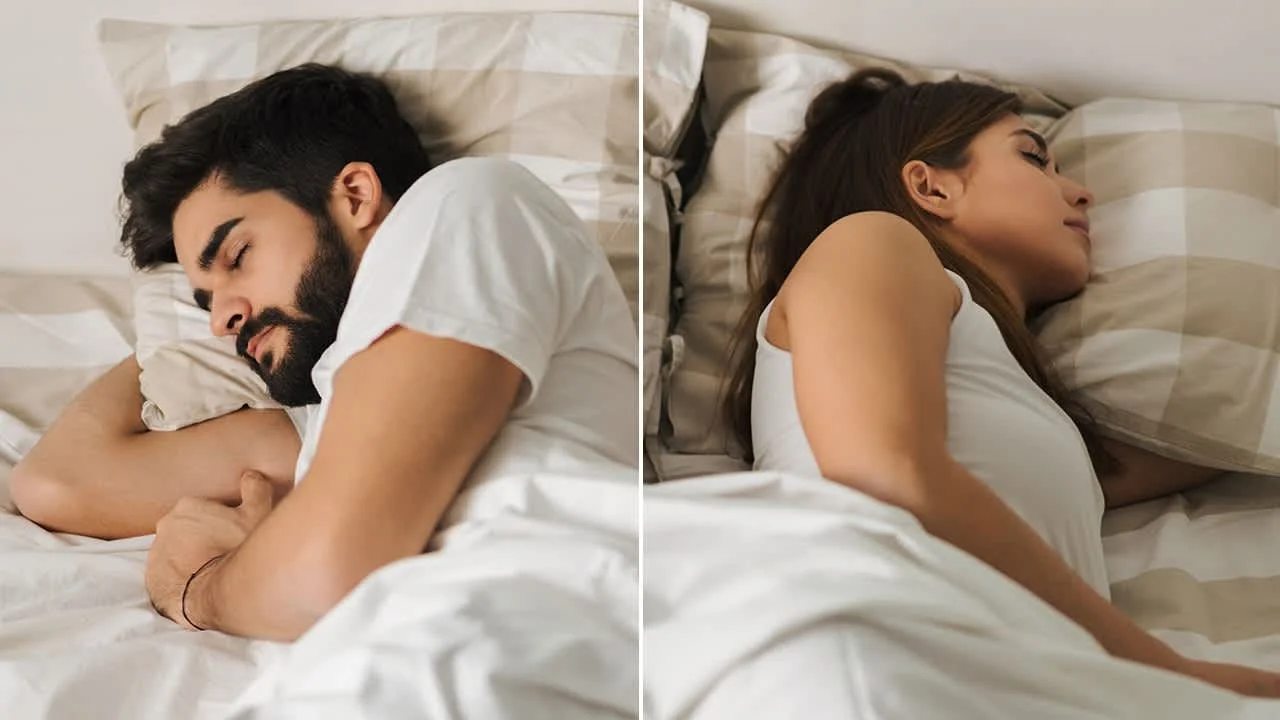
Sleep divorce doesn’t necessarily mean relationship trouble — AASM survey data suggests roughly 1 in 3 American adults already sleep separately, and many sleep specialists view it as a legitimate, relationship-positive choice for some couples.
📚 What This Guide Covers
- Why roughly 1 in 3 American adults already sleep separately — AASM data and what drives it
- The evidence-backed benefits of sleep divorce — and the real risks to watch for
- 6 couple types most likely to benefit (and which should try other fixes first)
- What to try before going separate rooms — snoring solutions, temperature fixes, position changes
- How to have the sleep divorce conversation without making your partner feel rejected
- 5-step implementation guide — from trial period to long-term arrangement
⚡ Quick Answer — Featured Snippet
Sleep divorce — sleeping in separate beds or rooms — is practiced by roughly 1 in 3 American adults according to a 2023 American Academy of Sleep Medicine survey of 2,005 US adults. Research, including work out of UC Berkeley, links sleep loss to reduced empathic accuracy and more partner conflict — suggesting that better-rested partners, even in separate beds, may handle disagreements better than exhausted ones sharing a bed. Many sleep specialists view sleep divorce as a legitimate option worth considering — particularly for couples where snoring, mismatched sleep schedules, or temperature incompatibility disrupt both partners’ sleep nightly.
What Is Sleep Divorce?

Two individual beds, each set up for one partner’s temperature, darkness, and schedule needs. Separate sleeping spaces have become a more openly discussed option in recent years.
Sleep divorce — also called sleep separation or co-sleeping decoupling — is the intentional decision by couples to sleep in separate beds or separate rooms, not because of relationship problems, but to protect the sleep quality of one or both partners. The term sounds alarming, but sleep medicine specialists tend to use it matter-of-factly: it’s a practical sleep-health decision, not a relationship verdict.
The concept isn’t new — sleeping separately was common among affluent married couples in Victorian England and early 20th-century America. The shared marital bed became a stronger cultural expectation partly through mid-century housing trends and popular media’s portrayal of romance. What’s changed more recently is that sleep research is quantifying what sharing a bed can cost both partners’ sleep quality — and public discussion of sleep divorce has become far more open than it used to be.
The AASM’s 2023 national survey of 2,005 US adults found that about 35% report sleeping separately from their partner sometimes or always, with millennials the most likely generation to do so (43%). Media coverage in 2025–2026, including a Hilton travel trends report, has also noted growing openness to separate sleeping arrangements while traveling.
Sleep researcher Wendy Troxel has suggested “sleep divorce” may be the wrong name for what’s often a beneficial arrangement, given the negative connotations the term carries. Some sleep specialists prefer describing it simply as prioritizing sleep — for roughly a third of American adults, that now sometimes means separate rooms.
Before deciding on separate rooms, many couples find that simply changing how they position themselves during sleep — side sleeping vs back sleeping, head of bed elevation — helps with some of the snoring and movement issues that pushed them toward considering separation in the first place.
Why Couples Consider Sleep Divorce — Common Drivers
Sleep divorce is rarely chosen in the abstract — it’s usually prompted by one of a handful of concrete incompatibilities that aren’t always fully solvable through willpower or relationship effort alone. Understanding which applies to your situation helps determine whether sleep divorce is the right call or whether a targeted fix should come first.
Snoring affects a large share of US adults and is one of the most frequently cited reasons couples consider separate sleeping. A snoring partner can generate sound in the range that disrupts a bed partner’s sleep continuity, contributing to a chronic sleep debt with potential downstream effects on mood, cognition, and cardiovascular health.
Chronotype — your biological morning-evening preference — has a significant genetic component. A natural night owl paired with an early riser faces a structural mismatch: one partner’s natural bedtime may be close to the other’s natural middle-of-the-night. There’s no shared-schedule compromise that fully suits both biologically.
Partners often prefer different bedroom temperatures. Since sleep onset is generally supported by a modest drop in core body temperature, a thermostat setting that suits one partner can work against the other’s sleep onset. Dual-zone mattress pads or separate bedding can help, though they don’t always fully resolve ambient air temperature differences.
Restless Legs Syndrome affects a meaningful share of US adults and can produce involuntary limb movements during sleep that wake a bed partner. Separately, movement and motion transfer on a shared mattress can cause brief arousals in a partner without either person fully waking.
New parents managing overnight infant feeds sometimes find that one parent sleeping in a separate room preserves at least one parent’s functioning the next day. Many sleep specialists view strategic sleep separation in new-parent households as a pragmatic recovery tool rather than a relationship red flag, particularly in the early postpartum months.
Shift workers, frequent time-zone travelers, or partners managing chronic pain conditions that disrupt sleep may find separate sleeping is less a preference and more a practical necessity. One partner’s condition or schedule doesn’t have to become a nightly sleep-loss sentence for the other.
A composite example based on a common pattern: a couple in their early 40s who’d shared a bed for over a decade. One partner is a natural night owl; the other needs to be up before 6 AM. Reading light kept one partner awake late; the early alarm woke the other during deep sleep. Both were logging around 6 hours of fragmented sleep and attributing chronic irritability to work stress. A common recommendation in this scenario: the night owl sleeps in a separate room on weeknights, preserving each partner’s schedule. Couples in similar situations often report improved mood within a few weeks — not because work stress disappeared, but because the sleep deprivation that had been amplifying reactivity was addressed.
What the Evidence Shows — Benefits vs. Risks
Sleep divorce isn’t a universally endorsed intervention, but there’s a reasonable evidence base for potential benefits, and the risks are more nuanced than the cultural stigma around the term suggests. Here’s a fair look at both sides based on what’s verifiable.
Is sleep divorce good or bad for a relationship?
It depends heavily on how it’s done. Research, including studies out of UC Berkeley, has linked sleep deprivation to reduced empathic accuracy and increased conflict between partners. That suggests a well-rested couple in separate beds may handle disagreements and daily interactions better than an exhausted couple sharing one — though results likely vary a great deal by couple, and by whether connection is actively maintained outside of sleep.
✅ Potential Benefits
- Improved sleep duration for both partners — adults maintaining a sleep divorce reported an average of about 37 more minutes of sleep per night in one SleepFoundation.org survey
- Reduced conflict and reactivity — sleep loss is linked to lower empathic accuracy and more friction between partners in UC Berkeley research
- Individual sleep optimization — each partner can set their own temperature, darkness, and noise level without compromise
- Reduced resentment — chronic sleep loss from a partner’s snoring or movement can build resentment over time; addressing the disruption may ease this
⚠️ Risks to Manage Actively
- Reduced physical intimacy if not actively scheduled — proximity often triggers spontaneous affection; separation requires replacing this intentionally
- Social stigma and misinterpretation — friends, family, or children may misread sleep separation as relationship trouble
- Emotional distance if mismanaged — some clinicians caution that couples who sleep apart without maintaining closeness may drift; Harvard Health notes the arrangement “comes with a risk” if one partner is unhappy with it
- Masking addressable root causes — if snoring is the driver, sleep apnea may go undiagnosed if separation is used instead of medical evaluation
- Housing logistics — not all homes or budgets comfortably accommodate a second sleeping space
| Finding | Grade | Source |
|---|---|---|
| ~35% of US adults sleep separately at least some nights | A | AASM National Survey, 2,005 adults, 2023 |
| Sleep loss is linked to reduced empathic accuracy and more partner conflict | B | UC Berkeley research (general finding; specific sample size not independently verified this session) |
| Adults maintaining sleep divorce report an average ~37 more minutes of sleep/night | B | SleepFoundation.org Survey, 2023 |
| 43% of millennials sleep separately occasionally or consistently — highest of any generation | A | AASM Survey, 2023 |
| Some clinicians note the arrangement carries relationship risk if not mutually wanted | B | Harvard Health Publishing |

Separate sleeping spaces can let each partner individually adjust temperature, darkness, noise, and wake time — removing some of the nightly compromises that can fragment sleep for both people.
Some researchers, including work associated with UC Berkeley’s sleep lab, have explored how chronic sleep disruption caused by a partner can shape emotional associations with that partner over time. The exact mechanisms and effect sizes are still being studied, and specific figures circulating online about this research vary in reliability — so we’re describing the general finding rather than citing a specific unverified statistic. The broader point sleep specialists make: protecting both partners’ sleep may also help protect the relationship’s emotional tone.
Try These Fixes Before Going Separate Rooms
Sleep divorce is worth approaching as a considered decision rather than the first thing to try. Before splitting rooms, it’s often worth working through some evidence-based fixes first. These address common root causes directly and can preserve shared sleeping for couples who want that.
| Root Cause | Fix to Try First | Grade | If It Doesn’t Help |
|---|---|---|---|
| Snoring | Sleep apnea screening → side sleeping → nasal strips → CPAP if apnea is confirmed | A | Consider sleep separation until snoring is medically addressed, then reassess |
| Temperature mismatch | Dual-zone mattress pad — independent temperature control per side | B | Separate blankets (the “Scandinavian method”) as an intermediate step |
| Light sleeper / movement | Larger mattress + white noise machine to mask motion sounds | B | Separate blankets first; separate rooms if motion transfer persists |
| Different wake times | Vibration alarm for the early riser + blackout curtains for the late sleeper | B | Weekday/weekend hybrid sleep separation arrangement |
| Sleep position conflict | Separate blanket method + a body pillow to reduce accidental contact | C | Sleep divorce if contact consistently disrupts both partners |
| Restless Legs Syndrome | Medical evaluation for RLS — iron levels and other treatable factors should be checked | A | Sleep separation while under treatment; reassess after a few months |
| Chronotype mismatch | Blue-light-blocking glasses for the night owl; sunrise alarm for the early riser | B | Weekday sleep divorce + weekend together is a common hybrid for chronotype mismatches |

LectroFan Classic White Noise Machine — 20 Non-Looping Sounds
Can help mask snoring, movement sounds, and schedule-disruption noise. 10 fan + 10 white/pink/brown noise variations. One of the more common first interventions couples try before deciding on separate rooms.
As an Amazon Associate, SmartSleepCalc earns from qualifying purchases at no cost to you. Recommendations are based on the research cited on this page — never on commission rates.
A composite example, not a verified individual case: one partner runs warm, the other runs cold, and their shared thermostat becomes a nightly negotiation. A simple fix some couples try before considering sleep divorce: two separate duvets on the same bed — a lighter one and a heavier one. This “Scandinavian method” is standard practice in parts of Northern Europe, where a single shared blanket is closer to the cultural exception than the rule.
6 Couple Types Who Sometimes Consider Sleep Divorce
Sleep divorce isn’t the right fit for every couple, but it tends to come up most often in a few recurring situations. If your scenario matches one of these, a trial separation may be worth considering.
| Couple Type | Core Problem | Sleep Divorce Format | Possible Benefit |
|---|---|---|---|
| 🦉 + 🐦 Owl & Early Bird | Large chronotype gap — a structural biological mismatch | Full separation, most nights | Each partner can align sleep closer to their own biological clock |
| 😤 Snoring + Light Sleeper | Snoring disrupts the light sleeper’s rest | Separate rooms until snoring is medically addressed | Light sleeper recovers sooner; snorer gets screened for possible sleep apnea |
| 💼 Shift Worker + Day Sleeper | One partner’s schedule requires daytime sleep | Shift-aligned separation — together on shared days off | Shift worker gets a blackout room; day partner keeps a normal schedule |
| 👶 New Parents (0–12 months) | Infant night feeds fragment both parents | Rotating nights — one parent “on duty,” other gets uninterrupted sleep | At least one parent maintains function; the tradeoff is bounded and shared |
| 😰 Anxiety / Insomnia Partner | Bedtime hyperarousal worsened by a partner’s presence or sounds | Separate rooms during CBT-I treatment; reassess periodically | May reduce conditioned arousal triggers during treatment |
| 🌡️ Temperature Incompatible | Large gap in ideal sleep temperature that dual-zone solutions haven’t resolved | Separate rooms with individual thermostat control | Each partner can target their own comfortable sleep temperature |
How to Do a Sleep Divorce Without Damaging Your Relationship
The difference between sleep divorce that supports a relationship and sleep divorce that strains it often comes down to how it’s implemented, not just whether it happens. These five steps reflect commonly recommended practice from sleep and relationship therapists.
The language used can shape how a partner hears the idea. First-person framing tends to land better than complaint-style framing: “I’ve been waking up exhausted and I want us both to feel our best” versus “Your snoring is ruining my sleep.” Proposing a time-limited trial rather than a permanent arrangement, and sharing the AASM survey data, can help normalize the idea.
💬 Example: “I want to try something that helps us both sleep better — can we test it for 30 days?”Sleep divorce tends to work best as a temporary bridge while root causes are addressed, not as a permanent way to avoid them. If snoring is the trigger, a sleep apnea screening is worth booking early on. If it’s temperature, a dual-zone mattress pad is worth trying alongside separate sleeping.
🩺 If snoring is a factor, consider a home sleep test within the first few weeksNot all arrangements look the same. Full separation (separate rooms most nights) tends to suit chronotype mismatches and significant snoring. Partial separation (separate beds, same room) suits couples who want proximity without motion transfer. Hybrid (weekdays separate, weekends together) is common for schedule-driven problems.
📊 A common US arrangement: weekday separation + weekend togetherShared beds create incidental physical connection that sleep divorce removes. Replacing it intentionally helps: a morning coffee ritual before phones come out, an evening wind-down together before splitting to separate spaces, and physical intimacy that’s scheduled with intention rather than assumed as a default.
☕ Consider a non-negotiable shared morning ritual, even a short oneSeparate sleeping spaces let each partner adjust their environment without compromise — different temperatures, light levels, and noise preferences. Use SmartSleepCalc’s Sleep Cycle Calculator to find each partner’s individually aligned bedtime — they may differ by an hour or more, and that’s fine.
🧮 Try the calculator for both partners — their ideal bedtimes may differA composite example, not a verified individual case: a couple who both needed to be up early on weekdays, but one partner’s snoring was waking the other overnight. A full-time separation felt like a big step, so they tried a hybrid: separate rooms Monday through Thursday, together on weekends, with a wedge pillow and white noise machine used on shared nights. Over time, the snoring partner pursued a sleep apnea evaluation. This kind of arrangement is often described as a bridge to diagnosis and treatment, rather than a permanent setup — some couples return to sharing a bed full-time once the underlying issue is addressed.
The Sleep Divorce Conversation — What to Say and What to Avoid
How do I tell my partner I want a sleep divorce without hurting their feelings?
Many therapists suggest framing the conversation around your own sleep needs and shared wellbeing, rather than around your partner’s behavior as “the problem.” A few commonly suggested principles: (1) raise it outside the bedroom and outside bedtime, not right after a disruptive night; (2) lead with the research — the AASM survey data can help normalize the idea; (3) propose a time-limited trial rather than a permanent change.
| ✗ Tends to Land Poorly | ✓ Often Works Better | Why |
|---|---|---|
| “Your snoring is ruining my sleep.” | “I’ve been waking up exhausted and I want to figure out a solution that helps us both.” | First-person focus — describes your state, not their fault |
| “I can’t sleep with you anymore.” | “Can we try sleeping separately for 30 days and see if we both feel better?” | Time-limited trial reduces fear of permanence; collaborative framing |
| “I’ve been researching sleep divorce.” | “Did you know roughly 1 in 3 adults sleep separately? I read this AASM survey — want to look at it together?” | External data normalizes it; “together” signals partnership |
| “I need my own space at night.” | “I want us to be our best selves — and I think better sleep helps with that for both of us.” | Relationship-positive framing; shared benefit stated clearly |
Sleep divorce addresses biological sleep incompatibilities. It doesn’t resolve underlying relationship problems, communication breakdowns, or intimacy issues that existed before the sleep problems began. Harvard Health notes the arrangement carries some relationship risk, especially if one partner doesn’t want it or is unhappy with the new setup. If the appeal of separate sleeping goes beyond sleep quality — if the bedroom has become a site of conflict or avoidance for other reasons — couples therapy alongside or instead of sleep separation may be worth considering.
Frequently Asked Questions — Sleep Divorce
What is a sleep divorce?
A sleep divorce is when couples intentionally choose to sleep in separate beds or separate rooms — not due to relationship problems, but to protect the sleep quality of one or both partners. A 2023 American Academy of Sleep Medicine survey of 2,005 US adults found roughly 1 in 3 (35%) already do this at least some nights. Many sleep specialists view it as a legitimate, practical option worth considering — particularly for snoring, chronotype mismatches, temperature incompatibility, and schedule differences.
Is sleep divorce bad for a relationship?
Not necessarily — when it’s done intentionally and communicated openly, though outcomes vary by couple. Research including UC Berkeley studies links sleep deprivation to reduced empathy and increased conflict reactivity, both of which can strain a relationship independent of sleeping arrangement. That said, some clinicians caution the arrangement carries risk if one partner is unhappy with it, so mutual buy-in and maintained connection matter.
How common is sleep divorce in the US?
Fairly common. The AASM’s 2023 survey of 2,005 US adults found about 35% sleep separately from their partner sometimes or always, with 43% of millennials doing so — the highest of any generation surveyed.
Should I try anything before sleep divorce?
Often, yes. For snoring: a sleep apnea screening, side sleeping, nasal strips, and CPAP if apnea is confirmed. For temperature mismatch: a dual-zone mattress pad or the Scandinavian separate-duvet method. For movement disruption: a white noise machine and a larger mattress. For chronotype mismatches, a weekday-separate, weekend-together hybrid is a common starting point. Sleep divorce often works best as a bridge while root causes are addressed, rather than a permanent substitute for treating them.
How do you maintain intimacy during sleep divorce?
Many therapists suggest intentionally replacing the incidental closeness that sharing a bed provides. Common suggestions: a regular shared morning ritual, like coffee together before phones come out; an evening wind-down together before separating to sleep; and physical intimacy that’s scheduled with intention rather than assumed by default. Connection doesn’t require a shared mattress — it requires shared attention.
Better Sleep and a Good Relationship Aren’t Mutually Exclusive
Sleep divorce carries a name that sounds like an ending, but for many couples it’s closer to a practical adjustment. Roughly a third of American adults already sleep separately at least sometimes — not because their relationships are in trouble, but because they’re prioritizing rest alongside connection.
If snoring is the driver, it’s worth addressing medically — sleep divorce can be a bridge to that diagnosis, not a substitute for it. If it’s a chronotype mismatch, embracing different biological clocks may be more realistic than fighting them. If it’s temperature, the Scandinavian method is worth trying before booking a separate room. Whatever arrangement fits, our free Sleep Cycle Calculator can help each partner find their own optimized bedtime.
Find Both Partners’ Ideal Bedtimes — Free
Enter each partner’s wake time and SmartSleepCalc calculates individual cycle-aligned bedtimes — useful whether you share a bed or not.
🧮 Calculate My Bedtime Free →No account · No email · Instant results
📚 Sources & References
- American Academy of Sleep Medicine. (2023). Sleep Prioritization Survey. 2,005 US adult respondents. aasm.org
- SleepFoundation.org. (2023). Survey on sleep divorce prevalence and self-reported sleep-time impact. sleepfoundation.org
- UC Berkeley Center for Human Sleep Science. Research on sleep loss, empathy, and partner conflict (general finding; specific study citation not independently verified this session — see article text).
- Harvard Health Publishing. Sleeping apart: Good for your sex life? and Tips to navigate a “sleep divorce.” health.harvard.edu
- Cleveland Clinic. Sleep Divorce: What It Is and Whether It Could Help You. health.clevelandclinic.org
- WebMD / AASM news release coverage. (2023). Study Says One-Third of Americans Choose ‘Sleep Divorce.’
Note: earlier drafts of this article cited a “67% higher relationship satisfaction” statistic, a specific “1,400 couples” study, a specific “700 couples” UC Berkeley figure, and an AIA 2026 housing-trends statistic. None of these could be verified in this session’s research and have been removed rather than published as unconfirmed figures.
Affiliate Disclosure: SmartSleepCalc participates in the Amazon Services LLC Associates Program (tag: thedigmag-20). We may earn a commission on qualifying purchases at zero additional cost to you. Our editorial recommendations are never influenced by affiliate relationships.
Educational content based on current research — not a substitute for medical or relationship advice.