How to Stop Snoring: What the Evidence Actually Supports
Snoring has more than one cause, so there is no single fix that works for everyone. This guide ranks common options by the strength and directness of the evidence, explains when snoring may be a sign of obstructive sleep apnea, and keeps shopping recommendations separate from medical guidance.
The best first step depends on the pattern. Back-sleep-dependent snoring may improve with side sleeping. Nasal obstruction may respond to nasal treatment or dilation. Persistent primary snoring can respond to a mandibular advancement oral appliance after obstructive sleep apnea has been excluded. Oropharyngeal exercises also have randomized-trial support. But loud habitual snoring plus gasping, witnessed breathing pauses, or excessive daytime sleepiness should trigger an evaluation for sleep apnea rather than more self-treatment.
When Snoring May Be More Than “Just Snoring”
Snoring can occur without obstructive sleep apnea, but it is also one of the classic OSA symptoms. AASM guidance says questionnaires and symptoms alone cannot diagnose OSA; diagnosis requires appropriate testing in clinical context.
A partner notices repeated pauses, choking, or gasping during sleep.
You struggle to stay awake during work, meetings, or driving despite enough time in bed.
Repeated abrupt awakenings with a sense of airway blockage deserve medical attention.
High blood pressure, obesity, atrial fibrillation, or other clinical risk factors can increase concern for OSA.
If OSA warning signs are present, use a validated screening questionnaire only as a prompt for medical evaluation—not as a way to rule OSA in or out. SmartSleepCalc’s separate OSA screening page should only be promoted here after its current P0 audit is completed.
Snoring Treatments Ranked by Evidence
These grades are SmartSleepCalc editorial labels. They summarize how direct and consistent the evidence is for reducing snoring—not a formal medical GRADE system.
Randomized trials and AASM/AADSM guidance support oral appliances for adults with diagnosed primary snoring after OSA has been excluded.
Randomized trials have reported reductions in objective and subjective snoring measures after several weeks of structured exercises.
Snoring often decreases in the lateral position for people whose snoring is clearly worse on their back. Evidence is strongest when positional dependence is present.
Small randomized studies show external or internal nasal dilation can reduce snoring in selected people, particularly those with chronic rhinitis or narrow nasal passages.
Experimental studies show alcohol can worsen sleep-disordered breathing and oxygenation in people who snore. Direct evidence for a precise “snoring cutoff hour” is limited.
Higher BMI and neck size are associated with snoring and OSA, but not every snorer is overweight and direct primary-snoring weight-loss trials are limited.
Oral Appliances: The Best-Supported Device for Primary Snoring
A 2024 randomized clinical trial compared a mandibular advancement device with a combined airway-and-positional program in adults with primary snoring. Both approaches improved partner-reported snoring, showing that more than one targeted strategy can help.
AASM/AADSM guidance supports oral appliances for adults who request treatment for primary snoring without OSA. The guideline specifically warns that primary snoring should be diagnosed within medical care because snoring can accompany OSA and misclassification can matter.
Oropharyngeal Exercises: Useful, but They Take Time
Upper-airway exercises have been tested in randomized trials. A 2015 trial in people with primary snoring or mild-to-moderate OSA found objective snoring improved after three months of daily exercises. A 2024 randomized trial in people with simple snoring also reported improvements in snoring index, loudness, and quantity after a four-week exercise program.
Structured, repeated tongue/oropharyngeal exercises can reduce snoring in some adults.
A generic “7-minute routine” guaranteed to work in one week.
Think in weeks, not one night, and stop if exercises cause pain or swallowing problems.
Positional Therapy: Best When Snoring Is Clearly Back-Sleep Dependent
Body position matters for many people. A sleep-lab study of nonapneic snorers found that lateral sleep reduced snoring time and intensity in most participants. Modern randomized trials in positional OSA also show that positional devices can reduce sleep-disordered breathing, although OSA treatment evidence should not be automatically generalized to simple snoring.
Nasal Strips and Dilators: Helpful Mainly for Nasal Obstruction
Nasal dilators can improve nasal airflow, but their snoring effect is not universal. In a small randomized placebo-controlled study of people with chronic rhinitis and primary snoring, an external nasal dilator reduced snoring frequency but did not improve every sleep measure. Earlier randomized work also found benefit in selected habitual snorers with nasal obstruction.
Snoring worsens with allergies, nasal congestion, or restricted nasal breathing.
Snoring is caused mainly by tongue/jaw collapse or persists regardless of nasal breathing.
If congestion is persistent, recurrent, one-sided, or associated with nosebleeds or loss of smell, consider medical evaluation rather than repeatedly self-treating.
Alcohol, Smoking, Weight, and Other Habits
| Factor | What evidence supports | Safer recommendation |
|---|---|---|
| Alcohol | Experimental studies show nighttime alcohol can worsen breathing and oxygenation in people who snore. | If snoring reliably worsens after alcohol, reducing or avoiding evening alcohol is reasonable. Avoid claiming a universal exact cutoff. |
| Weight | Higher BMI and neck circumference are associated with snoring and OSA; direct evidence for simple snoring is less precise. | If overweight, gradual weight management may help overall sleep-breathing risk. Do not promise a fixed percentage reduction in snoring. |
| Smoking | Smoking is associated with upper-airway irritation and habitual snoring in observational research. | Stopping smoking is worthwhile for broad health reasons, but do not market a “2-hour before bed” rule as proven treatment. |
| Sedating medicines | Some sedatives can worsen upper-airway collapsibility or breathing. | Do not stop prescribed medicine on your own; ask the prescriber if snoring or breathing changes began after a medication change. |
When to See a Doctor About Snoring
Arrange medical evaluation if snoring is loud and persistent, especially when it occurs with breathing pauses, choking/gasping, severe daytime sleepiness, resistant hypertension, or repeated morning symptoms. AASM states that only a medical provider can diagnose OSA or primary snoring.
What testing may involve
Polysomnography remains the standard diagnostic test for OSA. For selected uncomplicated adults with signs and symptoms suggesting increased risk of moderate-to-severe OSA, a technically adequate home sleep apnea test can be appropriate. AASM’s position statement says HSAT is a medical assessment that should be ordered within clinical care, and automatically scored device output alone should not be used to make diagnosis or treatment decisions.
What Not to Rely On
Recording noise can help you notice trends, but an app cannot determine whether breathing events meet OSA diagnostic criteria.
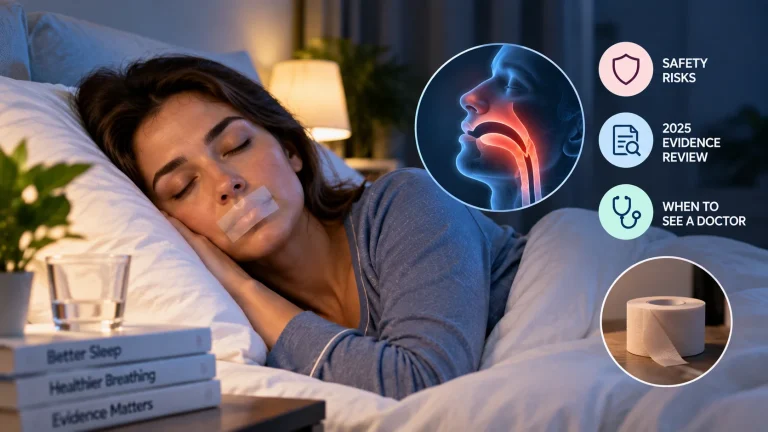
Do not use mouth taping to bypass unexplained nasal obstruction or suspected sleep apnea. Read the Mouth Taping evidence review for the 2025 systematic-review context.
Be skeptical of products that promise to stop all snoring without identifying the mechanism.
Product Options: Match the Tool to the Problem
This section is intentionally secondary. A product is not evidence simply because it has many reviews. If you use affiliate links, disclose them clearly and do not turn product ratings, Amazon badges, or marketing claims into medical evidence.
Categories worth considering
Reasonable only when nasal restriction appears to contribute. Evidence is condition-specific.
Useful when snoring is clearly worse on the back. The pillow itself is not the treatment mechanism—the position is.
Best-supported device category, but persistent snoring should be medically assessed for OSA before treatment is assumed to be “simple snoring.”
Snoring FAQs
What is the fastest way to reduce snoring?
There is no universal fastest fix. If snoring is clearly positional, side sleeping may help immediately. If it is driven by nasal obstruction, a nasal dilator may help some people. Persistent snoring requires a more targeted approach.
Do anti-snoring mouthpieces work?
Mandibular advancement oral appliances have good evidence for primary snoring in adults after OSA has been excluded. AASM/AADSM guidance supports oral-appliance therapy for adults who request treatment for primary snoring.
Can snoring mean sleep apnea?
Yes. Loud habitual snoring is a common OSA symptom, especially when combined with witnessed breathing pauses, gasping/choking, or daytime sleepiness. Snoring alone cannot diagnose OSA.
Do nasal strips work?
They can help selected people with nasal obstruction or chronic rhinitis. Evidence is much less convincing for snoring caused by the tongue, jaw, or other throat structures.
Do throat exercises help snoring?
Randomized trials suggest structured oropharyngeal exercises can reduce snoring measures in some adults. Benefits generally require repeated practice over several weeks.
Can weight loss stop snoring?
Weight reduction may help when excess weight contributes to upper-airway narrowing or OSA risk, but not every snorer is overweight and there is no reliable promise that losing a fixed percentage of body weight will stop snoring.
Should I order a home sleep apnea test myself?
AASM states that HSAT is a medical assessment that should be ordered and interpreted within appropriate medical care. It is not meant for general screening of asymptomatic people.
Primary Studies & Clinical Guidance
- Schwab RJ et al. Mandibular Advancement vs Combined Airway and Positional Therapy for Snoring: A Randomized Clinical Trial. PubMed
- Ieto V et al. Effects of Oropharyngeal Exercises on Snoring: A Randomized Trial. PubMed
- Effects of modified oropharyngeal exercises on individuals with simple snoring. Randomized controlled trial, 2024. PubMed
- Virkkula P et al. External nasal dilation reduces snoring in chronic rhinitis patients: randomized controlled trial. PubMed
- Höijer U et al. The effects of nasal dilation on snoring and obstructive sleep apnea. Randomized clinical trial. PubMed
- Nakano H et al. Effects of body position on snoring in apneic and nonapneic snorers. PubMed
- Riemann R et al. The influence of nocturnal alcohol ingestion on snoring. PubMed
- AASM/AADSM. Clinical Practice Guideline for Oral Appliance Therapy in OSA and Snoring. Guideline
- American Academy of Sleep Medicine. Clinical use of a home sleep apnea test: updated position statement. AASM
- AASM. Clinical Practice Guideline for Diagnostic Testing for Adult OSA. Guideline