Cuddling Positions for Sleep: 7 Comfortable Options for Couples
There is no scientifically proven “best” cuddling position for sleep. The useful goal is simpler: choose contact that feels good to both people, allows easy movement, does not trap uncomfortable heat or pressure, and does not interfere with breathing or prescribed sleep treatment.
The best cuddling position is the one both partners can leave or adjust easily without pain, overheating, breathing difficulty, or sleep disruption. Research has not identified one named position that improves sleep. A 2025 study of 143 bed-sharing couples found closer positions at sleep onset were linked with lower couple stress and, indirectly, lower insecure attachment—but not with significantly less sleep disturbance.
Cuddling May Support Connection, but Position-Specific Sleep Claims Are Still Limited
- 143 mixed-gender heterosexual couples who shared a bed most nights.
- Closer physical positions at sleep onset were associated with lower couple-level stress.
- Closer positions were indirectly linked with lower insecure attachment through lower stress.
- Physical closeness at sleep onset was not significantly associated with sleep disturbance.
- The study was cross-sectional, so it cannot prove that cuddling caused lower stress or better relationship outcomes.
- A 2024 narrative review found preliminary evidence that affectionate/non-sexual touch is associated with better sleep quality.
- A 2025 systematic review/meta-analysis of 62 studies and 43,860 participants found better couple relationship quality was associated with better sleep.
- Daily-diary research in 210 married couples linked more sleep-touch with happier/calmer morning mood.
- None of these studies establishes a medically superior spoon, half-spoon, face-to-face, or back-to-back position.
Seven Cuddling Positions to Try
Treat each position as adjustable. Either person should be able to roll away, change pillows, use the bathroom, or stop contact without resistance.
Both people lie on their sides facing the same direction, with one partner behind the other. It can feel warm and close, but the lower arm/shoulder may become uncomfortable if it is trapped or used as a pillow.
Lie in the same direction but keep more space between torsos or legs. One arm or hand can maintain contact without combining as much body weight.
Both partners lie on their sides facing each other. This can work for winding down, but breath, heat, pillow preferences, or neck position may make it less comfortable for all-night sleep.
Keep upper bodies in preferred sleep positions and touch at the calves, feet, or ankles. This can preserve a sense of connection while giving both people more room and less shared body heat.
Both people face away while their backs, hips, or calves lightly touch. This allows each person to use their preferred side-sleep setup and move more independently.
One partner lies more on the back while the other leans into the chest or shoulder. This may feel comforting while awake or settling down, but neck, shoulder, arm, breathing, or heat discomfort are reasons to change position.
Both people stay in their usual sleep positions while a hand, forearm, shoulder, or foot maintains light contact. This is often the simplest option when either person needs room to move.
Compare Cuddling Positions by What Usually Matters Most
| Position | Contact | Heat | Freedom to move | Pressure / comfort watch-out | May suit |
|---|---|---|---|---|---|
| Classic spoon | High | Higher | Lower | Lower arm/shoulder, ribs, hips | Couples who like close side-by-side contact and can reposition easily |
| Half-spoon | Medium-high | Moderate | Moderate | Arm/shoulder placement | Couples wanting closeness with more personal space |
| Face-to-face | High | Higher | Moderate | Neck/pillow mismatch, breath, heat | Wind-down and brief close contact |
| Leg/ankle contact | Low | Low | High | Knee/hip comfort if legs are tightly intertwined | Hot sleepers or couples who prefer separate upper-body space |
| Back-to-back touch | Low-medium | Low-moderate | High | Pressure only if bodies are pushed together | Independent side sleepers who still want contact |
| Loose embrace | High | Higher | Lower | Neck, shoulder, arm, chest pressure | Relaxing together before one or both partners reposition |
| Hand/forearm touch | Very low | Very low | Very high | Hand/arm numbness if pressure builds | Couples who value contact but need full postural freedom |
Cuddle Comfort Matcher
This does not diagnose a sleep or pain problem. It uses transparent comfort rules to suggest a contact level, not a medically “best” position.
If Cuddling Keeps Waking Someone Up
Heat? Shoulder pressure? Numb arm? Snoring? PAP-mask leaks? Different bedtime? Frequent movement? Start with the problem instead of blaming the relationship or the position name.
Move from full-body contact to half-spoon, back-to-back touch, leg/ankle contact, or one hand/forearm.
Keep the pillow, bedding, PAP equipment, pregnancy support, or clinician-recommended positioning each person actually needs.
Agree in advance that rolling away during sleep is normal and does not require an emotional explanation.
If snoring/gasping, ongoing numbness, significant pain, repeated PAP disruption, or chronic partner-related sleep loss persists, address that issue directly rather than forcing more cuddling.
Cuddling Myths That Can Make Sleep Harder
No. The 2025 study found closer sleep-onset positions were linked with lower stress, but not significantly with less sleep disturbance.
No named cuddling position has been established as medically best. Half-spoon may simply feel more workable for some couples because it allows more space.
No validated duration has been established. Cuddle for as long as both people enjoy it and can still transition comfortably to sleep.
No. People change position for comfort, temperature, breathing, pain and normal movement. Sleep posture by itself cannot diagnose relationship quality.
Pain, numbness and tingling are reasons to reposition. Relationship closeness does not require holding an uncomfortable posture.
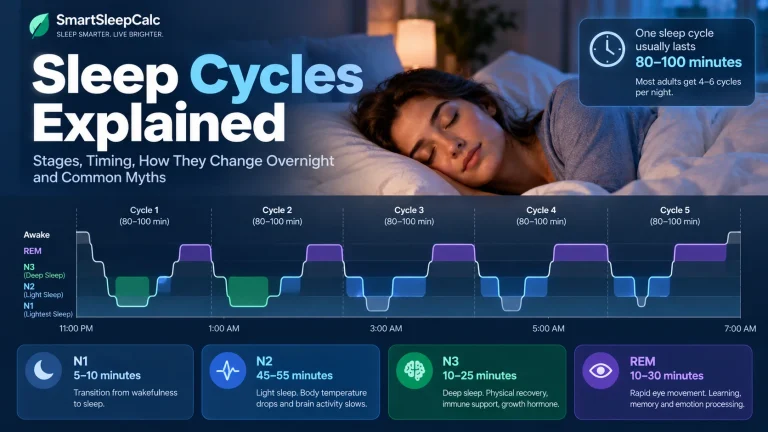
No. Sleep cycles vary and clock time cannot identify an individual’s future sleep stage. Move whenever either person needs to.
When to Address a Health or Sleep Problem
Change position rather than pushing through. Ongoing symptoms—especially weakness or persistent numbness—deserve appropriate clinical evaluation.
These can be signs of obstructive sleep apnea. Cuddling position should not be used as a substitute for evaluation.
Protect mask fit and prescribed treatment. Use lighter contact or more space rather than sleeping in a posture that disrupts therapy.
If contact, movement, schedules, temperature or caregiving keeps disrupting sleep, the Sleep Divorce decision guide covers reversible ways to test more separation without treating it as a relationship failure.
Cuddling Positions FAQs
What is the best cuddling position for sleep?
There is no scientifically established best position. Start with the amount of contact both people want, then reduce contact if heat, pressure, numbness, breathing difficulty, or movement restriction becomes a problem.
Is spooning good for sleeping?
It can be comfortable for some side-sleeping couples, but full spooning also adds warmth and can trap an arm or put pressure on a shoulder. A looser half-spoon is an easy adjustment if full spooning becomes uncomfortable.
How long should couples cuddle before sleep?
There is no evidence-based required duration. The 2025 sleep-onset-position study measured closeness at sleep onset; it did not establish a 10-, 15-, or 20-minute therapeutic window.
Is it normal to stop cuddling during the night?
Yes. People change position for comfort, temperature, pain, breathing and normal movement. Moving apart during sleep does not by itself indicate relationship trouble.
Does cuddling release oxytocin?
Affectionate touch can involve oxytocin and other stress-regulation systems, but the relationship between cuddling, oxytocin and sleep is still being studied. Specific cuddle positions have not been shown to produce a known dose of oxytocin or a guaranteed sleep benefit.
What if cuddling makes my back, neck, shoulder, or arm hurt?
Reposition rather than holding the pose. Use the sleep posture and support that feels comfortable for each person. Persistent or worsening pain, weakness, or numbness deserves evaluation on its own.
Related SmartSleepCalc Guides
Sources
- Novak JR, Miller KC. “Cuddle buddies”: Couples sleep position closeness at onset is indirectly related to lower insecure attachment through lower couple perceived stress. Journal of Social and Personal Relationships. 2025;42(4):1102–1118. Study
- The association between couple relationships and sleep: a systematic review and meta-analysis. Sleep Medicine Reviews. 2025;79:102018. Included 62 studies and 43,860 participants. Review
- Xie Y, Feeney BC. A narrative review of research linking non-sexual social touch to sleep quality. Journal of Sleep Research. 2024;33(5):e14174. PubMed
- Roberts NA, et al. Affective Experience and Regulation via Sleep, Touch, and “Sleep-Touch” Among Couples. Affective Science. 2022;3(2):353–369. PubMed
- Junker I, Bergel J, Deresko E, Freund S, Schredl M. Sleep positions of couples at sleep onset: a questionnaire study. International Journal of Dream Research. 2016;9(2):137–141. Article