How to Stop Sleep Paralysis in the Moment
Sleep paralysis happens when your brain wakes up during REM atonia — the state where your body is intentionally paralyzed to stop you acting out dreams. You are fully conscious but temporarily unable to move. The episode feels terrifying, but it is not dangerous and it ends on its own, usually within 30 seconds to 2 minutes.
The Science Behind Sleep Paralysis
Your brain enters REM sleep and releases glycine and GABA to chemically suppress voluntary muscle movement — a process called REM atonia. When you wake up before this suppression lifts, you are conscious but your body is still locked in sleep mode. Hallucinations happen because your brain’s threat-detection system fires while you are still half-dreaming.
5 Techniques to End Sleep Paralysis Now
These five techniques are ordered by how quickly you can apply them when you cannot move. Start with Step 1 and work down the list as your body responds.
What Applying These Steps Looks Like
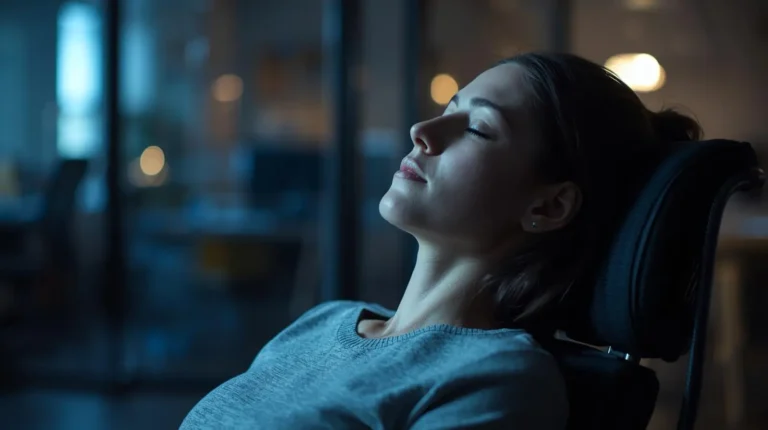
Sara wakes and immediately feels pressure on her chest and cannot move her arms. Her first instinct is to fight — but she remembered reading about REM atonia. Instead of panicking, she starts the 4-7-8 breath: in for 4, hold for 7, out for 8. Her heart rate slows slightly. She then moves her eyes side to side — she can. She focuses on curling her right index finger. After two attempts, she feels it respond. She shifts attention to five physical sensations: the duvet weight, her own heartbeat, a distant car sound, her breath, the pillow texture. Within 80 seconds of the episode starting, she rolls onto her side and the paralysis fully releases. She does not experience another episode that night.
What Not to Do During an Episode
These reactions feel natural but make sleep paralysis worse. Knowing them in advance helps you override them in the moment.
How to Reduce Future Episodes
Sleep paralysis is strongly linked to sleep deprivation, irregular schedules, and stress. These evidence-backed changes reduce how often it occurs.
Talk to a healthcare professional if you experience sleep paralysis more than once per week, if it is causing you significant anxiety or avoidance of sleep, or if it comes alongside other symptoms such as excessive daytime sleepiness, sudden muscle weakness triggered by laughter or emotion (cataplexy), or vivid dream-like hallucinations while fully awake. These can be signs of narcolepsy, which is a manageable medical condition.
Frequently Asked Questions
These are the most common questions people ask when they first experience sleep paralysis or are trying to understand what is happening to their body.
Can sleep paralysis physically hurt me?
No. Sleep paralysis cannot physically harm you. Although the experience can feel intense — including the sensation of suffocation, pressure on your chest, or a threatening presence — none of these are real physiological events. The pressure sensation comes from the fact that your breathing is slightly shallower during REM sleep, not from anything pressing on you. Your airways remain open and your heart continues beating normally throughout the episode.
How long does a sleep paralysis episode last?
Most episodes last between 20 seconds and 2 minutes, though they can feel much longer because your sense of time distorts when the amygdala is highly activated. In rare cases, an episode can persist for up to 10 minutes. Panic extends the subjective experience significantly — which is one reason why calm breathing is so effective at making episodes feel shorter and less distressing.
Why does sleep paralysis keep happening to me?
Recurring sleep paralysis usually points to disrupted REM sleep architecture. Common causes include: chronic sleep deprivation (sleeping less than 7 hours consistently), high anxiety levels before bed, back-sleeping posture, irregular sleep and wake times, and in some cases, a clinical sleep disorder such as narcolepsy. Keeping a sleep diary for two weeks — noting bedtime, wake time, stress levels, and episodes — can help you identify your specific trigger pattern.
Does the 4-7-8 breathing method actually work during an episode?
Yes, with an important caveat: it works on the fear and distress response, not on physically ending REM atonia faster. Controlled breathing activates the vagus nerve, which lowers your heart rate and reduces cortisol. This makes the episode feel dramatically less frightening and can shorten the subjective experience. Combined with micro-movements, it is the most accessible and evidence-consistent approach available without any external intervention.
Is sleep paralysis a sign of mental illness?
Not on its own. Sleep paralysis is a neurological phenomenon — a mismatch in the timing of REM-off switches — not a psychiatric condition. However, people with anxiety disorders, PTSD, and depression do experience it at higher rates, likely because these conditions fragment sleep architecture and increase amygdala reactivity. Experiencing sleep paralysis is not a diagnostic sign of mental illness, but if it is frequent and associated with significant distress, discussing it with a doctor is worthwhile.
Can I train myself to end sleep paralysis faster over time?
Yes. Many people who understand the science of REM atonia and practice calm responses report that their episodes become shorter and less frightening over time. This is essentially emotional habituation — your amygdala learns that the stimulus is not a real threat. Practicing the 4-7-8 breath and micro-movement sequence while awake (as a mental rehearsal before sleep) primes your brain to deploy them automatically during a paralysis event.
In One Minute: What to Do Right Now
Stay calm — you are in REM atonia, not in danger. Start 4-7-8 breathing immediately. Move your eyes side to side. Curl one finger or move your tongue. Name 5 physical sensations around you. Remind yourself: “This is temporary and will pass in under two minutes.” Do not fight, do not hold your breath, and do not stare at any hallucinations. After the episode ends, sit up for a few minutes before returning to sleep.