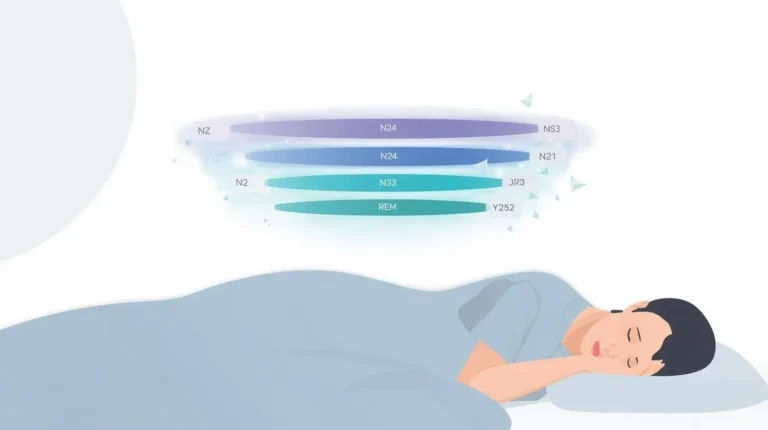
Deep Sleep (N3)
The Complete Science Guide
What deep sleep actually is, what it does at a mechanistic level, how it changes with age, and what is genuinely proven to increase it. Based on polysomnography research and AASM 2007 staging criteria.
Deep sleep is not the same as REM sleep. This is the most widespread sleep science confusion in 2024–2026, amplified by consumer wearables that label N3 and REM differently across devices — or conflate them entirely. Deep sleep (N3 or slow-wave sleep) is a non-REM stage where the brain produces slow delta waves and the body is in its most profoundly relaxed physical state. REM involves near-waking brain activity with a paralysed body. They are physiologically opposite. This page covers deep sleep (N3) only. See our REM sleep guide for the other stage.
What Deep Sleep Actually Is
Deep sleep, formally designated Stage N3 by the American Academy of Sleep Medicine (AASM 2007), is the deepest and most physically restorative phase of the sleep cycle. It is the stage most people mean when they say they “slept well” — though most have no idea what is happening neurologically.
Stage N3: the technical definition
Deep sleep is defined by the AASM (2007) as sleep during which 20% or more of each 30-second epoch consists of delta waves — high-amplitude, low-frequency (0.5–4 Hz) oscillations generated by the thalamus and cortex working in synchrony. This slow-wave activity is the electroencephalographic signature that distinguishes N3 from all other sleep stages. Previously divided into stages 3 and 4, N3 replaced both in the 2007 AASM revision.
What the body is doing during N3
During N3, heart rate reaches its nightly minimum. Blood pressure falls 10–20% below waking levels — the “nocturnal dip” strongly associated with cardiovascular health. Breathing slows and becomes highly regular. Core body temperature continues its overnight decline. Skeletal muscles are deeply relaxed but not paralysed — movement is possible though rare. The brain is in its most inactive state relative to any other sleep stage.
Why N3 is called slow-wave sleep
The term slow-wave sleep (SWS) refers directly to the delta oscillations visible on EEG. These slow waves are thought to perform neural housekeeping — coordinating the replay of daytime experiences between the hippocampus (short-term memory) and neocortex (long-term storage), consolidating declarative memories during the deepest part of each sleep cycle. The slow oscillation drives these memory replay events.
When in the night does N3 occur?
Deep sleep is heavily concentrated in the first half of the night — typically in cycles 1 and 2 (the first 3 hours of sleep). By cycles 3, 4, and 5, N3 periods shorten dramatically and are largely replaced by REM sleep. This timing is fixed to sleep onset, not clock time — going to bed later does not delay N3; it simply removes or shortens it.
Over 70% of nightly growth hormone secretion occurs during the first two N3 periods — typically within the first 1.5–3 hours of sleep (Van Cauter et al., 2000). This is why early-night sleep disruption is particularly damaging: it doesn’t just lose sleep time, it specifically eliminates the window of maximum GH secretion. Going to bed later does not shift this window — it simply removes it. Late nights are not equivalent to late mornings for physical restoration.
What Deep Sleep Does — Mechanisms
“Deep sleep is restorative” is not content — it is a label. Here is what N3 actually does at a physiological level, and why each mechanism matters.
Deep Sleep Across the Lifespan
N3 declines significantly with age — a normal, documented feature of healthy ageing confirmed in polysomnography studies across thousands of subjects (Ohayon et al., 2004). Enter your age to see your expected range.
| Age Group | N3 % of Sleep |
|---|---|
| Age 5–12 | 22–25% |
| Age 13–19 | 18–22% |
| Age 20–29 | 14–18% |
| Age 30–39 | 11–15% |
| Age 40–49 | 8–12% |
| Age 50–59 | 5–9% |
| Age 60–69 | 3–7% |
| Age 70+ | 1–5% |
Source: Ohayon MM et al. (2004) meta-analysis, Sleep journal. Values represent approximate normal ranges across thousands of polysomnography subjects.
Deep Sleep vs REM — Side-by-Side
These two stages are frequently confused — including by consumer devices. They are physiologically near-opposite states that serve entirely different functions.
| Feature | 👁 Deep Sleep (N3) | 🌟 REM Sleep |
|---|---|---|
| When it occurs | Mostly first half of the night | Mostly second half of the night |
| Brain activity | Delta waves — very slow, high amplitude | Mixed frequency — near-waking pattern |
| Eye movement | None | Rapid — eyes scan under lids |
| Muscle tone | Relaxed but responsive | Paralysed (atonia) |
| Heart rate | Slowest of the night | Variable, often elevated |
| Dreaming | Rare — vague if present | Vivid, narrative, emotional |
| Primary function | Physical restoration, GH release, immunity | Memory processing, emotional regulation |
| Waking experience | Heavy grogginess (sleep inertia) | Alert — may remember dream |
| % of adult sleep | ~25% | ~25% |
What Suppresses N3 Deep Sleep
Evidence-graded list based on controlled sleep studies. “Strong” = consistent findings across multiple RCTs or large observational studies. “Moderate” = replicated but with smaller effect sizes or methodological variation.
How to Improve Deep Sleep
Evidence-graded interventions with known mechanisms. Listed by effect size. No supplements or devices are equivalent to the first three behavioural interventions.
Frequently Asked Questions
What is deep sleep and why is it important?
Deep sleep (N3 or slow-wave sleep) is the sleep stage characterised by delta brain waves — slow, high-amplitude oscillations generated during the deepest phase of non-REM sleep. It is important for physical restoration: over 70% of nightly growth hormone secretion occurs during the first N3 period, driving tissue repair and muscle recovery. The immune system consolidates during N3, with cytokine production peaking during slow-wave activity. Metabolic waste products — including proteins associated with Alzheimer’s disease — are cleared from the brain during N3 via the glymphatic system. Despite representing approximately 25% of total sleep time, N3 is arguably the most physically critical sleep stage.
How much deep sleep do I need per night?
The answer depends significantly on your age. Teenagers typically get 90–120 minutes of N3 per night (18–22% of sleep). Adults in their 20s–30s average 80–100 minutes (14–18%). Adults in their 40s–50s average 50–70 minutes (8–12%). Adults 65+ often get only 20–40 minutes (3–7%) — and this is clinically normal for their age. The more meaningful question is whether your N3 is normal for your age group, not whether it matches a younger person’s baseline. Use the age chart above to see the expected range for your age (Ohayon et al., 2004).
Why do I feel so groggy when I wake up from deep sleep?
Waking from N3 causes sleep inertia — a period of impaired alertness and cognitive function typically lasting 20–40 minutes. Sleep inertia from N3 waking is caused by elevated adenosine levels that haven’t yet cleared, combined with the sudden shift from slow delta-wave activity to waking theta and alpha patterns. The brain literally takes time to “reboot” from its most deeply inactive state. This is why cycle-aligned wake times — waking at the end of a complete 90-minute cycle when you’re in light N1/N2 sleep — minimise grogginess. Our sleep cycle calculator finds these optimal wake windows.