Toddler Sleep: Ages 1-5
From the 18-month regression to the nap drop, toddler sleep is one of the most challenging — and most misunderstood — phases. The nap transition readiness checker, sleep regression guide, and night terrors explainer are designed to give parents accurate, evidence-based guidance without the anxiety.
Sleep by Age: 1-5 Years
Select your child’s age for typical sleep totals, nap patterns, and the key sleep challenge for that stage. These are population averages — individual variation within these ranges is normal. The nap transition in particular has a wide age range; the readiness checker below is more useful than age alone.
Nap Transition Readiness Checker
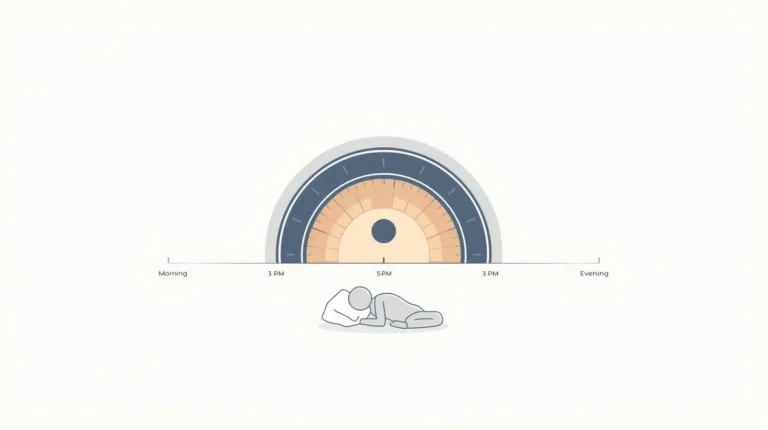
The 2-to-1 nap transition typically happens between 13-18 months. The 1-to-0 nap drop typically happens between 3-5 years — but individual variation is significant, and age alone is a poor predictor. These five questions assess the behavioural and sleep markers that actually indicate readiness, rather than relying on age or peer comparison.
Readiness Checker
Is your toddler ready to drop their nap?
Toddler Sleep Regressions: Three Ages, Three Specific Causes
Toddler sleep regressions are not random or mysterious — each has a specific developmental cause. Understanding the cause changes the response from “something is wrong” to “this is predictable developmental progress.” All three regressions are temporary if the child’s routine remains consistent.
Developmental cause
Vocabulary explosion — toddlers typically acquire 50+ new words rapidly. Increased awareness of self and separation. Brain processing load is very high.
Typical duration
2-6 weeks. Returns to baseline with consistent routine.
Key feature
Increased night waking and calling out. Heightened separation anxiety at bedtime. May coincide with the 2-to-1 nap transition.
Developmental cause
The toddler is asserting independence and beginning to understand they can refuse. Growing imagination also introduces new fears. This is a cognitive leap, not defiance.
Typical duration
2-6 weeks. The key driver is the independence phase, which continues beyond the sleep disruption period.
Key feature
Bedtime resistance from a child who previously settled well. Increased night calling out. New fears appearing (darkness, noises). Nap still essential for most 2-year-olds.
Developmental cause
Major cognitive development: theory of mind emerging, narrative thinking expanding. Many children also beginning to drop or inconsistently take the nap, creating overtiredness that disrupts night sleep.
Typical duration
2-4 weeks if nap schedule is appropriately adjusted. Longer if nap transition is mishandled.
Key feature
Difficulty settling, early morning waking, night wakings returning. New nightmares may appear (REM sleep is increasing relative to N3). Inconsistent nap — some days napping, some days not.
Bedtime Resistance: Biology or Behaviour?
Toddler bedtime resistance has two distinct causes that require different responses. Applying a behavioural solution to a biological problem — or vice versa — is ineffective and frustrating for parents and toddler alike. Identifying the type accurately is the critical first step.
Biological Cause
Overtiredness: the cortisol paradox
Counterintuitively, overtired toddlers are harder to settle, not easier. When adenosine (the sleep-pressure molecule) reaches a critical threshold, the stress system (HPA axis) activates cortisol as a fatigue-compensation mechanism. This creates a hyperaroused, wound-up state — the child who cannot stop moving, cannot be comforted, and escalates at bedtime.
Signs this is the cause
Behavioural Cause
FOMO, conditioned avoidance, and anxiety
Toddlers who are not overtired but resist bedtime are typically responding to one of three things: fear of missing out on family activity, conditioned avoidance (bedtime has been associated with parental departure and distress), or genuine anxiety about the dark or being alone. These are developmentally normal and respond to predictable structure.
Signs this is the cause
Night Terrors vs Nightmares: Completely Different Phenomena
Night terrors and nightmares are frequently confused but occur in different sleep stages, at different times of night, with different features, and require completely different parental responses. Responding to a night terror as if it were a nightmare can extend and worsen the episode.
Night Terrors (Sleep Terrors)
N3 deep sleep — not a conscious experience
Nightmares
REM sleep — a conscious, memorable experience
Sleep Cycle Calculator
Find the Right Bedtime for Your Toddler’s Wake Time
Knowing your toddler’s required wake time, the calculator shows the bedtimes that complete full sleep cycles — minimising sleep inertia and night waking from mid-cycle disruption.
Calculate Cycle-Aligned BedtimesFrequently Asked Questions
How much sleep does a toddler need?
The NSF recommends 11-14 hours for children aged 1-2 years and 10-13 hours for children aged 3-5 years. These totals include both night sleep and daytime naps. At 12-18 months most toddlers still need 2 naps totalling 2-3 hours. By 18 months most have transitioned to 1 nap of 1-2 hours. By 3-4 years, nap need varies significantly — some children still need a nap at 5 years, while others drop it at 3. Night sleep accounts for 10-12 hours for most toddlers aged 1-3 and 10-11 hours for most aged 3-5. Individual variation within these ranges is normal; the readiness checker above is more informative than age comparisons for nap transition decisions.
When should toddlers stop napping?
The 1-to-0 nap transition typically occurs between 3 and 5 years, with 3.5-4 years being the most common window. However, age alone is a poor predictor — some 5-year-olds still benefit from a nap, while some 3-year-olds are genuinely ready to drop it. The nap transition readiness checker above uses five behavioural markers that are more reliable than age: consistent nap resistance over 3+ weeks, ability to manage until bedtime without extreme overtiredness, bedtime being pushed past 8:30pm by daytime napping, and child being over 3 years. A useful intermediate step is quiet rest time — 30-45 minutes in a darkened room with a quiet activity — which provides enough sensory downtime to prevent overtiredness even without actual sleep.
Why does my toddler fight sleep even when tired?
Two distinct mechanisms. First, the cortisol overtiredness paradox: when adenosine (homeostatic sleep pressure) accumulates beyond a threshold, the body activates cortisol as a fatigue-compensation stress response. This creates a hyperaroused second-wind state — the toddler appears energised and wound-up precisely because they are exhausted. The solution is a consistently earlier bedtime, not later. Second, developmental FOMO and conditioned avoidance: toddlers between 18 months and 5 years are cognitively capable of understanding that the household continues without them and increasingly motivated to remain part of it. A predictable, brief, consistent bedtime routine that signals a clear boundary — and gives the child limited choices within it to satisfy the autonomy need — addresses this cause. The critical diagnostic question: is the child wound-up and emotionally escalating (biological overtiredness) or calm and stalling (behavioural FOMO)?