Why Am I Still Tired After 8 Hours of Sleep?
Eight hours tells you how long you were in bed. It does not tell you whether your sleep was continuous, well timed, restorative, or whether something outside sleep is draining your energy.
If you still feel tired after 8 hours of sleep, the problem may be sleep quality, fragmented sleep, an irregular body-clock schedule, accumulated sleep loss, a medication or substance effect, stress or depression, a sleep disorder such as obstructive sleep apnea, or another medical cause such as anemia or thyroid disease. If the problem is only brief grogginess after waking, sleep inertia may be involved. If fatigue lasts through the day or continues for weeks, the useful next step is to look beyond clock time alone.
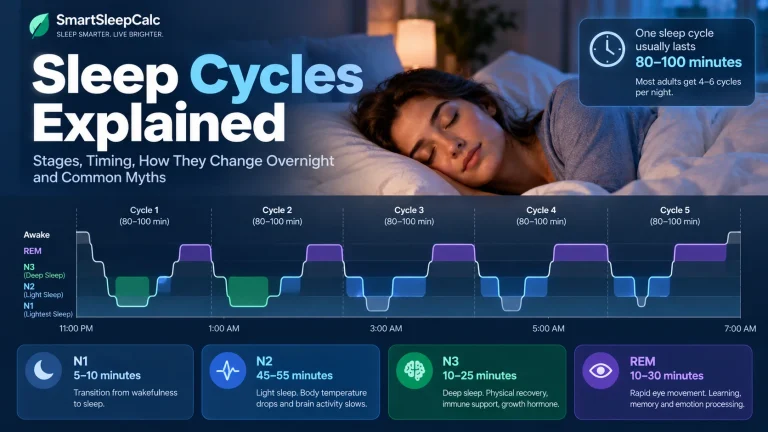
Real sleep cycles are not fixed at exactly 90 minutes. NIH says cycles typically restart about every 80–100 minutes, and they change across the night. A clock cannot tell whether your alarm will catch N1, N2, N3, or REM. Waking from deeper sleep can worsen sleep inertia in some situations, but it is only one factor.
Is This Morning Grogginess or All-Day Fatigue?
Choose the description that fits best. This is not a diagnosis. It only points you toward the part of the page most worth checking first.
Eight Hours in Bed Is Not the Same as Eight Hours of Restorative Sleep
A long sleep opportunity can still contain repeated awakenings, breathing disturbances, pain, noise, alcohol-related fragmentation, restless legs, or long periods awake that you do not count accurately. That is why the first useful question is not “Was I in bed for eight hours?” but “Was my sleep continuous enough to restore me?”
How much time you actually slept. Adults generally need at least 7 hours regularly, but individual needs vary.
Repeated awakenings and brief arousals can make an apparently long night less restorative.
A consistent schedule that fits your circadian rhythm can matter even when total hours look similar.
Common Reasons You Can Still Feel Tired After Enough Time in Bed
These causes can overlap. A symptom pattern can suggest what to discuss with a professional, but it cannot confirm a diagnosis.
1. Your sleep is fragmented
Noise, temperature, pain, alcohol, late caffeine, nighttime bathroom trips, reflux, congestion, a partner, or frequent brief awakenings can reduce sleep continuity. You may not remember every arousal.
2. You are experiencing sleep inertia
Sleep inertia is temporary grogginess, slower thinking, and reduced alertness after waking. Research shows it can be worse after prior sleep loss, at an unfavorable circadian time, and sometimes after waking from deeper sleep. It usually improves with time awake and should not be treated as proof that your sleep length was wrong.
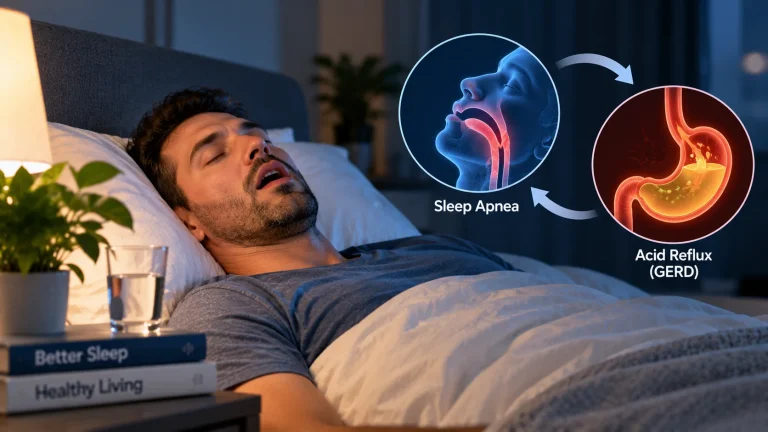
3. Obstructive sleep apnea may be disrupting sleep
NHLBI lists loud snoring, breathing that starts and stops, gasping, daytime sleepiness/tiredness, dry mouth, headaches and nighttime urination among possible sleep-apnea symptoms. A sleep study is used to diagnose the condition.
4. Your body clock and required schedule may not match well
Sleep timing changes alertness as well as sleep opportunity. Irregular bedtimes, shift work, travel, very late sleep schedules, or large weekday/weekend differences can leave you sleepy at the wrong time even when one night adds up to eight hours.
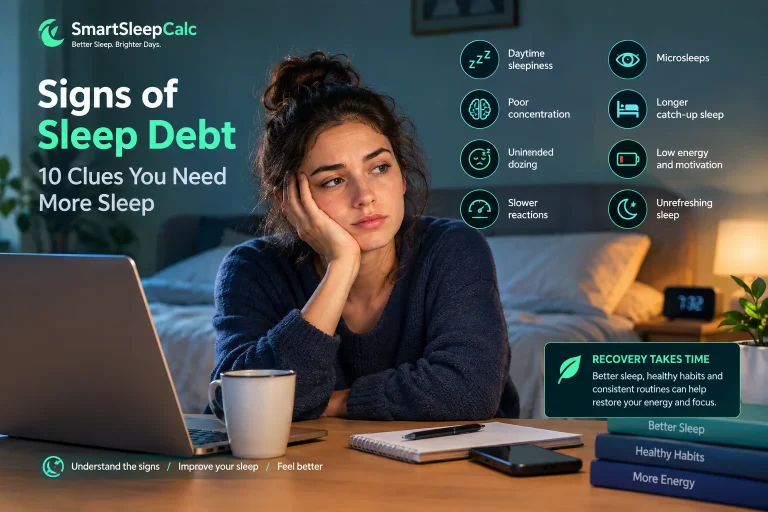
5. You may still be carrying sleep debt
One longer night does not prove that several short nights have been fully recovered. If you recently cut sleep for work, study, travel, illness, a new baby, or social plans, your current fatigue may reflect the broader week rather than last night alone.
6. A medicine or substance may be contributing
MedlinePlus notes that some medicines—including certain antihistamines, antidepressants, pain medicines and sedating drugs—can contribute to drowsiness or fatigue. Alcohol can also impair sleep quality. Do not stop or change a prescribed medicine without talking with the prescriber.
7. Fatigue may be coming from something other than sleep
Fatigue is a symptom, not a diagnosis. MedlinePlus lists many possible causes, including anemia, thyroid disease, infections, diabetes, chronic pain, kidney/liver/heart disease, depression and anxiety. A clinician may use your history, exam and selected tests to narrow the cause.
| Pattern or clue | Worth discussing | Why it matters |
|---|---|---|
| Cold intolerance, constipation, weight gain, dry skin | Thyroid function | These can occur with hypothyroidism, which can also cause fatigue. |
| Pale skin, dizziness, shortness of breath, heavy periods | Anemia / iron status | Anemia can cause fatigue and reduced oxygen delivery; blood tests are used for diagnosis. |
| Low mood, loss of interest, concentration problems, sleep change | Depression | NIMH lists fatigue and sleep changes among common depression symptoms. |
| Major activity reduction for 6+ months plus post-exertional worsening and unrefreshing sleep | ME/CFS evaluation | CDC emphasizes that ME/CFS requires a specific symptom pattern and cannot be diagnosed from tiredness alone. |
| Snoring, gasping, breathing pauses, morning headache or severe daytime sleepiness | Sleep-apnea evaluation | These are recognized sleep-apnea clues; diagnosis requires clinical testing. |
Try a 3-Night Restoration Audit Before Blaming “8 Hours”
Track a few variables together. One number on a sleep tracker rarely explains a morning by itself.
Record time in bed and your best estimate of actual sleep. Do not assume they are identical.
Note bathroom trips, pain, reflux, noise, alcohol, congestion, snoring reports or restless sleep.
Morning-only grogginess and persistent all-day fatigue point to different next questions.
When Should You Talk to a Healthcare Professional?
MedlinePlus advises contacting a healthcare provider when fatigue persists for weeks or does not improve with adequate sleep and basic self-care. Persistent fatigue deserves evaluation because sleep is only one of many possible causes.
Fatigue lasts several weeks, is getting worse, interferes with work/school/driving, or continues despite a stable sleep opportunity.
You snore loudly, gasp, have witnessed breathing pauses, morning headaches, or marked daytime sleepiness.
You also have unexplained weight change, fever, regular night sweats, cold intolerance, heavy bleeding, persistent pain or other new symptoms.
Fatigue started after a new medicine or dose change. Do not stop a prescribed medicine on your own.
Seek urgent help for severe trouble breathing, chest pain, fainting, confusion, blue/gray lips or skin, a sudden major neurological change, or another symptom that feels like a medical emergency. If you are dangerously sleepy, do not drive or operate machinery.
Go Deeper Only When the Pattern Fits
Tired After 8 Hours of Sleep: Common Questions
Is it normal to still be tired after 8 hours of sleep?
Is 7.5 hours better than 8 hours because of 90-minute cycles?
Can sleep inertia make me tired even after enough sleep?
How do I know if sleep apnea could be the reason?
What blood tests are used for fatigue?
What if I sleep 9 or 10 hours and still feel tired?
Sources Used for This Update
- National Heart, Lung, and Blood Institute (NHLBI). Sleep Phases and Stages — sleep cycles typically restart every 80–100 minutes; stage composition changes across the night.
- Hilditch CJ, McHill AW. Sleep inertia: current insights — sleep inertia definition, variability, circadian timing, prior sleep loss and sleep-depth evidence.
- MedlinePlus. Fatigue — broad causes of fatigue and when persistent fatigue warrants medical evaluation.
- NHLBI. Sleep Apnea Symptoms — snoring, gasping, breathing pauses, daytime sleepiness/tiredness and other clues.
- MedlinePlus. Hypothyroidism and Anemia — symptom context for fatigue-related medical evaluation.
- National Institute of Mental Health. Depression — fatigue, sleep changes and other common symptoms.
- CDC. ME/CFS Symptoms — unrefreshing sleep, post-exertional malaise and required symptom pattern.
- American Academy of Sleep Medicine / Sleep Research Society. Recommended sleep duration for adults — healthy adults should obtain 7 or more hours regularly; individual need varies.