What Is Sleep Apnea? Types, Symptoms & Diagnosis
Sleep apnea causes breathing to repeatedly slow or stop during sleep. The most common type is obstructive sleep apnea, when throat muscles relax and block the airway; in central sleep apnea, the brain briefly fails to signal breaths. Only a sleep study can diagnose it — this guide explains the types, warning signs, and next steps.
Sleep apnea is a sleep disorder where breathing repeatedly slows or stops during sleep. The most common type, obstructive sleep apnea, happens when throat muscles relax and block the airway. Central sleep apnea happens when the brain briefly fails to signal the breathing muscles. A sleep study is needed to diagnose it.
What Does “Sleep Apnea” Mean?
“Apnea” means a pause in breathing. In sleep apnea, these pauses repeat through the night: breathing slows or stops for seconds at a time, blood oxygen can dip, and the brain briefly wakes you just enough to reopen the airway. You usually fall straight back asleep and remember nothing — but the repeated interruptions fragment your sleep.
A sleep study measures these pauses with the apnea-hypopnea index (AHI) — the number of breathing pauses per hour of sleep. Researchers use AHI cutoffs such as 5 or more, and 15 or more, events per hour to describe mild-to-severe and moderate-to-severe disease in studies. Your own diagnosis and severity grade come from a clinician reading your full sleep study, not from a number alone.
What Are the Types of Sleep Apnea?
The American Academy of Sleep Medicine’s International Classification of Sleep Disorders (ICSD-3-TR) groups sleep apnea under sleep-related breathing disorders. There are three main patterns:
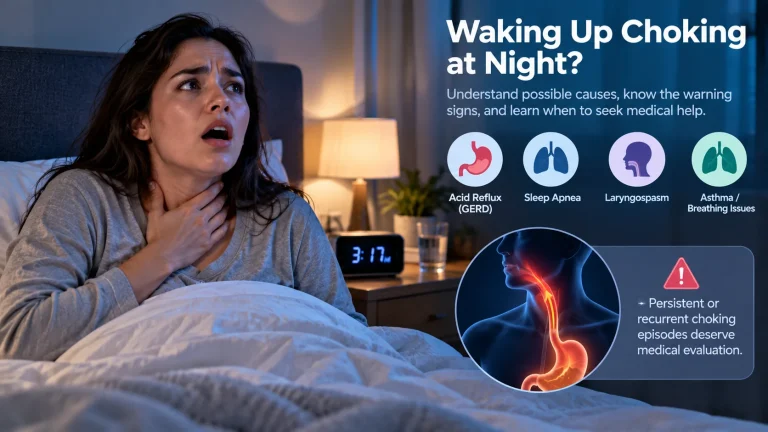
The muscles in the back of the throat relax too much during sleep and the airway narrows or closes. You keep trying to breathe against a blocked airway, which causes loud snoring, gasping, or choking sounds.
The airway stays open, but the brain briefly fails to send the signals that drive breathing. It is often linked to other medical conditions that affect the brain, heart, or nervous system.
A combination of both patterns in the same person — obstructive blockages plus central pauses in breathing effort. Sorting out which pattern dominates is part of the clinical evaluation.
Obstructive vs Central Sleep Apnea at a Glance
| Obstructive (OSA) | Central (CSA) | |
|---|---|---|
| What goes wrong | Throat muscles relax; airway narrows or closes | Brain’s breathing signals pause; airway stays open |
| Typical sign | Loud snoring with pauses, then gasping | Pauses without snoring; may wake short of breath |
| Often linked to | Excess weight, large neck, narrowed airway anatomy | Heart failure, stroke, neurological conditions, some medications |
| How it’s confirmed | A sleep study interpreted by a clinician — symptoms alone cannot tell the types apart | |
Why the type matters: the underlying cause points to different tests and treatments, which is one more reason a proper evaluation beats guessing from symptoms alone.
What Causes Sleep Apnea?
For obstructive sleep apnea, the immediate cause is tissue in the upper airway collapsing during sleep. Several factors make that collapse more likely:
- Excess weight, especially around the neck and midsection, which can narrow the upper airway.
- Airway anatomy — a naturally narrow throat, large tonsils or adenoids, or nasal congestion.
- Smoking, which can inflame the upper airway, and alcohol or sedatives before bed, which relax throat muscles.
- Sleeping on your back, which lets gravity narrow the airway for some people.
- Age, male sex, and family history — risk rises with age, men are diagnosed more often and at younger ages, and a family history raises risk.
These are risk factors, not proof: many people with risk factors never develop apnea, and people without obvious risk factors can still have it. That is why symptoms — not risk profiles — should drive the decision to get evaluated.
A Note on Women
Women can develop sleep apnea too, and may report less “classic” symptoms: daytime fatigue, morning headaches, insomnia, or mood changes rather than thunderous snoring. If your picture doesn’t match the stereotype, it still deserves a conversation with your clinician. Read more: sleep apnea in women.
Is Sleep Apnea Dangerous?
Sleep apnea is common and often under-recognized. A 2019 analysis estimated that about 936 million adults aged 30–69 worldwide have mild to severe obstructive sleep apnea, with 425 million in the moderate-to-severe range. An American Heart Association scientific statement has noted that OSA is often under-recognized and undertreated, including in cardiovascular care.
On risk: a prospective study of the Wisconsin Sleep Cohort found a dose-response association between sleep-disordered breathing and later hypertension — the odds of having hypertension at follow-up rose with baseline breathing-pause severity (odds ratios roughly 1.4, 2.0, and 2.9 across severity bands). Association is not causation, but the pattern persisted after adjusting for factors like body weight and age.
The National Heart, Lung, and Blood Institute (NHLBI) states that untreated sleep apnea increases the risk for stroke, heart attack, and other serious problems, and can impair concentration, memory, decision-making, and behavior through poor-quality sleep.
How Is Sleep Apnea Diagnosed?
Diagnosis requires a clinical evaluation plus objective testing — the NHLBI notes that your provider may have you do a sleep study. The usual path:
Your clinician asks about snoring, witnessed pauses, daytime sleepiness, and health history.
The standard test is polysomnography — in a lab, or at home with portable equipment for selected patients. It records breathing, oxygen levels, brain activity, and heart rate while you sleep.
Only a qualified professional can diagnose sleep apnea and grade its severity from the full study.
Should I Talk to My Doctor About a Sleep Study?
Answer these six questions honestly. This checker is screening only — it cannot diagnose sleep apnea or rule it out. Every result ends with the same advice: bring your answers to a clinician.
Which Warning Signs Need Prompt Attention?
One isolated symptom usually does not require urgent testing. Evaluation becomes more useful — and more urgent — with the patterns below.
Talk to a clinician promptly — don’t wait for your next routine visit — if you have witnessed breathing pauses or gasping during sleep, severe daytime sleepiness, drowsy driving or near-misses, or morning chest pain or severe headaches. Call emergency services for chest pain, trouble breathing while awake, or fainting.
Someone has seen you stop breathing, gasp, or choke in your sleep.
Daytime sleepiness so strong it affects driving, work, or safety.
Falling asleep at the wheel or during conversations.
Waking with chest discomfort, severe headache, or confusion.
This page is educational and not medical advice. If something feels urgent, seek care now rather than finishing this article.
What Should I Do Next?
Read our guide to sleep apnea symptoms, including nighttime and daytime signs.
Try the sleep apnea risk calculator or the STOP-Bang questionnaire as preparation for a medical visit (screening, not diagnosis).
Not all snoring is apnea, but loud habitual snoring deserves attention: snoring vs sleep apnea.
Read about sleep apnea treatment options before your appointment so you can ask better questions.
Bring the printable note from the checker above (or any symptom list) to your primary-care clinician, who can refer you for a sleep study if appropriate.
Sleep Apnea FAQs
What is sleep apnea in simple terms?
Sleep apnea is a disorder where your breathing repeatedly pauses during sleep — either because the throat closes (obstructive) or the brain briefly stops signaling breaths (central). Each pause can briefly wake the brain, fragmenting sleep even if you remember nothing.
What are the three types of sleep apnea?
The three types are obstructive sleep apnea (blocked airway — the most common), central sleep apnea (paused breathing signals from the brain), and complex or mixed sleep apnea (both patterns together). The type is determined by clinical evaluation and a sleep study.
What is the difference between obstructive and central sleep apnea?
In obstructive sleep apnea, throat muscles relax and physically block the airway while breathing effort continues. In central sleep apnea, the airway stays open but the brain temporarily stops telling the breathing muscles to work. Symptoms alone usually can’t distinguish them.
Is sleep apnea dangerous?
Untreated sleep apnea is associated with higher risk of hypertension, stroke, and heart attack, according to the NHLBI and prospective cohort studies. Association isn’t proof of causation, but the condition is common and under-recognized — which is why evaluation matters.
Can sleep apnea be cured?
There is no guaranteed cure. Effective treatments exist — including CPAP, oral appliances, positional therapy, and weight management — and some people’s apnea resolves after major weight loss or corrective surgery. A sleep clinician can advise on options for your situation.
Can I test for sleep apnea at home?
Clinicians sometimes order home sleep apnea tests for selected patients, but only a qualified professional interpreting proper test data can diagnose sleep apnea. Online questionnaires and calculators are screening tools — useful preparation, not a diagnosis.
Is snoring always sleep apnea?
No. Loud, habitual snoring is the most common symptom of obstructive sleep apnea, but not everyone who snores has it. Snoring with witnessed pauses, gasping, or strong daytime sleepiness is the pattern most worth discussing with a clinician.
Sources
- American Academy of Sleep Medicine. International Classification of Sleep Disorders, Third Edition, Text Revision (ICSD-3-TR). Supports the classification of sleep apnea types under sleep-related breathing disorders.
- National Heart, Lung, and Blood Institute. Sleep Apnea. Supports the definitions, symptoms, sleep-study diagnosis, and risks of untreated sleep apnea.
- Benjafield AV, et al. Estimation of the global prevalence and burden of obstructive sleep apnoea: a literature-based analysis. Lancet Respir Med. 2019;7(8):687–698. PMID: 31300334. PubMed. Supports the global prevalence estimates (936 million mild-to-severe; 425 million moderate-to-severe adults aged 30–69).
- Epstein LJ, et al. Clinical guideline for the evaluation, management and long-term care of obstructive sleep apnea in adults. J Clin Sleep Med. 2009;5(3):263–276. PMID: 19960649. PubMed. AASM clinical guideline supporting comprehensive evaluation with objective testing when OSA is suspected.
- Peppard PE, et al. Prospective study of the association between sleep-disordered breathing and hypertension. N Engl J Med. 2000;342:1378–1384. PMID: 10805822. PubMed. Supports the dose-response association between sleep-disordered breathing and hypertension (association, not proven causation).
- National Heart, Lung, and Blood Institute. Sleep Apnea in Children. Supports the pediatric note on causes, symptoms, and sleep-study diagnosis in children.