Sleep Diary Guide · 100% Free
How to Keep a Sleep Diary That Actually Helps You Sleep Better
A sleep diary turns vague impressions (“I sleep terribly”) into numbers you can actually use. This guide covers what to record, the three formulas that matter, and what your diary can and can’t tell you.
A sleep diary is a daily log of your sleep times and habits, usually kept for one to two weeks. Each morning you record bedtime, how long it took to fall asleep, nighttime awakenings, final wake time, naps, and habits like caffeine or alcohol. From those entries you can calculate total sleep time and sleep efficiency. It can’t diagnose a sleep disorder, but it gives you and your clinician a clearer picture than memory alone.
What a sleep diary is
A sleep diary (also called a sleep log or sleep journal) is a day-by-day record of when you sleep and what surrounds your sleep. Clinicians have used diaries for decades because concrete nightly entries are more reliable than a general memory of “how I’ve been sleeping.” The standardized version researchers use is the Consensus Sleep Diary, published by Carney and colleagues in 2012.
Most doctors ask for at least one week of entries; two weeks is the common clinical standard. The American Academy of Sleep Medicine even publishes a two-week diary form. If you’re tracking on your own, two weeks gives a fairer picture than a few nights, since one bad night says little and a pattern says a lot. Fill it out each morning, ideally within an hour of waking, while the night is still fresh.
What to record each morning
Keep it quick: under five minutes. The same fields every day matter more than perfect precision on any one day. These are the terms a diary uses, and they don’t all mean the same thing:
- Bedtime
- When you got into bed, not when you tried to sleep.
- Lights-out
- When you actually tried to fall asleep (lights off, phone down). The gap between bedtime and lights-out is where scrolling usually hides.
- Sleep onset latency
- How many minutes it took to fall asleep after lights-out. An estimate is fine; don’t watch the clock.
- Awakenings (count and WASO)
- How many times you woke up, and roughly how many minutes you spent awake in total during the night (wake after sleep onset).
- Final wake time
- When you woke up for the last time and didn’t go back to sleep, even if you stayed in bed.
- Out-of-bed time
- When you physically got out of bed. The gap between final wake and out-of-bed time counts as time in bed, not sleep.
- Naps
- Any daytime naps, with start time and length. Late or long naps are a common explanation for nighttime trouble.
- Caffeine and alcohol
- What you had and roughly when, especially anything within about six hours of bed.
- Daytime sleepiness and sleep quality
- A simple 1–5 rating for how rested you felt and how sleepy the day was. Perceived quality is subjective, and that’s the point: it captures what numbers miss.
How clinicians use sleep diaries
Doctors request diaries because patterns beat impressions. Two weeks of entries can reveal an irregular schedule, chronic short sleep, or long stretches of wakefulness in bed, things people rarely report accurately from memory. Diaries are also used to track whether a treatment is working and to prepare for sleep studies: showing stable sleep in the weeks before testing makes the test results easier to interpret.
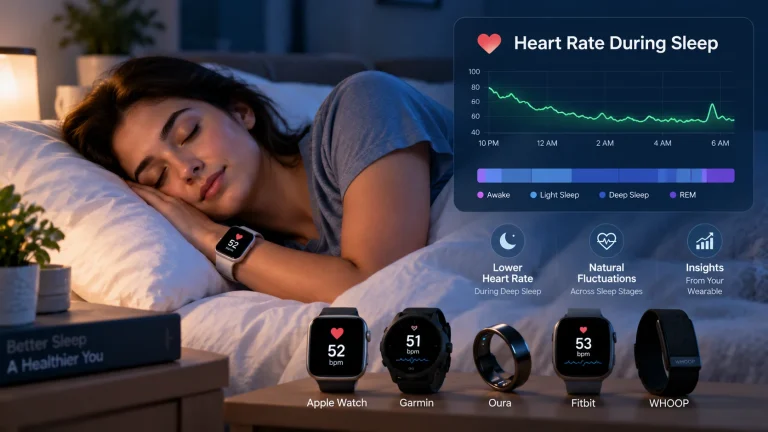
Diaries are sometimes paired with actigraphy, a wrist device that estimates sleep from movement, which gives a more objective record. Consumer wearables use similar movement-based methods, but most have not been rigorously tested for accuracy, so clinicians treat the diary as the anchor and the device as context, not the other way around.
How to calculate time in bed, total sleep time, and sleep efficiency
Three numbers turn a diary into insight. All three come straight from the fields above. No device needed.
Time in bed (TIB) = out-of-bed time − bedtime
Example: in bed 10:30 PM, up at 6:30 AM → 8 hours in bed.
Total sleep time (TST) = TIB − minutes to fall asleep − minutes awake during the night
Example: 8 hours − 30 min falling asleep − 30 min awake at night = 7 hours asleep.
Sleep efficiency = (TST ÷ TIB) × 100
Example: (7 ÷ 8) × 100 = 87.5%.
Sleep efficiency describes what share of your bed time was actually sleep. In research, around 85% or higher is commonly used as a rough marker of consolidated sleep. It’s descriptive, not a diagnosis. Single nights bounce around; the two-week average is what matters.
Sleep efficiency calculator
Enter last night’s numbers to see the math. This is an estimate for planning, not a medical measurement.
How to read your 14 days
Once the diary is full, work through it in this order: timing first, red flags last.
- Check timing first. Is bedtime and wake time steady within about an hour, or swinging wildly? Irregular timing alone explains a lot of bad sleep.
- Look for patterns, not single nights. One rough night means little. Three or more similar nights a week, across two weeks, is a pattern worth acting on.
- Separate look-alikes. Nine hours in bed with six asleep (low efficiency) is a different problem from six hours in bed fully asleep (short sleep). The formulas above tell them apart.
- Check low-risk explanations. Late caffeine, evening alcohol, naps after mid-afternoon, an erratic schedule. Rule these out before assuming something deeper.
- Note red flags. Loud snoring, gasping, witnessed breathing pauses, or struggling to stay awake while driving don’t belong in a “wait and see” pile.
- Pick the next step. Change one habit for one to two weeks and keep the diary going. Or bring the diary to a clinician if a pattern persists or red flags appear.
What a sleep diary can’t tell you
A diary records your perception of the night, and perception has limits. People tend to overestimate how long it took to fall asleep and underestimate total sleep, especially on anxious nights. That’s normal, and it’s why diaries track trends rather than exact minutes.
What it can’t do: diagnose insomnia, sleep apnea, or any other disorder; measure sleep stages, breathing, or oxygen; or replace a sleep study. A low efficiency number describes your nights. It doesn’t name a condition. And a good two weeks doesn’t rule anything out either; some disorders need overnight testing to find. Treat the diary as evidence for a conversation, not a verdict.
14-day sleep diary template
Print this page or copy the columns into a notebook or spreadsheet. Fill it in each morning. On mobile, scroll the table sideways.
| Day | Bedtime | Lights out | Min to fall asleep | Wake-ups (count) | Min awake at night | Final wake | Out of bed | Naps (time / length) | Caffeine / alcohol | Sleep quality (1–5) | Notes |
|---|---|---|---|---|---|---|---|---|---|---|---|
| 1 | |||||||||||
| 2 | |||||||||||
| 3 | |||||||||||
| 4 | |||||||||||
| 5 | |||||||||||
| 6 | |||||||||||
| 7 | |||||||||||
| 8 | |||||||||||
| 9 | |||||||||||
| 10 | |||||||||||
| 11 | |||||||||||
| 12 | |||||||||||
| 13 | |||||||||||
| 14 |
Your next step
After two weeks, average your nightly sleep efficiency and look at the ladder above. If you want a second lens on the same pattern, run your usual answers through our sleep-quality snapshot tool. It scores eight reported factors with every weight published, and it’s explicit about what it can’t tell you. When bedtimes and wake times drift across the two weeks, build a fixed sleep schedule from your averages — one consistent window makes the next two weeks much easier to read. If a pattern persists for weeks or any red flag shows up, bring the diary to your clinician; it’s exactly the kind of record doctors ask for.
When to talk to a clinician
Consider routine (not urgent) professional evaluation if you have persistent trouble falling or staying asleep several nights a week for weeks, especially with daytime impairment. Seek prompt care if you have loud snoring with choking or gasping, witnessed breathing pauses, or trouble staying awake while driving. Those need medical evaluation, not a longer diary.
Talk to your doctor promptly if sleep problems are frequent or severe, or if you have loud snoring, gasping, witnessed breathing pauses, or severe daytime sleepiness. Drowsy driving especially warrants prompt care. A diary helps the visit; it doesn’t replace it.
Sleep diary: common questions
How long should I keep a sleep diary?
At least one week; two weeks is the common clinical standard, and the American Academy of Sleep Medicine publishes a two-week diary form. Longer tracking helps when you’re testing whether a treatment or habit change is working. Shorter than a week rarely shows a real pattern.
What’s the difference between bedtime and lights-out?
Bedtime is when you get into bed; lights-out is when you actually try to sleep. The gap between them, often phone or TV time, counts as time in bed but not sleep, so it lowers sleep efficiency. Recording both keeps the math honest.
Can a sleep diary diagnose insomnia or sleep apnea?
No. A diary describes patterns (timing, duration, efficiency), but diagnosis needs clinical evaluation, and sleep apnea needs overnight testing. Think of the diary as evidence you bring to the conversation, not the verdict.
Is a sleep diary more accurate than my smartwatch?
They measure different things. A diary captures your perceived sleep plus habits like caffeine and naps; wearables estimate sleep from movement, and most consumer devices haven’t been rigorously tested for accuracy. Clinicians often use both, with the diary as the anchor.
What is a good sleep efficiency?
In research, around 85% or higher is commonly used as a rough marker of consolidated sleep. Single nights vary a lot, so judge the two-week average, not one night. Treat it as a description of your sleep, not a diagnosis.
Should I write down naps?
Yes. Note the time and length of each nap. Late-afternoon or long naps are a frequent explanation for trouble falling asleep at night, and you won’t spot the connection without the record.
Sources
- Carney CE, Buysse DJ, Ancoli-Israel S, Edinger JD, Krystal AD, Lichstein KL, Morin CM. The consensus sleep diary: standardizing prospective sleep self-monitoring. Sleep. 2012;35(2):287–302.The standardized diary this page’s fields and definitions follow. Link verified live October 2026.
- Sleep Foundation. Sleep Diary: How and Why You Should Keep One.Supports the diary fields, the one-to-two-week guidance, clinician uses, wearable-accuracy caution, and when-to-see-a-doctor points. Link verified live October 2026.