Sleep Efficiency: What the Number Means and What It Doesn’t
Sleep efficiency is the percentage of your time in bed that you actually spend asleep. It can be useful in a sleep diary, sleep study, or treatment follow-up, but the number depends on how sleep and time in bed were measured. One night, one wearable score, or one percentage by itself cannot diagnose a sleep disorder.
Sleep efficiency compares total sleep time with total time in bed. If you spend eight hours in bed and sleep for seven, your calculated sleep efficiency is 87.5%. The metric can help describe sleep continuity, especially when tracked across several nights, but it does not show why you were awake, whether you received enough sleep, or whether a medical condition is present.
What Sleep Efficiency Means
Sleep efficiency describes how much of your time in bed was spent asleep. It is usually expressed as a percentage. A night with little wakefulness after you get into bed tends to produce a higher value. More time trying to fall asleep, waking during the night, or lying awake before getting up can lower it.
The metric is useful because “eight hours in bed” and “eight hours asleep” are not the same measurement. Someone might go to bed at 10:30 p.m., take 30 minutes to fall asleep, wake for 25 minutes overnight, and spend another 20 minutes awake before getting up. Their time in bed would be longer than their total sleep time.
Sleep professionals often consider sleep efficiency alongside other measures such as sleep onset latency, wake after sleep onset, total sleep time, symptoms, and daytime function. The American Academy of Sleep Medicine includes sleep efficiency among sleep-continuity outcomes used in insomnia research and treatment evaluation. That context matters. The percentage is one part of the picture rather than a stand-alone verdict on whether you slept “well.”
Time in bed and total sleep time are different inputs
Time in bed usually covers the interval you intend to spend in bed for sleep. Total sleep time is the amount of that interval estimated to have been spent asleep. The exact values can differ depending on whether they come from your memory, a sleep diary, actigraphy, a consumer wearable, or polysomnography in a sleep lab.
That measurement difference is easy to miss. If your watch says 91% and your sleep diary works out to 84%, the two numbers may be based on different sleep/wake estimates. It does not automatically mean one is “wrong.”
Sleep Efficiency Formula
The basic formula divides total sleep time by time in bed, then multiplies the result by 100. The arithmetic is simple. Getting reliable inputs is the harder part.
How Sleep Clinics Measure It vs. How Wearables Estimate It
The formula stays the same, but the way sleep and wake are detected can change the result. A diary uses your report. Actigraphy infers sleep and wake mainly from movement. Polysomnography records signals such as brain activity, eye movement, muscle activity, breathing, and other physiologic data during a sleep study.
Sleep diary
You record bedtimes, estimated sleep onset, awakenings, wake time, naps, and related habits. Diaries are practical for seeing patterns across days and are used in insomnia evaluation and treatment monitoring.
Polysomnography
A laboratory sleep study identifies sleep and wake using several physiologic signals. It provides much richer information than a percentage alone and may be used when another sleep disorder is suspected.
Wearable or sensor
Consumer devices estimate sleep using combinations of movement, heart-rate signals, temperature, or other sensors. Algorithms differ by device, so efficiency values are not automatically interchangeable.
| Method | How sleep is identified | Useful for | Main limitation |
|---|---|---|---|
| Sleep diary | Your estimated sleep and wake times | Patterns across several nights; insomnia evaluation context | People may misestimate when they actually fell asleep or briefly woke |
| Polysomnography | Brain, eye, muscle and other physiologic signals | Detailed clinical sleep assessment when indicated | A lab night is different from normal home sleep and is not needed for every complaint |
| Actigraphy | Movement patterns over time | Longer-term rest/activity patterns in appropriate clinical contexts | Quiet wakefulness may sometimes be classified as sleep |
| Consumer wearable | Device-specific sensor data and proprietary algorithms | Personal trend tracking | Accuracy varies by device, person and sleep pattern |
Why wearable efficiency can run high
Many wrist and bedside devices are good at identifying sleep but have more difficulty identifying quiet wakefulness. A 2025 validation study of six commercial wrist-worn devices found that most differed significantly from polysomnography on total sleep time, sleep efficiency, and wake after sleep onset. The devices detected more than 90% of sleep epochs, while wake specificity ranged from about 29% to 52%.
A separate study of more than 400 nights found that an under-mattress consumer sensor overestimated sleep efficiency by an average of 9 percentage points compared with polysomnography. Performance was more variable during daytime sleep and among people with sleep disorders.
These findings do not make wearables useless. They show why a wearable percentage is better treated as an estimate and trend signal than a clinical measurement. Look at patterns over time and consider how you actually feel and function.
Why One Sleep Efficiency Percentage Is Not a Diagnosis
A sleep efficiency value describes one feature of a sleep period. It does not identify the cause of wakefulness. Two people can have the same percentage for very different reasons.
One person may spend extra time in bed reading before sleep. Another may take a long time to fall asleep. Someone else may wake repeatedly because of pain, hot flashes, caregiving, noise, reflux, breathing problems, medication effects, or an irregular schedule. The resulting percentage can look similar even though the underlying situations are not.
Clinical research sometimes uses particular sleep-efficiency thresholds within a defined population or treatment protocol. Those cut points should not be turned into a universal diagnosis for everyone using a smartwatch. The American Academy of Sleep Medicine’s insomnia guidance treats sleep efficiency as one sleep-continuity outcome alongside sleep latency, wake after sleep onset, symptom severity, daytime outcomes, and other information.
A high percentage does not prove that you slept long enough. Five hours of mostly continuous sleep can produce high efficiency while still being too little sleep for many adults.
The formula only uses sleep time and time in bed. It cannot tell you how much N1, N2, N3, or REM sleep you had.
Low efficiency can occur with insomnia and many other situations, but the number does not diagnose insomnia, sleep apnea, restless legs syndrome, or another condition.
A watch, ring, mattress sensor, diary, and laboratory study may classify sleep and wake differently.
What Can Lower Sleep Efficiency?
Anything that increases awake time while you are in bed can lower the calculation. Sometimes that reflects a sleep problem. Sometimes it reflects behavior, schedule, or the way the measurement was collected.
Taking longer to fall asleep adds awake time to the denominator.
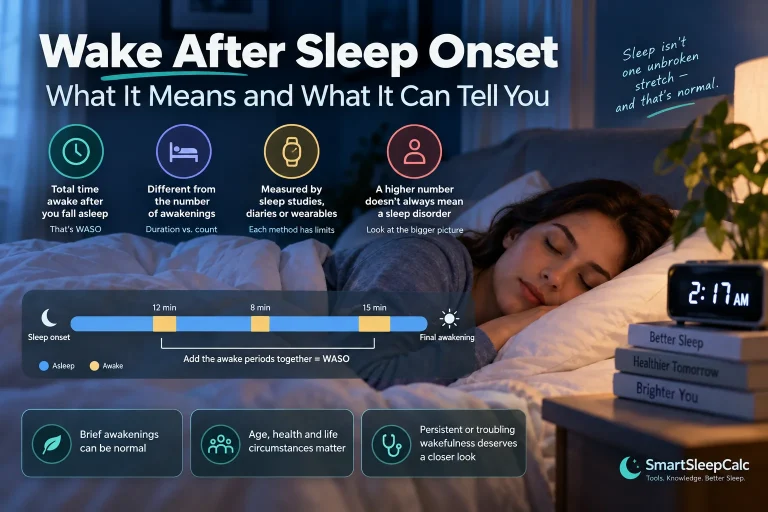
More wake after sleep onset reduces the portion of time in bed spent asleep.
Reading, scrolling, working, or trying to “catch up” by staying in bed longer can change the ratio.
Noise, uncomfortable temperature, light, pets, children, or a partner can interrupt sleep.
Caffeine, alcohol, nicotine, and some medicines can change sleep timing or continuity.
Pain, menopause symptoms, insomnia, breathing disorders, movement disorders, and other conditions may affect sleep continuity.
A bad night can simply be a bad night
A single percentage is especially easy to overread. Travel, stress, illness, an unusual bedtime, alcohol, a noisy neighbor, or a child waking overnight can change one night’s result. A short run of sleep-diary entries usually gives more context than repeatedly checking one morning score.
NHLBI recommends that people preparing to discuss insomnia symptoms with a clinician consider keeping a sleep diary for one to two weeks. Recording bedtime, wake time, naps, daytime sleepiness, caffeine, alcohol, and exercise can make a pattern easier to see.
When Persistent Low Sleep Efficiency Deserves Evaluation
The percentage matters most when it matches a persistent problem you can feel in daily life. Consider discussing your sleep with a healthcare professional if difficulty falling asleep or staying asleep keeps recurring, you regularly wake unrefreshed, or daytime sleepiness affects work, school, driving, or other routine activities.
NHLBI notes that insomnia evaluation may include questions about how long it takes you to fall asleep, how often you wake, how long you stay awake, how refreshed you feel, your schedule, medicines, caffeine or alcohol use, and symptoms such as loud snoring or waking short of breath. A sleep diary can help organize that information.
A clinician may consider sleep efficiency as one piece of the assessment. Depending on the symptoms, they may also look for another cause of disrupted sleep rather than trying to “fix the percentage” itself.
Get help sooner when safety is affected
Do not rely on a wearable score if you are struggling to stay awake while driving or during other safety-sensitive tasks. Recurrent loud snoring, gasping, breathing pauses reported by another person, or severe daytime sleepiness also deserve medical attention. New or severe symptoms should be assessed based on the symptom itself, not your sleep efficiency number.
Sleep efficiency becomes more useful when you look at it beside total sleep time, sleep timing, awakenings, and how you feel the next day.
Sleep Efficiency FAQ
What is sleep efficiency in simple terms?
Sleep efficiency is the share of your time in bed that you actually spend asleep. Divide total sleep time by time in bed and multiply by 100. It describes sleep continuity, but it does not tell you why you were awake or diagnose a sleep disorder.
Is 85% sleep efficiency always good?
An 85% value is often discussed in insomnia research and treatment contexts, but it is not a universal pass/fail line for every person. Measurement method, sleep duration, symptoms, age, health, and trends across several nights all affect interpretation.
Can sleep efficiency be high if I am not getting enough sleep?
Yes. If you sleep for nearly all the time you spend in bed, the percentage can be high even when the total sleep period is short. Sleep efficiency should therefore be viewed alongside total sleep time rather than used as a substitute for sleep-duration guidance.
Why is my watch’s sleep efficiency different from my diary?
Your diary depends on your estimate of when you slept and woke. A wearable uses sensors and a proprietary algorithm to classify sleep and wake. Quiet wakefulness can be difficult for consumer devices to identify, so the two methods may produce different values from the same night.
Does low sleep efficiency mean I have insomnia?
Low efficiency can occur in people with insomnia, but it is not enough to diagnose insomnia. Clinicians consider symptoms, frequency, duration, daytime effects, schedule, health history, substances, medications, and possible alternative sleep disorders.
Should I calculate sleep efficiency every night?
You can track it if the information is useful, but one-night fluctuations are common. A short sleep diary over several nights usually gives more context than reacting to one morning percentage. Stop tracking if the number itself is making you more anxious about sleep.
Is polysomnography needed to measure sleep efficiency?
No. Sleep efficiency can be calculated from a diary or estimated by actigraphy and consumer devices. Polysomnography provides a more detailed physiologic assessment and is generally used when a clinical sleep study is indicated for the broader sleep problem, not simply to obtain one percentage.
Sources
The sources below were used for the measurement, wearable-accuracy, and clinical-context statements on this page. Manufacturer or marketplace content was not used.
Last researched: September 14, 2026 · SmartSleepCalc.com · Author: Muzammal Shahzad Butt, Founder & Editor