Sleep Help Guide · 100% Free
Should You Sleep or Stay Up? What the Evidence Says
It’s late, you’re still awake, and the clock is deciding for you. This guide gives you a straight answer for tonight — sleep, nap, or push through — plus what the research actually says about short nights. This is harm reduction for a night that’s already short, not a plan to sleep less.
Yes — some sleep almost always beats none. Even 1 to 2 hours gives your brain a full sleep cycle of about 90 minutes, which beats the impairment of a full all-nighter. Sleep in roughly 90-minute blocks, never drive drowsy, and don’t make short nights a habit. Use the tool below for your exact situation.
What 1–2, 3–4, or 5 hours actually does to you tomorrow
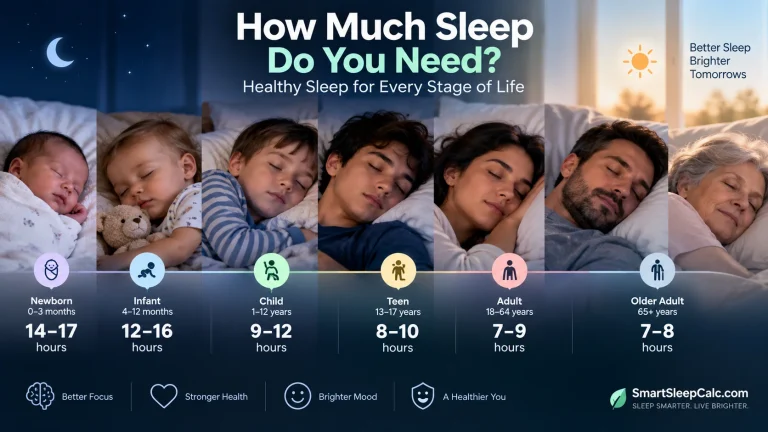
Adults need 7 or more hours a night on a regular basis — that’s the consensus of the American Academy of Sleep Medicine and the Sleep Research Society. Anything below that is damage control, and the damage scales with how little you get. Here’s the honest breakdown.
1–2 hours
Enough for roughly one full sleep cycle (about 90–110 minutes). That single cycle beats a full all-nighter for alertness and reaction time the next day. Expect grogginess on waking — that’s sleep inertia, and bright light plus movement shakes it off.
Evidence: 90–110 minute full cycles (Healthline); a 2-hour nap after sleep loss improved alertness and performance (Rise Science, citing nap research).3–4 hours
Two full cycles: meaningful recovery, and noticeably better than 1–2 hours. You’re still impaired, though — reaction time, judgment, and memory all take a hit. This is the zone where people feel “fine” but perform like they’ve been drinking.
Evidence: 17–19 hours awake produces impairment similar to a blood alcohol level of 0.05% (Williamson & Feyer 2000).5 hours
Better, but still short of the 7+ most adults need. One 5-hour night is recoverable. The trap is repetition: two weeks of 6-or-fewer-hour nights produced cognitive deficits similar to up to two nights of no sleep at all — while people rated themselves only mildly sleepy.
Evidence: chronic restriction study, Van Dongen et al. 2003, Sleep.The decision ladder: sleep, nap, or stay up?
Match your situation to the rung. The principle is simple: sleep in complete ~90-minute cycles when you can, take a short 20-minute nap when you can’t, and only push through when there’s genuinely no time to sleep.
4.5+ hours available → Sleep
Go to bed now. Aim for multiples of ~90 minutes (4.5 or 6 hours) so you wake at the end of a cycle, not in the middle of one. Stop scrolling — every 30 minutes you delay costs you a third of a cycle.
2.5–4.5 hours → Sleep in cycles
Sleep for 3 hours (two cycles) rather than an odd amount like 3.5. Waking mid-cycle is what causes that crushed, groggy feeling. Set one alarm and put the phone across the room.
1.5–2.5 hours → One full cycle
Take a single ~90-minute cycle. It won’t fix everything, but it’s the most restorative use of the time. If 90 minutes isn’t possible, a 20-minute power nap still beats nothing.
Under 1.5 hours → Nap or push through
A 20-minute nap gives a real alertness lift without deep grogginess. If even that isn’t possible: bright light, movement, and one round of caffeine early — then no more caffeine within about 8 hours of your next bedtime.
Tonight decision tool
Answer three quick questions and get a plan for your exact situation. This is a planning aid, not medical advice — and it never diagnoses anything.
What should I do tonight?
Two myths worth killing tonight
Myth 1: “I can compress 8 hours of sleep into 4”
You can’t. Sleep isn’t a file you zip. A night’s sleep is built from ~90-minute cycles, and the first half of the night is rich in deep sleep while the second half is rich in REM sleep. Cut the night in half and you don’t get “half of everything” — you lose most of one stage or the other. Memory consolidation, hormonal regulation, and the clearing of adenosine (the chemical that builds sleep pressure while you’re awake) all need real time. Four focused hours beats zero, but it is not eight hours in disguise.
Myth 2: “I can train myself to need less sleep”
No — and this one has a genetic plot twist. A small number of people genuinely thrive on ~6 hours: researchers traced it to rare gene variants, starting with a DEC2 mutation found in a family averaging 6.25 hours versus 8.06 in their relatives (He et al. 2009). About seven such genes are now known. The catch: it’s rare — the original researchers found no other carriers in a 250-person sample — and it runs in families. You can’t train your way into it any more than you can train your way into different eye color. If you “trained yourself” to 5 hours and feel fine, keep reading the next section before celebrating.
“I only need 5 hours” — real, or sleep debt you’ve stopped noticing?
Both exist, and they feel identical from the inside. Here’s how to tell them apart:
- It might be real if short sleep runs in your family, you wake naturally without an alarm feeling genuinely refreshed, and you have no daytime sleepiness, no weekend catch-up marathons, and no one telling you you’re irritable. That’s the rare natural-short-sleeper pattern.
- It’s probably normalized sleep debt if you need an alarm, need caffeine to function, crash on weekends, or feel “fine” but keep making small errors. The Van Dongen 2003 study is the cautionary tale here: after two weeks of short nights, people’s performance collapsed while their own sleepiness ratings barely moved. You are the least reliable judge of your own impairment.
The test costs nothing: sleep 7.5–8 hours for two full weeks and see who you become. Most “5-hour people” discover they were tired the entire time.
Tonight protocol: 3 hours until you’re up
The most common scenario. Do exactly this:
- Decide now. Every 20 minutes of scrolling costs you a quarter of a sleep cycle. The decision is made: you’re sleeping 3 hours.
- Set one alarm for 3 hours from now and put the phone across the room. Two full ~90-minute cycles, waking at a cycle boundary.
- Make it dark, cool, and quiet. Eye mask or dark room, earplugs if noise is an issue. Don’t start a new show “to wind down.”
- Wake up like you mean it. Light on immediately, feet on the floor, move around, splash cold water. Sleep inertia fades in 15–30 minutes.
- Caffeine only if needed, and early. Caffeine’s half-life averages about 5 hours — a morning coffee is still half-present at dinner time. Have it in the morning, then cut it off roughly 8 hours before your next bedtime.
- Do not drive drowsy. See the red box below — this one is non-negotiable.
- Recover tomorrow night, not by oversleeping 12 hours (which wrecks the next night) but with a normal, full night at your usual time.
The drowsy-driving warning (read this one)
Do not drive drowsy. After 17–19 hours awake, reaction time and accuracy can be as impaired as at a blood alcohol level of 0.05% — and the impairment keeps climbing. In the US, drowsy driving is linked to around 100,000 crashes a year. If you must travel after a short night: nap first (even 20 minutes helps), get a ride, take transit, or delay. Treating severe sleepiness as “fine” is how people get hurt.
Talk to a clinician if short nights aren’t occasional: trouble sleeping 3+ nights a week for weeks, loud snoring with gasping or witnessed breathing pauses, severe daytime sleepiness, or falling asleep unintentionally during the day. A planning tool can’t sort medical causes — a clinician can.
Your next step
Tonight is damage control; the real win is fewer short nights. If short nights happen because you can’t fall asleep, our Why Can’t I Sleep guide helps you sort the causes with its culprit checker. If your bedtimes drift all over the week, build a fixed sleep schedule from your real averages — consistency is the cheapest sleep aid there is. And if you want an honest read on your overall pattern, run it through our sleep-quality snapshot tool, which scores eight reported factors with every weight published.
Short sleep: common questions
Is 2 hours of sleep better than none?
Yes, in almost every case. Two hours covers roughly one full ~90-minute sleep cycle, which measurably beats a full all-nighter for alertness, reaction time, and mood the next day. Aim to wake at a cycle boundary (about 90 or 180 minutes) to avoid the worst grogginess.
Should I sleep for 2 hours or stay up all night?
Sleep the 2 hours. An all-nighter blocks every restorative sleep stage, while even one full cycle gives your brain deep sleep and some REM. The only common exception is timing: if you have under an hour, a 20-minute power nap or pushing through with bright light may leave you less groggy than waking mid-cycle.
Can you function on 3 hours of sleep?
Short-term, yes — 3 hours is two full sleep cycles, and most people get through the day. But “function” doesn’t mean “fine”: expect slower reactions, worse judgment, and fragile mood. Don’t drive drowsy, keep the day’s demands light if you can, and get a full night the next night.
Is 5 hours of sleep enough?
For one night, it’s survivable and far better than less. As a habit, no — adults need 7 or more hours regularly, and chronic 5–6 hour nights produce deficits similar to skipping entire nights, while you stop noticing how impaired you are. True natural short sleepers exist but are rare and it runs in families.
Can I train myself to need less sleep?
No. Needing genuinely less sleep is linked to rare gene variants (like DEC2) that you either inherit or don’t — it isn’t trainable. What people usually “train” is tolerance: they stop feeling the sleepiness while the performance deficits keep accumulating. That’s the most dangerous kind of tired.
Is 1 hour of sleep better than no sleep?
Marginally — an hour is better than zero, but it usually means waking mid-cycle, so expect heavy grogginess. With under 90 minutes available, a 20-minute power nap often leaves you feeling better than a full hour, because you wake before deep sleep sets in.
Sources
- Watson NF et al. Recommended Amount of Sleep for a Healthy Adult: A Joint Consensus Statement of the American Academy of Sleep Medicine and Sleep Research Society. SLEEP 2015. Full text (PMC4434546)AASM/SRS consensus: adults should sleep 7 or more hours per night regularly. Link verified live October 2026.
- Williamson AM, Feyer A-M. Moderate sleep deprivation produces impairments in cognitive and motor performance equivalent to legally prescribed levels of alcohol intoxication. Occup Environ Med 2000. PubMed PMID 1098433517–19 hours awake ≈ BAC 0.05% impairment; longer wakefulness ≈ 0.10%. Link verified live October 2026.
- Van Dongen HPA et al. The Cumulative Cost of Additional Wakefulness. Sleep 2003;26:117–126. DOI 10.1093/sleep/26.2.117Chronic ≤6h nights for 14 days produced deficits like up to 2 nights of total deprivation while subjective sleepiness plateaued. Citation verified October 2026.
- He Y et al. The transcriptional repressor DEC2 regulates sleep length in mammals. Science 2009 (via Live Science summary). SummaryDEC2 mutation in familial natural short sleep: carriers averaged ~6.25h vs ~8.06h; rare — no other carriers in a 250-person sample. Link verified live October 2026.
- NHTSA drowsy-driving figures (via The Zebra research compilation). Statistics page~100,000 drowsy-driving crashes/year in the US, ~1,550 deaths, ~71,000 injuries, citing NHTSA. Link verified live October 2026.
- Caffeine and sleep. Oura. How caffeine impacts sleepCaffeine half-life averages ~5 hours, range ~1.5–9.5 hours; blocks adenosine, the sleep-pressure chemical. Link verified live October 2026.
- Is 2 hours of sleep better than no sleep? Healthline. Article90–110 minutes for a full sleep cycle; any sleep beats none. Used for cycle-length framing. Link verified live October 2026.
- Is it better to get 2 hours sleep or none? Rise Science. ArticleNap research (20–90 min benefits) and sleep-physician commentary, incl. sleep inertia framing. Link verified live October 2026.