Can’t Sleep in Hotels? The First-Night Effect Explained
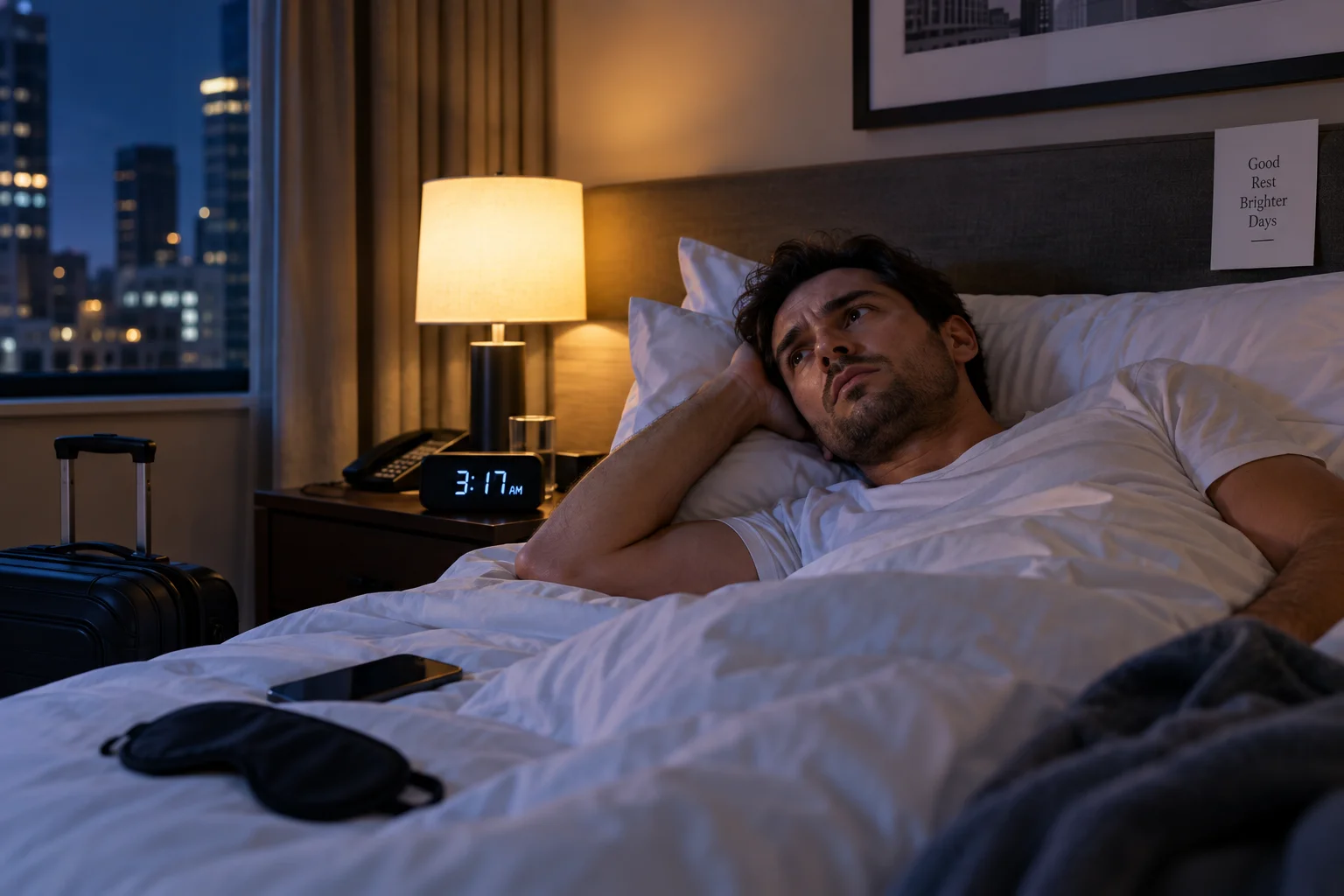
Tossing and turning on your first night in a hotel does not always mean you have insomnia. Sleep researchers have studied the “first-night effect” for decades: sleep on an initial night in a new place is often lighter, shorter, or more broken up. But a hotel stay can also bring jet lag, noise, light, a warm room, or a racing mind — and more than one of these can hit on the same night.
Poor sleep on your first hotel night is common and often eases by night two. Research finds first nights linked, on average, to taking longer to fall asleep, more waking during the night, and less total sleep. Still, check the other suspects too: crossing time zones points to jet lag, while noise, light, heat, an uncomfortable bed, or worrying about tomorrow can cause the same restless night without any time-zone change.
What Is the First-Night Effect?
The first-night effect is the tendency for sleep on an initial night in a sleep lab — or any new sleep setting — to look different from sleep on a later night. It was first described in lab studies where people slept with monitoring equipment somewhere other than their own bedroom.
A 2022 meta-analysis pooled 53 studies of healthy people. On average, first nights came with taking about 3 minutes longer to fall asleep, about 7 more minutes awake during the night, about 18 minutes less total sleep, about 3% lower sleep efficiency, longer time to reach REM sleep, less REM sleep, and more light N1 sleep than second nights. These are group averages, not promises about your night.
A 2024 study added two twists: first-night effects also showed up when the two recording nights were a week apart, and they appeared in familiar home recordings too — not only in strange labs. So unfamiliarity alone does not explain the whole effect.
Trip Sleep Decoder: What Ruined Your Hotel Night?
Answer four quick questions about your trip. You will get the most likely pattern behind your bad night — plus a personal hotel sleep checklist built from your answers, with a copy button so you can take it on your next trip. This is educational only, not a diagnosis.
Can’t Sleep Away From Home? Ask: What Changed?
“Hotel insomnia” is really several different problems wearing one name. Use this table to sort them.
| What changed? | Likely context | Clues | What to test |
|---|---|---|---|
| You crossed several time zones | Jet lag / body-clock mismatch | You feel sleepy at the “wrong” local time, wake very early or late, or feel wide awake at hotel bedtime. | Shift toward destination time with daylight and meals; do not treat it as only a room problem. |
| Same time zone, but the room is new | First-night / new-place effect | Night one is restless, but night two feels easier even though nothing in the room changed. | Keep your usual bedtime routine and let the newness wear off. |
| The room feels different from home | Noise, light, temperature, or bed mismatch | Elevator hum, hallway light, warm air, a too-soft mattress, or pillows that feel wrong. | Fix the room directly instead of assuming your brain “can’t sleep away from home.” |
| You are trying hard to fall asleep | Worry / sleep effort | Clock-checking, counting down hours until morning, replaying tomorrow’s meeting or flight. | Break the checking habit and stop grading your sleep while it is happening. |
Hotel Sleep Problems Are Not Always the First-Night Effect
If you flew across multiple time zones, your body clock may not match local time yet. The CDC describes jet lag as a short-term body-clock problem caused by fast travel across time zones.
That means a 10:30 p.m. hotel bedtime can land when your body still thinks it is afternoon. A better pillow may make the room nicer, but it cannot fix the timing mismatch underneath.
Linked to the first night or a new sleep setting. It can happen with zero time-zone change.
Follows fast time-zone travel. Your inner clock and the local clock disagree.
Does “Half Your Brain Stay Awake” in a Hotel?
You may have seen this online. It comes from a real 2016 lab study — but the viral version is too simple.
Researchers found that on the first lab night, slow-wave activity was lopsided in part of the brain’s default-mode network, and the less-deeply-sleeping side woke more easily to odd sounds. On later nights, the lopsided pattern was gone.
That supports the idea that the sleeping brain can stay more alert to strange sounds on an initial night. It does not prove that exactly half of everyone’s brain literally stays awake in every hotel.
Noise, Light, and Temperature Can Ruin Hotel Sleep
A new place is only one layer. Heart-health guidance for good sleep stresses a cool, quiet, dark room — and hotels can miss on all three.
Elevators, hallways, traffic, thin walls, AC units, and slamming doors make sounds you never hear at home.
Hallway glow under the door, thermostat LEDs, clock displays, and thin curtains can leave the room brighter than your bedroom.
A room that runs warm, or bedding that traps heat, can keep you from settling in comfortably.
Different pillows, mattress firmness, and blanket weight feel extra noticeable on night one.
What to Do When Hotel Sleep Is Hard for You
Do not set a super-early hotel bedtime just because tomorrow matters. Allow enough time for sleep, but stay near your usual schedule unless you are shifting for a new time zone.
Use the same pre-sleep routine as home: shower, reading, clothes, phone cutoff. Familiar cues cut down on needless change.
Set the temperature, close the curtains, cover stray lights, and handle obvious noise early. CDC travel guidance calls for a quiet, dark, cool, comfortable room.
An eye mask and earplugs weigh almost nothing and cover the two most common hotel complaints: light and noise.
After big time-zone jumps, daylight, meals, and sleep timing help your body clock catch up. Follow current travel-health guidance rather than blaming the mattress.
Checking the clock and counting leftover hours raises alertness. Keep the clock out of sight and let the night be what it is.
Skip late-day caffeine if it keeps you up. Alcohol may make you drowsy at first but can still break up the second half of the night.
Why Do Some People Sleep Better in Hotels?
Not everyone gets a bad first night. Some people sleep better away from home because the hotel removes whatever normally gets in the way.
No unfinished chores, no desk full of work, no reminders of tomorrow’s to-do list sitting next to the bed.
A well-built hotel with blackout curtains can beat a bright or noisy bedroom at home.
Hotel climate control may land closer to the cool room your body likes for sleep.
The mattress or pillows may simply fit you better than what you sleep on at home.
When to Consider Insomnia Beyond the First-Night Effect
One rough first night is not enough to call it insomnia. Heart-health guidance describes insomnia as repeated trouble falling or staying asleep, or poor sleep quality, even with enough time and a decent place to sleep.
Night one is rough, but later nights feel clearly better. That pattern fits a new-place adjustment effect.
If sleep stays bad through the whole trip, even after the room feels normal, look past the first-night effect toward room conditions, worry, schedule disruption, or broader insomnia.
Repeated poor sleep at home and away, despite good conditions, deserves a proper insomnia check rather than being blamed on travel.
Hotel Sleep and First-Night Effect FAQs
Why can’t I sleep the first night in a hotel?
A new setting can play a role, but also check time-zone changes, noise, light, temperature, bedding, travel stress, and worry about the next day. The first-night effect is one suspect, not the only one.
Does the first-night effect get better on night two?
Group studies often show better sleep on later nights than the first. But it varies by person, and a noisy room or major jet lag can keep hurting sleep past night one.
Does half of your brain really stay awake in a new place?
A 2016 lab study found lopsided deep-sleep activity on the first night, with the lighter-sleeping side waking more easily to odd sounds. That is not proof that half of everyone’s brain stays awake in every hotel.
Is hotel insomnia the same as jet lag?
No. Jet lag comes from fast travel across time zones throwing off your body clock. You can get a first-night effect in a hotel without leaving your time zone at all.
Why do hotel noises bother me more than sounds at home?
New, unpredictable sounds stand out more. Research also hints the sleeping brain can react more strongly to strange sounds on a first night — though that idea should not be oversimplified.
What should I pack if hotel light or noise keeps me awake?
An eye mask and earplugs are the simple, CDC-mentioned backups. Also check curtains, glowing displays, hallway light, and AC noise before bed.
Why do I sleep better in hotels than at home?
The hotel may accidentally fix your home problems: darker room, less noise, cooler air, a better mattress, or fewer stress reminders by the bed. Compare the two and copy what works back home.
When does “I can’t sleep away from home” need professional help?
Consider it if the problem lasts across trips, causes major daytime issues, comes with strong travel anxiety, or you also sleep poorly at home despite good conditions.
Sources
- Ding L, Chen B, Dai Y, Li Y. Sleep Medicine. 2022. A Meta-Analysis of the First-Night Effect in Healthy Individuals for the Full Age Spectrum . 53-study meta-analysis: first nights linked on average to longer sleep onset, more wake after sleep onset, longer REM latency, less total sleep, lower sleep efficiency, less REM, and more N1 sleep.
- Wick AZ, Combertaldi SL, Rasch B. Sleep. 2024. The First-Night Effect of Sleep Occurs Over Nonconsecutive Nights in Unfamiliar and Familiar Environments . First-night effects across week-apart nights, clearest for sleep onset, wake after sleep onset, and total sleep time; seen in familiar settings too; slow-wave asymmetry not simply tied to the effect.
- Tamaki M, Bang JW, Watanabe T, Sasaki Y. Current Biology. 2016. Night Watch in One Brain Hemisphere During Sleep Associated With the First-Night Effect in Humans . Lab study of first-night slow-wave asymmetry and stronger waking responses to unusual sounds; mechanistic evidence, not a literal “half-awake brain.”
- National Heart, Lung, and Blood Institute. Insomnia . How insomnia is defined, plus the roles of schedule, stress, and environment change.
- National Heart, Lung, and Blood Institute. Insomnia Treatment . Cool, quiet, dark sleep setting; regular schedule; stress management; CBT-I guidance.
- CDC Yellow Book 2026. Jet Lag Disorder . Travel-medicine guidance on body-clock disruption, destination timing, light, alcohol, caffeine, and travel sleep.
- CDC / NIOSH. Aircrew and Jet Lag . Practical hotel-sleep tips: dark, quiet, cool rooms, eye masks, earplugs, and cutting stray light.
Log One Trip Before Blaming the Hotel
Next trip, jot down the time-zone change, bedtime, room temperature, light, noise, caffeine, alcohol, and roughly how long sleep took. If night two improves with no big change, newness was likely part of it. If sleep only improves after you fix the room, block light, move away from the elevator, or stop clock-watching, you have found your real lever.
Use the Jet Lag Calculator to plan sleep and light around your flights.
Open the Jet Lag Calculator → Try the Sleep Calculator →